Impakter
  • Environment
    • Biodiversity
    • Climate Change
    • Circular Economy
    • Energy
  • FINANCE
    • ESG News
    • Sustainable Finance
    • Business
  • TECH
    • Start-up
    • AI & Machine Learning
    • Green Tech
  • Industry News
    • Entertainment
    • Food and Agriculture
    • Health
    • Politics & Foreign Affairs
    • Philanthropy
    • Science
    • Sport
  • Editorial Series
    • SDGs Series
    • Shape Your Future
    • Sustainable Cities
      • Copenhagen
      • San Francisco
      • Seattle
      • Sydney
  • About us
    • Company
    • Team
    • Partners
    • Write for Impakter
    • Contact Us
    • Privacy Policy
No Result
View All Result
  • Environment
    • Biodiversity
    • Climate Change
    • Circular Economy
    • Energy
  • FINANCE
    • ESG News
    • Sustainable Finance
    • Business
  • TECH
    • Start-up
    • AI & Machine Learning
    • Green Tech
  • Industry News
    • Entertainment
    • Food and Agriculture
    • Health
    • Politics & Foreign Affairs
    • Philanthropy
    • Science
    • Sport
  • Editorial Series
    • SDGs Series
    • Shape Your Future
    • Sustainable Cities
      • Copenhagen
      • San Francisco
      • Seattle
      • Sydney
  • About us
    • Company
    • Team
    • Partners
    • Write for Impakter
    • Contact Us
    • Privacy Policy
No Result
View All Result
Impakter
No Result
View All Result

The Bottom of the Arctic Is Blooming

Researchers found phytoplankton hidden on the Arctic seafloor, hinting at a cascade of effects on the local ecology and the carbon cycle

byEOS
November 16, 2022
in Environment
Arctic bloom

This story on the phytoplankton bloom at the bottom of the Arctic originally appeared in EOS and is part of Covering Climate Now, a global journalism collaboration strengthening coverage of the climate story.


Every year in the spring, the Arctic Ocean blooms. Instead of with flowers, surface waters are inundated with microscopic algae. After the bloom has exhausted the nutrients on the surface, these plankton sink to the seafloor and, without light, die or remain in a stable state.

At least, that was what we thought. A new study in Global Change Biology, however, uncovered that in the summer, phytoplankton could bloom at the bottom of the Arctic.

In the summer of 2016, Takuhei Shiozaki, coauthor of the study and a researcher at the University of Tokyo, was on board a scientific cruise conducting investigations in the Arctic. While taking routine samples and measurements in the Chukchi Sea, Shiozaki and his colleagues found that instead of being in a stable state with low productivity, algae in water samples from the seafloor showed high primary production, indicating a bloom.

Phytoplankton Thrive in the Warming Ocean

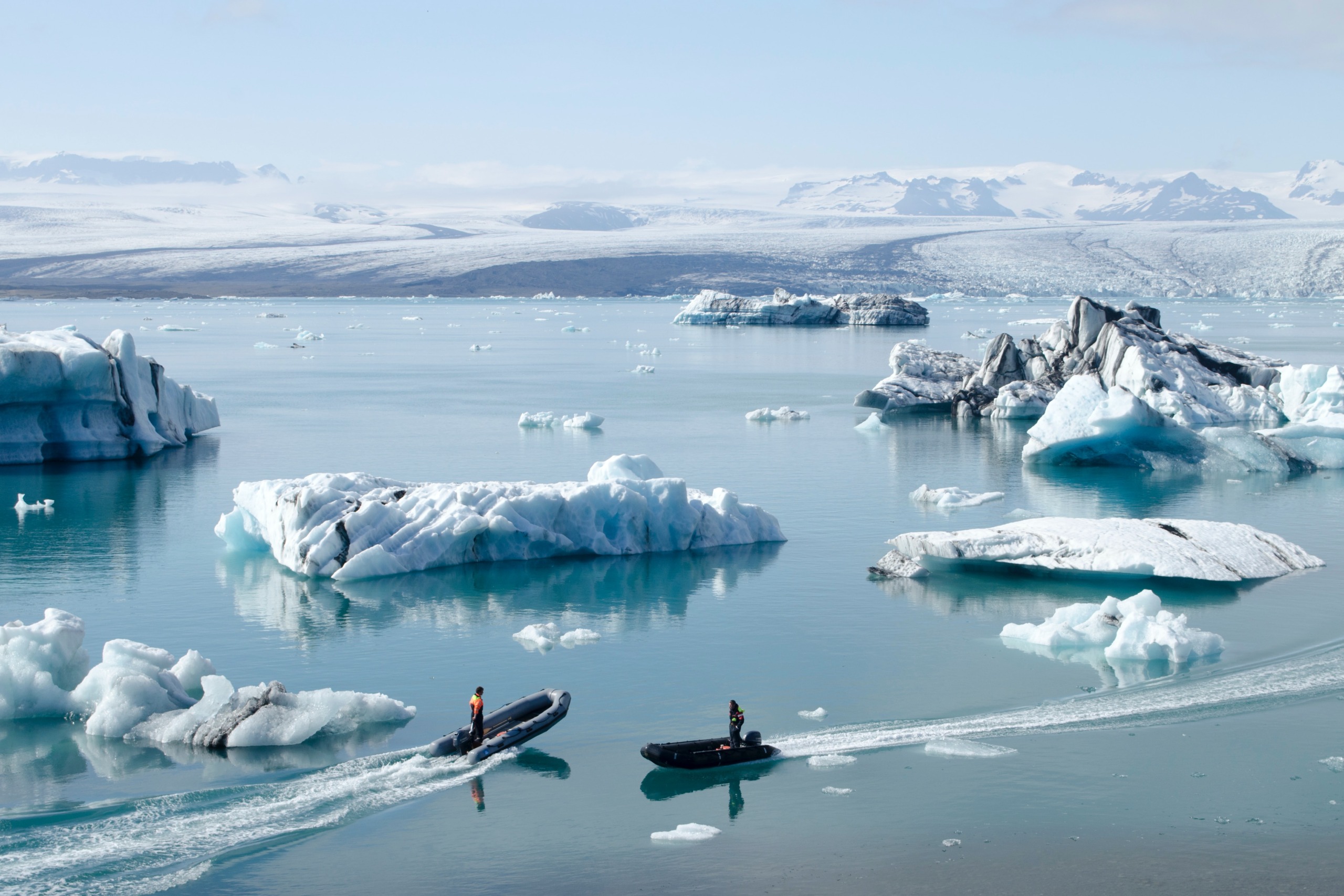
Many areas that used to be covered by ice year-round are now ice-free in the summer.

The effects of climate change are especially severe in the Arctic, causing the region to warm at a rate nearly 4 times as fast as the rest of the planet. Many marine areas that used to be covered by ice year-round are now ice-free in the summer. Shiozaki and his team speculated that this lack of ice, coupled with seasonally transparent water and increases in the amount of solar radiation absorbed (irradiance), allows sunlight to reach the bottom of the ocean in shallow areas, triggering phytoplankton blooms.

To support their hypothesis, the research team returned to the Chukchi Sea to take more samples. They also conducted a lab experiment, re-creating seafloor temperature and light conditions, and incubating sediment samples for 24 days with seawater filtered for organisms. Microscopic algae bloomed in the samples, even when irradiance was only 1% of what is normally found on the surface.


Related Articles: Can Refreezing the Arctic Help Reverse Climate Change? | The Arctic Is Warming 4 Times Faster Than Rest of the World – and More Quickly Than Previously Thought | The Effects of Arctic Warming on Indigenous Communities

Lars Chresten Lund-Hansen, a researcher at Aarhus University in Denmark, was surprised by the results and hopes to have more proof of algal blooms. “Instead of doing experiments with the sediment, it would be great if they could somehow conduct an experiment in situ to make sure that these algae are really alive,” he said.

A Cascade of Implications

If there is indeed primary production going on at the bottom of the ocean, the implications could be far-reaching. As phytoplankton form the basis of the food web in the Arctic, bottom blooms could alter the ecosystem—according to authors of the 2020 Arctic Report Card, for example, previously documented algal blooms indirectly contributed to increases in bowhead whale populations. The hidden blooms could also have an impact on the carbon cycle, as phytoplankton remove carbon from the environment during photosynthesis.

“Assuming that carbon is actively fixed by phytoplankton in the subsurface, this process should be taken into account.”

“Investigations of the carbon sequestration capacity of the Arctic Ocean have focused on surface processes,” said Shiozaki. “However, assuming that carbon is actively fixed by phytoplankton in the subsurface, this process should be taken into account.”

The first step to greater understanding of the diatoms is an accurate estimation of how widespread the hidden blooms may be. To reach such an estimation, scientists modeled the irradiance at the seafloor based on satellite data from the Arctic shelf region, where many areas are shallow enough to support blooms. The models showed that bottom blooms could theoretically occur in almost a quarter of the region.

The research team hopes to get a more precise understanding of the actual distribution and impact of the blooms by extending field observations into additional shelf areas, as well as by collaborating with ecosystem modelers.

“We still don’t know the total production and the amount of phytoplankton ‘seed’ on the seafloor that [could] be the origin of a bottom-associated bloom,” said Shiozaki. “It is important to estimate this to understand the impact on the biogeochemical cycles and the ecosystem.”

— —

This article was authored by science writer Fanni Daniella Szakal (@FanniDaniella).


Editor’s Note: The opinions expressed here by the authors are their own, not those of Impakter.com — In the Featured Photo: New research shows phytoplankton could bloom at the bottom of the Arctic. Featured Photo Credit: Rolf Gelpke.

Tags: algaeArctic OceanCCNClimate ChangeCOP27Covering Climate NowEcosystemEcosystem ProtectionEOS MagazineGlobal Change Ecology
Previous Post

A Natural Path to Conflict Prevention: Unpacking the Nature–Security Nexus

Next Post

Bezos Pledges to Donate His Fortune While Amazon Lays off Workers

Related Posts

India’s Contradictions in a Fractured World: Democracy, Identity, Power, and Silence
Climate Change

India’s Contradictions in a Fractured World: Democracy, Identity, Power, and Silence

March 16, 2026
How Climate Change Threatens the Sports Economy
Climate Change

How Climate Change Threatens the Sports Economy

March 16, 2026
Fossil Fuel Pollution’s Effect on Oceans Comes With Huge Costs
Climate Change

Fossil Fuel Pollution’s Effect on Oceans Comes With Huge Costs

March 16, 2026
Next Post
Bezos Pledges to Donate His Fortune While Amazon Lays off Workers

Bezos Pledges to Donate His Fortune While Amazon Lays off Workers

Related News

ESG news regarding the Iran conflict highlighting risks of fossil fuel dependence and rising European gas prices, Vietnam seeking support from Japan and South Korea to secure crude oil supplies, India considering easing penalties on renewable power producers over grid-supply rules, and Germany missing climate targets as emissions reductions stall in 2025.

Iran Conflict an “Abject Lesson” in Fossil Fuel Dependence

March 16, 2026
India’s Contradictions in a Fractured World: Democracy, Identity, Power, and Silence

India’s Contradictions in a Fractured World: Democracy, Identity, Power, and Silence

March 16, 2026

Impakter informs you through the ESG news site and empowers your business CSRD compliance and ESG compliance with its Klimado SaaS ESG assessment tool marketplace that can be found on: www.klimado.com

Registered Office Address

Klimado GmbH
Niddastrasse 63,

60329, Frankfurt am Main, Germany


IMPAKTER is a Klimado GmbH website

Impakter is a publication that is identified by the following International Standard Serial Number (ISSN) is the following 2515-9569 (Printed) and 2515-9577 (online – Website).


Office Hours - Monday to Friday

9.30am - 5.00pm CEST


Email

stories [at] impakter.com

By Audience

  • TECH
    • Start-up
    • AI & MACHINE LEARNING
    • Green Tech
  • ENVIRONMENT
    • Biodiversity
    • Energy
    • Circular Economy
    • Climate Change
  • INDUSTRY NEWS
    • Entertainment
    • Food and Agriculture
    • Health
    • Politics & Foreign Affairs
    • Philanthropy
    • Science
    • Sport
    • Editorial Series

ESG/Finance Daily

  • ESG News
  • Sustainable Finance
  • Business

About Us

  • Team
  • Partners
  • Write for Impakter
  • Contact Us
  • Privacy Policy

© 2026 IMPAKTER. All rights reserved.

No Result
View All Result
  • Environment
    • Biodiversity
    • Climate Change
    • Circular Economy
    • Energy
  • FINANCE
    • ESG News
    • Sustainable Finance
    • Business
  • TECH
    • Start-up
    • AI & Machine Learning
    • Green Tech
  • Industry News
    • Entertainment
    • Food and Agriculture
    • Health
    • Politics & Foreign Affairs
    • Philanthropy
    • Science
    • Sport
  • Editorial Series
    • SDGs Series
    • Shape Your Future
    • Sustainable Cities
      • Copenhagen
      • San Francisco
      • Seattle
      • Sydney
  • About us
    • Company
    • Team
    • Partners
    • Write for Impakter
    • Contact Us
    • Privacy Policy

© 2026 IMPAKTER. All rights reserved.