Harnessing solar power from space may sound like a futuristic concept, but its roots trace back to the early days of theorizing about space.
In 1923, the pioneering Russian theorist Konstantin Tsiolkovsky proposed an ambitious concept to utilize space mirrors that would concentrate a powerful beam of sunlight onto the Earth’s surface. By deploying this ingenious system, Tsiolkovsky aimed to tap into the vast potential of solar energy from space, introducing an early notion of Space-Based Solar Power (SBSP).
He even calculated the potential heat generated by this method, acknowledging the challenges that cloudy days might pose to such novel techniques.
Fast forward to the present day, and the concept of Space-Based Solar Power remains a captivating prospect.
As stated by the European Space Agency (ESA): “Sunlight is on average more than ten times as intense at the top of the atmosphere as it is down at the surface of the Earth,” making high orbit an ideal location to capture vast amounts of solar energy.
How Does Space-Based Solar Power Work?
The idea is simple: Collect solar energy in space and transfer it to Earth.
Although not a new concept, recent technological advancements have made this vision more attainable.
Here’s how it would work:
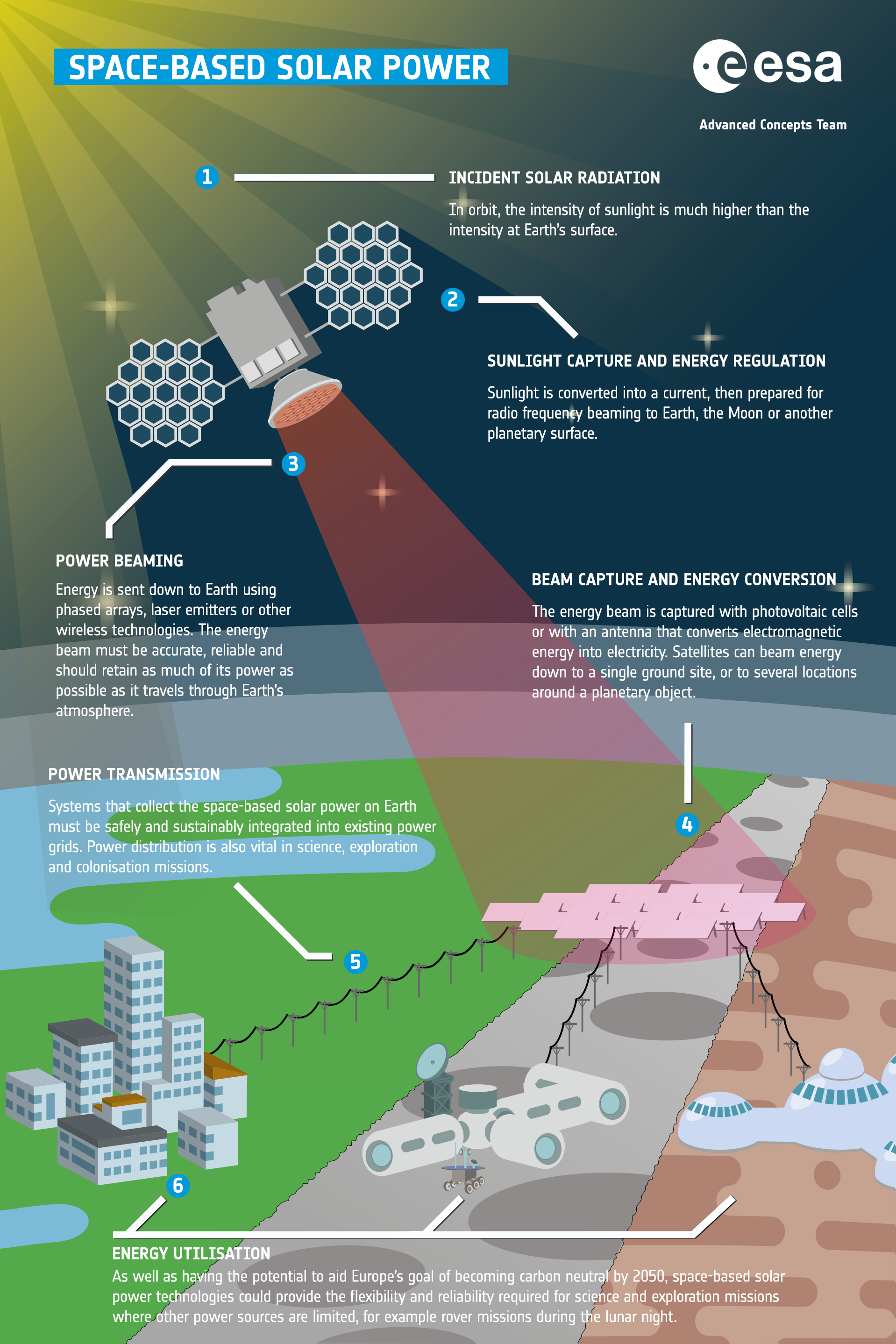 By tapping into the virtually unlimited and continuous solar energy available in space, space-based stations can generate electricity around the clock, making them an appealing and promising source of sustainable power for our energy-hungry world.
According to IEA’s projections, achieving net zero by 2050 will require two‐thirds of the total energy supply in 2050 to come from wind, solar, bioenergy, geothermal, and hydro energy. “Solar becomes the largest source, accounting for one‐fifth of energy supplies,” IEA writes.
Overcoming Hurdles: What Are Some of the Main Challenges of Space-Based Solar Power?
While space-based solar power holds tremendous promise, it faces several formidable challenges that must be overcome to achieve its full potential.
One of the most significant hurdles is the sheer scale required for optimal solar power generation, both in space and on Earth.
“A single solar power satellite at geostationary orbit might extend more than a kilometre across, with the receiver station on the ground needing a footprint more than ten times larger,” the ESA estimates.
Assembling such colossal structures in space demands an extensive number of launches, making it a complex and costly endeavor.
However, ESA clarifies that, as worldwide launch costs continue to decline, the feasibility of constructing these structures could become more economically viable, “and the end-result would be a continuously available source of clean energy.”
Related Articles: End of the ISS Era: What’s in Store for Low-Earth Orbit? | All The Way From Space To Earth: Caltech’s Project Leads the Race in Space-Based Solar Energy | Why Biomining Could Be The Future Of Space Society| What Is the ‘Dark Universe’ Made up Of?
Another major technical challenge lies in transmitting the harvested solar energy from space to the Earth’s surface.
To transport the energy to surface-based receivers, researchers plan to convert the electricity generated by the solar arrays into microwaves, as lasers can be hindered by clouds.
However, microwaves disperse as they travel, necessitating precise synchronization and the use of large receiving stations to collect them efficiently.
Transforming solar energy into electricity, followed by its conversion into microwaves, and eventually reconverting it back to electricity on the ground unavoidably results in energy losses.
To make the system economically viable, ESA estimates that “approximately 10-15% of the power falling on the panels of the satellite should be delivered into the grid.”
Advancing the Frontiers: What Is the State of Space-Based Solar Power Technology?
Space-based solar power has seen significant advancements and promising developments from various research teams and organizations worldwide.
ESA’s preparatory initiative, SOLARIS, aims to pave the way for a potential full development program by 2025, “by establishing the technical, political and programmatic viability of Space-Based Solar Power for terrestrial clean energy needs.”
At the opening of the 2022 Council Meeting at the Ministerial Level, ESA’s Director General Josef Aschbacher, when talking about solar power from space, considered their feasibility to be a possible “game changer for Europe’s energy situation, but also for humanity.”
Just imagine you could collect solar power, in the order of GWs, and beam it down to the earth's surface. If that works, that would be a game changer for Europe's energy situation, and for humanity – Director General @AschbacherJosef of @esa at the opening of #CM22 on Solaris pic.twitter.com/Rx6Wh4nMeT
— Kim Borgen (eu/acc) (@kim_borgen) November 22, 2022
The SOLARIS initiative involves diverse studies and technology developments in partnership with European industry to “mature the technical feasibility and assess the benefits, implementation options, commercial opportunities and risks of Space-Based Solar Power as a contributor to terrestrial energy decarbonisation,” while also addressing potential environmental, health and safety concerns.
ESA has signed contracts for two parallel concept studies for commercial-scale space-based solar power plants, led by Arthur D Little and Thales Alenia Space Italy, respectively.
.@esa chooses @Thales_Alenia_S for #SOLARIS feasibility study https://t.co/NR0hdEnize
A European project to use clean solar power from space to meet energy requirements down on Earth#sustainability #Greenenergy @thalesgroup @LDO_Space #solarpower pic.twitter.com/2JXwGURMPi
— Thales Alenia Space (@Thales_Alenia_S) July 24, 2023
Thales Alenia Space, in particular, leads a consortium aiming at “‘harvesting’ solar energy in orbit” and transmitting it back to Earth, providing Europe with an ambitious solution to meet its net-zero emissions goal by 2050.
The most recent success of the Space Solar Power Demonstrator (SSPD-1), developed by Caltech’s Space-Based Solar Power Project (SSPP), further illustrates the advancements in this technology.
China has also reportedly made strides in its space-based solar power station program called Zhuri, or “chasing the sun,” announcing a trial launch in 2028.
In order to face some of the challenges of solar power satellites, Astrostrom GmbH, a Swiss company centered on the feasibility of harvesting clean energy from Space to Earth, has been investigating the feasibility of a “Greater Earth Lunar Power Station” (GE⊕-LPS).
As explained by Dr. Sanjay Vijendran, Lead for the SOLARIS initiative:
“Launching large numbers of gigawatt-scale solar power satellites into orbit from the surface of the Earth would run into the problem of a lack of launch capacity as well as potentially significant atmospheric pollution. But once a concept like GE⊕-LPS has proven the component manufacturing processes and assembly concept of a solar power satellite in lunar orbit, it can then be scaled up to produce further solar power satellites from lunar resources to serve Earth.”
Astrostrom’s pioneering study was selected from ESA’s open call “Clean Energy – New Ideas for Solar Power from Space” (a campaign looking for new ideas to expand the feasibility of such technologies), a testament to its revolutionary approach to Space-Based Solar Power (SBSP) systems.
The concept of gathering☀️sunlight from🌌space to
📡 transmit it down to users was first developed to serve planet🌍Earth. But Space-Based Solar Power #SBSP can also work for the🌗Moon. @astrostrom in🇨🇭has designed a lunar solar power satellite for @ESA https://t.co/n0TxAGF9ZX pic.twitter.com/dz2CS7kmOy— ESA Technology (@ESA_Tech) July 14, 2023
This innovative concept would make it possible to get power from lunar orbit to operations on the Moon’s surface and deliver clean baseload solar energy to Earth using Solar Power Satellites (SPS).
The “Space Energy Option” envisioned by Astrostrom holds the potential to drastically reduce the world’s reliance on fossil fuels for energy production, aligning with international climate and energy targets.
While progress is evident, challenges remain in achieving gigawatt-scale power collection in space and delivering it efficiently and safely to Earth.
Awareness raising among the energy sector and public authorities, as well as continued investments in technology R&D, are essential to fully realize the potential of space-based solar power in contributing to global climate goals.
While there are formidable challenges to overcome, the potential rewards of harnessing the Sun’s energy from space are undoubtedly worth the effort and investment.
From the historical visions of Konstantin Tsiolkovsky to the cutting-edge research of today, space-based solar power continues to shine brightly as a beacon of hope in our quest for clean and limitless energy.
Editor’s Note: The opinions expressed here by the authors are their own, not those of Impakter.com — In the Featured Photo: The Sun viewed from Space STS-101 mission. Featured Photo Credit: NASA.