
Impakter
  • Environment
    • Biodiversity
    • Climate Change
    • Circular Economy
    • Energy
  • FINANCE
    • ESG News
    • Sustainable Finance
    • Business
  • TECH
    • Start-up
    • AI & Machine Learning
    • Green Tech
  • Industry News
    • Entertainment
    • Food and Agriculture
    • Health
    • Politics & Foreign Affairs
    • Philanthropy
    • Science
    • Sport
  • Editorial Series
    • SDGs Series
    • Shape Your Future
    • Sustainable Cities
      • Copenhagen
      • San Francisco
      • Seattle
      • Sydney
  • About us
    • Company
    • Team
    • Partners
    • Write for Impakter
    • Contact Us
    • Privacy Policy
No Result
View All Result
Impakter logo
No Result
View All Result
Scaling up Adaptation Experiences in the Dry Corridor of Guatemala

Scaling up Adaptation Experiences in the Dry Corridor of Guatemala

CGIARbyCGIAR
January 30, 2021
in Environment
0
A new course for professionals that work in agricultural development in the Dry Corridor of Guatemala aims to scale climate change adaptation approaches and practices.

Guatemala is one of the most vulnerable countries to climate change and variability in Latin America. In the region known as the “Dry Corridor”, the “canícula” (reduction of precipitation during the summer) coincides with a critical phase in agricultural production; and in recent years, this reduction in precipitation has begun earlier, has lasted longer, and/or has been more intense.

During 2020, in addition to the health and socioeconomic crisis caused by the COVID-19 pandemic, the region has faced extreme rainfall, with significant impacts on food production and sources of employment, which has particularly affected small-scale farming families.

In order to support a sustainable recovery from the impacts of COVID-19, in the context of climate variability, the second edition of the seminar “Climate-Smart Villages” (CSV) is being held. This seminar aims to strengthen the technical capacity and human resources dedicated to rural development in the Dry Corridor of Guatemala for the development of CSV in this region. This training program is the result of the alliance between the Centro Universitario de Oriente (CUNORI, of the University Of San Carlos, Guatemala) and the CGIAR Research Program on Climate Change, Agriculture and Food Security (CCAFS).

Both institutions aim to scale up approaches and practices for climate change adaptation in agriculture and water management in the Dry Corridor of Guatemala, one of the area’s most vulnerable to increased climate variability in Central America.

Successful first edition of the training course

From the first edition of the course held in 2019, 30 professionals from 14 governmental and non-governmental organizations in the region graduated. Most had bachelor’s degrees or engineering degrees in different fields. The first edition combined didactic activities in intensive classroom sessions, with presentations by instructors from more than 15 local organizations. This second edition involved 36 professionals from 14 governmental and non-governmental organizations in the region.

CHALLENGES OF THE SECOND EDITION OF THE COURSE

The second edition maintains the four modules proposed in the first edition, focusing on: climate change adaptation practices and technologies; climate information management; collaboration and financing opportunities for adaptation initiatives; and design and planning of adaptation initiatives.

The design of the second edition, which began in November 2020 and will end in March 2021, was updated in response to two challenges: the crisis of COVID19 and the greater inclusion of the CSV approach in the work of local institutions.
''''
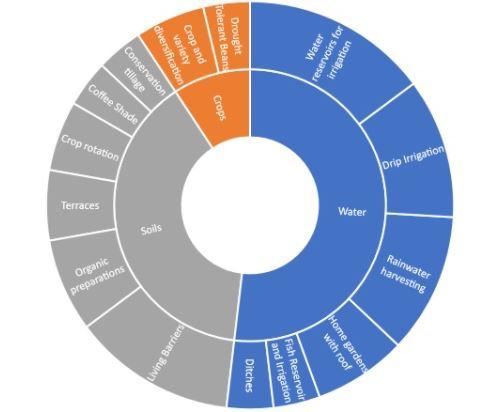
Figure 1. Preferences for water, soil and crop management practices and technologies among students, module 1 (FNS – food and nutrition security, PICSA – Participatory Integrated Climate Services for Agriculture, LTACs – Local Technical Agroclimatic Committees)

To respond to the challenge of the health crisis, the entire diploma course is now taught virtually, combining both synchronous and asynchronous activities, and didactic presentations from local, national, and international organizations that help ground the concepts with practical examples and lessons from their experience. This has required a review of the program, the teaching methodology, and the use of the virtual learning platform.

To respond to the second challenge, the selection of participants favored the participation of extensionists and field technicians, who expect to implement what they have learned in the course with farming families from different rural communities of the region.


Related Articles: Digital Nutrient Management Tool | Science-Policy Dialogues Ensure Impact 

In addition, several actions were taken based on the lessons learned from the first version, such as the establishment of previous institutional commitments and the selection of CSV practices and technologies according to the reality of each organization, to further facilitate their inclusion in ongoing projects or institutional work.

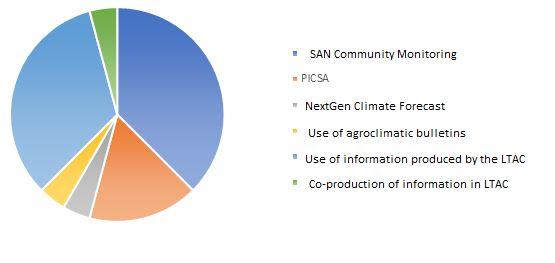
Preliminary results of surveys of student preferences for CSV practices and methodologies (see Figures 1 and 2 respectively) indicate a strong emphasis on water and soil management practices and technologies, and on local resource-based information management practices that support organizational and community preparedness and decision-making.
''''
Figure 2. Information management practices preferred by students, module 2 (FNS – food and nutrition security, PICSA – Participatory Integrated Climate Services for Agriculture, LTACs – Local Technical Agroclimatic Committees)
Other approaches implemented in the Dry Corridor
Some examples of other approaches that have been scaled up in the Central American country are the Local Technical Agroclimatic Committees that are implemented in the provinces of El Progreso, Zacapa, and Chiquimula (in collaboration with CUNORI, the Ministry of Agriculture, Livestock and Food of Guatemala – MAGA, the World Food Program – WFP, among others) and the CSV Olopa (in collaboration with the Asociación Regional Campesina Ch’orti’ – ASORECH).

FUTURE CHALLENGES

The participation in the first and second units of the second edition of the diploma course, held in November and December 2020, leads us to believe that the use of virtual training spaces is a good decision not only for this year’s situation but also for future scenarios with increasingly scarce resources.

However, it also presents us with new challenges in attracting and keeping participants’ attention, since formal and non-formal platforms, as well as other interactive tools, have been used to maintain participants’ interest.

These issues will be integrated into the subsequent follow-up of the course’s results, to see if scaling up at the organizational level is taking place, and what factors are restricting or supporting the scaling.


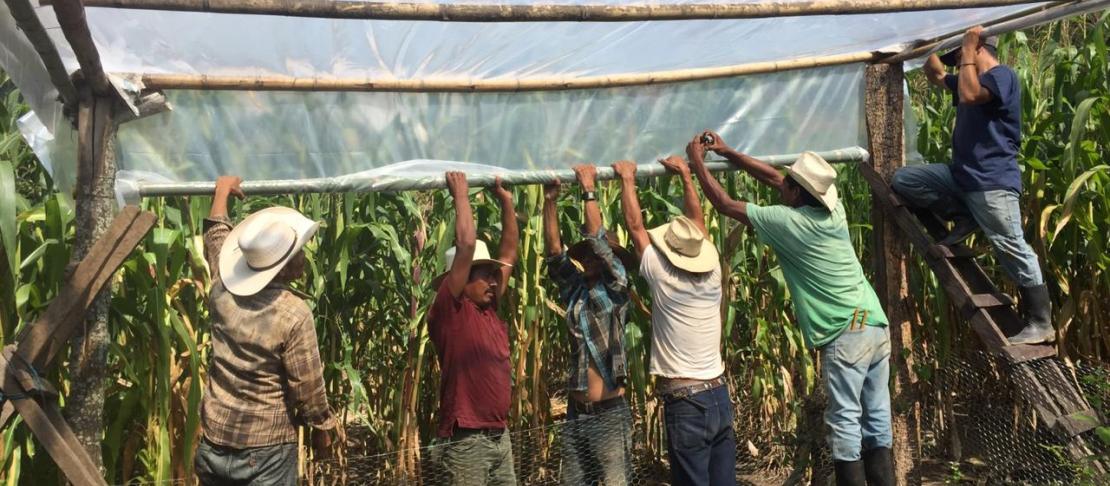
Editor’s Note: The opinions expressed here by Impakter.com contributors are their own, not those of  Impakter.com. In the Featured Photo: At CSV Olopa in Guatemala, farmers implement the practice of home gardens to build climate resilience. Featured Photo Credit: C. Lopez (ASORECH).

Tags: AgricultureClimate ChangeCOVID-19EducationLatin America
Previous Post

Direct Air Capture: Resource Considerations and Costs for Carbon Removal

Next Post

Our Sustainable Future: Electric Dream Cars

Related Posts

How Climate Change Is Driving Evolution
Climate Change

How Climate Change Is Driving Evolution

As global temperatures continue to rise at alarming rates, climate change threatens to wipe out entire groups of animal species....

byYuxi Lim
February 5, 2026
biodiversity loss
Biodiversity

The Economics of Biodiversity Loss

In the 1990s, India’s vulture population collapsed due to the unintended knock-on effect of a veterinary drug for cattle, with...

byStefano Giglio - Professor at Yale Universityand2 others
February 4, 2026
The Era of ‘Global Water Bankruptcy’ Has Begun
Climate Change

The Era of ‘Global Water Bankruptcy’ Has Begun

Humanity’s long-term water usage and damage have exceeded nature's renewal and safe limits, a situation scientists and the media have...

byNmesoma Ezetu
February 4, 2026
A picture with a wind power generator
Society

Emissions and Economic Growth: Is There Still a Link?

In prior decades, economic growth and emissions co-existed. As countries grew richer, they produced more and emitted more. This relationship...

byFedor Sukhoi
February 3, 2026
Three sponsors for the 2026 Winter Olympics in Italy could generate 1.3 million tons of CO2
Climate Change

Winter Olympics Sponsorship Emissions: Who Are the Main Offenders?

The 2026 Winter Olympic Games are set to begin in Italy next month. Scattered across towns in northern Italy, from...

bySarah Perras
February 2, 2026
WEF Report Ranks Environmental Challenges as Greatest Long-Term Threat to Global Stability
Business

WEF Report Ranks Environmental Challenges as Greatest Long-Term Threat to Global Stability

The World Economic Forum’s Global Risks Report 2025 found that environmental risks are deteriorating faster than other threats and challenges.  ...

byBenjamin Clabault
February 2, 2026
Thames Water closes in on rescue deal;
Environment

Thames Water Closes in on £16bn Rescue Deal

Today’s ESG Updates: Thames Water Closes in on £16bn Rescue Deal: Thames Water is edging closer to a multibillion-pound rescue...

byAriq Haidar
February 2, 2026
Food Waste in India
Climate Change

India’s Food Waste Is Turning Into an Environmental Time Bomb

India, a key player in this fight, is currently battling a confluence of climate-driven disasters. Last year’s punishing extreme heatwave,...

byPranjali Chowdhary - Research and Policy Associate at the Institute for Governance and Sustainable Development, Indiaand1 others
January 30, 2026
Next Post
Our Sustainable Future: Electric Dream Cars

Our Sustainable Future: Electric Dream Cars

Recent News

ESG News regarding Nuclear Waste Storage; Canada Replaces EV Mandate; EU and Turkey Resume Trade Modernization Talks; Startup Raises $29M for Desk-Sized Fusion Reactor

Volunteers Needed for Nuclear Waste Storage

February 6, 2026
Rare Earth Metals 101

Rare Earth Metals 101

February 6, 2026
How to Spot Greenwashing in the Publishing Industry

How to Spot Greenwashing in the Publishing Industry

February 6, 2026
  • ESG News
  • Sustainable Finance
  • Business

© 2025 Impakter.com owned by Klimado GmbH

No Result
View All Result
  • Environment
    • Biodiversity
    • Climate Change
    • Circular Economy
    • Energy
  • FINANCE
    • ESG News
    • Sustainable Finance
    • Business
  • TECH
    • Start-up
    • AI & Machine Learning
    • Green Tech
  • Industry News
    • Entertainment
    • Food and Agriculture
    • Health
    • Politics & Foreign Affairs
    • Philanthropy
    • Science
    • Sport
  • Editorial Series
    • SDGs Series
    • Shape Your Future
    • Sustainable Cities
      • Copenhagen
      • San Francisco
      • Seattle
      • Sydney
  • About us
    • Company
    • Team
    • Partners
    • Write for Impakter
    • Contact Us
    • Privacy Policy

© 2025 Impakter.com owned by Klimado GmbH