
Impakter
  • Environment
    • Biodiversity
    • Climate Change
    • Circular Economy
    • Energy
  • FINANCE
    • ESG News
    • Sustainable Finance
    • Business
  • TECH
    • Start-up
    • AI & Machine Learning
    • Green Tech
  • Industry News
    • Entertainment
    • Food and Agriculture
    • Health
    • Politics & Foreign Affairs
    • Philanthropy
    • Science
    • Sport
  • Editorial Series
    • SDGs Series
    • Shape Your Future
    • Sustainable Cities
      • Copenhagen
      • San Francisco
      • Seattle
      • Sydney
  • About us
    • Company
    • Team
    • Global Leaders
    • Partners
    • Write for Impakter
    • Contact Us
    • Privacy Policy
No Result
View All Result
Impakter logo
No Result
View All Result
Quality Food in Africa: The Challenges Facing Pig Production in Cameroon

Quality Food in Africa: The Challenges Facing Pig Production in Cameroon

Jean Armand Bokally Dande - JournalistbyJean Armand Bokally Dande - Journalist
February 20, 2019
in Business, Environment, GFAR Series, SDG Series, Society
1


Pig production in Cameroon, similar to many other African countries, requires good entrepreneurial skills. The trade is often unorganized, production costs high, and animal diseases common. Success is a real challenge, despite this, pig farmer Jonas Tchenda has managed his production successfully since 1978.

Forget about co-operation, big chain stores pushing margins, and meat packers dominating markets. Tchendas’ graveyard in Nkozoa, a town outside Cameroon’s capital Yaounde, has four hundred pigs, making the graveyard one of the largest farms in Cameroon. Tchendas’ family-run complex covers an area of 200 square meters, enabling him to breed a wide variety of animals: sows, pearls, geese, ducks, chickens and piglets and pigs for fattening.
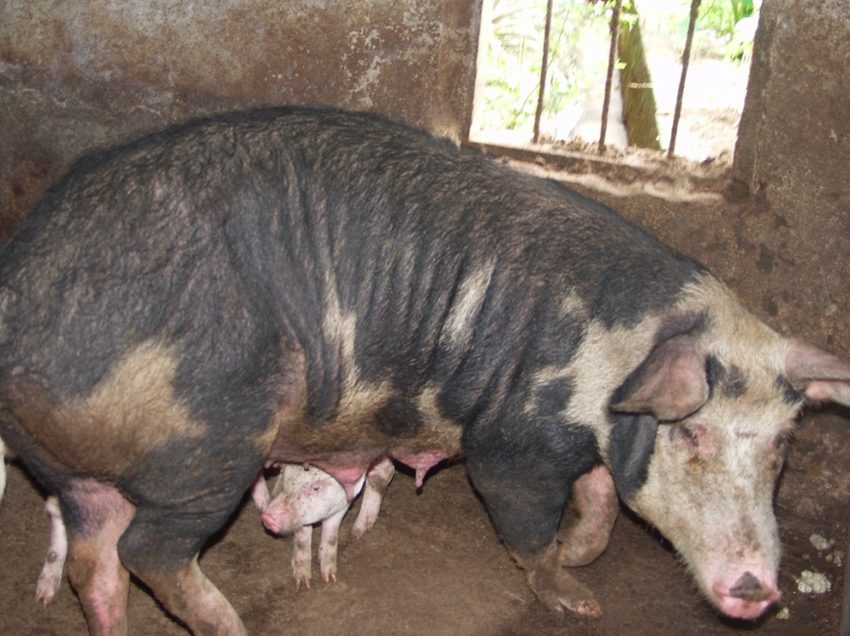
In the photo: Pig and piglet on Tchenda’s farm. Photo Credit: Jean Armand Bokally Dande.

At the age of two, Tchenda sells his animals directly to slaughter, or for feeding. The animals to be slaughtered are sold to merchants or to festivity organisers, in order to avoid the hassle of the pig production’s sticky trading market. Interestingly, Tchenda explains how one valuable and heavy pig can legally bring him 300-400,000 francs (CFA), approximately 450-600 Euros for his income.

Different Challenges in Cameroon’s Pig Production

Cameroon’s development of animal husbandry has encountered many adversities in recent years, including swine flu, reproductive disorders and parasites. In 2014, African swine fever (ASF) strongly shook the pork market, making good meat increasingly rare. In addition to these adversities, production prices are accelerating to higher costs. Also, unorganized management often leads to inbreeding and low fertility risk in the pigs, making the market considerably difficult to navigate. Certified slaughterhouses and processing plants are few, and there is no guarantee the meat will be cared for in the correct way.

“There is no market for pork in Yaounde, every producer organizes sales in a way that suits him best” says Tchenda.
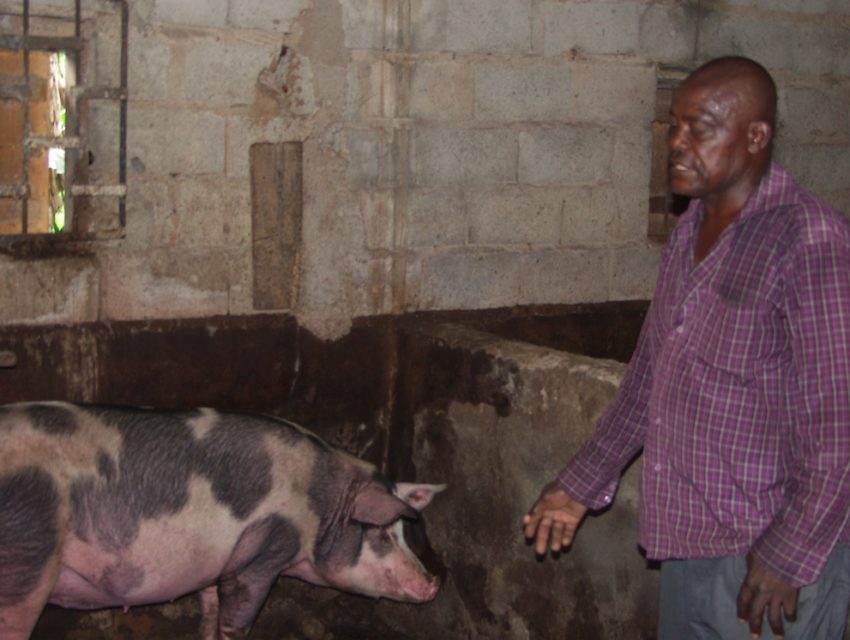
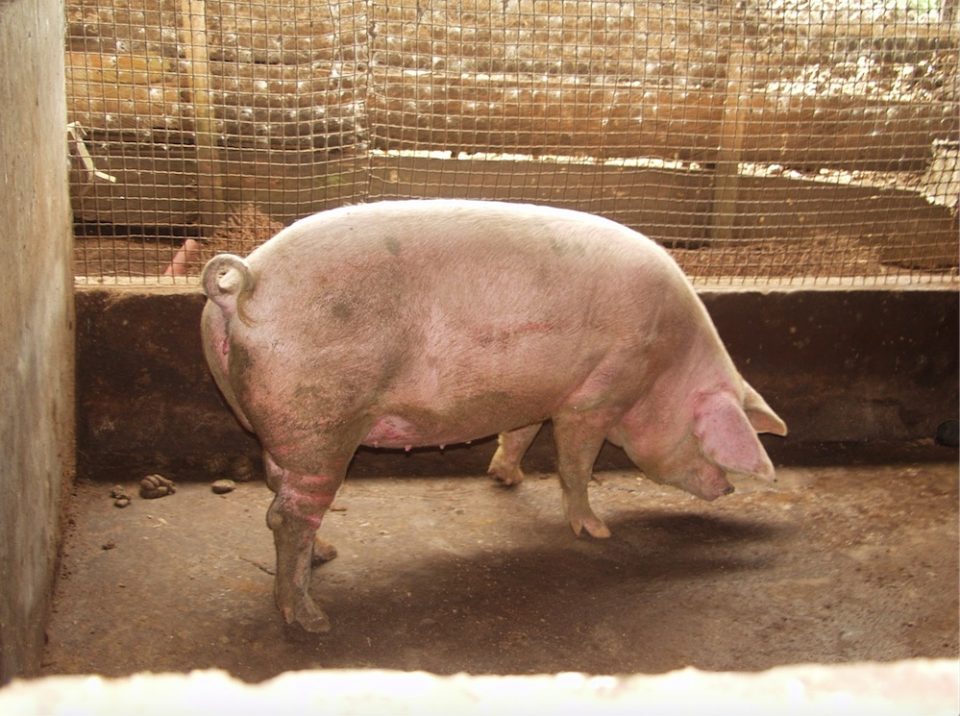
In the Photo: Mr Tchenda on his farm. Photo Credit: Jean Armand Bokally Dande.

Breeding

Tchenda’s farm complex is divided into several sectors, each one is nine square meters in size. Moreover, each department contains one or two hybrid pigs. The animals are a mixture of species of Large White, Duroc and sometimes local species.

“The local species are more resistant to disease. They also have another benefit, they can be 36 kilograms in six months. A good pig should weigh it” says Tchenda.

He usually uses pigs from his own farm for breeding as a precaution, as many producers are vague in revealing the age of their animals. To maintain the amount of animals on the farm, he castrates the males and the boars with the potential to breed, in order to possess extra good food. He mostly receives the animals’ food from the Institute for Agricultural Research and Development (IRAD) in Nkolbisson, six kilometers east of Yaounde. The rest of the food is grown by himself, or bought from other pig farmers in western Cameroon.

The food consists of a mixture of ingredients: starters from breweries, palm kernel flour, corn, soybeans, peanuts, ground fish, wheat flour, bone flour, shells, palm oil and sugar cake.

“The amount of ingredients varies for different types of pigs. For example, I give half less amount of corn, peanuts and others high fat foods to the breeding pigs against the pigs that are going to slaughter,” says Tchenda.
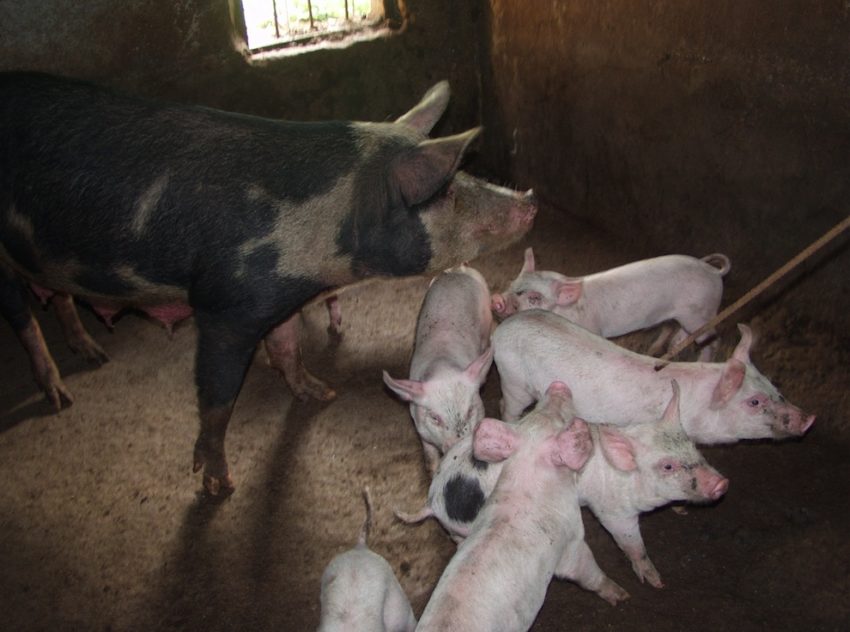
In the photo: Pig and piglet on Tchenda’s farm. Photo Credit: Jean Armand Bokally Dande.

A Better Future

Following the recent Ebola eruptions in several African countries, the so called “bush meat” (meat from wildlife), decreased in popularity and has been banned from many places of sale. Instead, it has become more common to eat pork at home, in restaurants and also in street kitchens.

Consequently, Cameroon Prime Minister Philemon Yang started a project in 2012 to help improve farmers market and animal breeders. As a part of this project, the ministry for animal husbandry has recently imported 77 breeding pigs from France, six of which were pigs and the remaining sows, with the aim to introduce new blood into the pig industry. This is a small progress on a global scale, however the chances of great success for Cameroon and Tchenda are minimal due to the shortcomings in the market.

However, Tchenda has seen his sector change and develop since the seventies, and has still managed to send all his children to school. For now, his farm holds an exemplary reputation within the pig breeding industry, as his success continues.
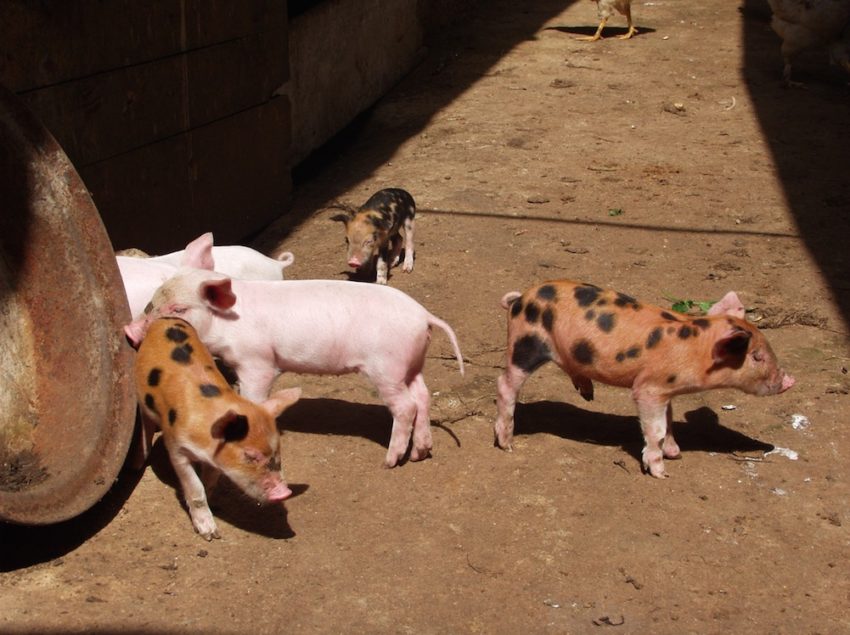
In the photo: Piglets on Tchenda’s farm. Photo Credit: Jean Armand Bokally Dande.

Editors Note: The opinions expressed here by Impakter.com columnists are their own, not those of Impakter.com. — In the Featured photo: A Pig on Tchenda’s farm. Photo Credit: Jean Armand Bokally Dande.
Tags: AgricultureCameroonGFARGFARimpaktersJean Armand Bokally DandePig BreedingPig FarmingQuality Food
Previous Post

To achieve sustainability, we need to change behavior first

Next Post

CLIMATE . CHANGE – Episode 1 – With Bertrand Piccard, Chairman of the Solar Impulse Foundation

Related Posts

soil
Biodiversity

To Prevent Ecological Collapse, We Must Start With the Soil

Soil is the single most biodiverse habitat on Earth, home to at least 59% of all species, including over 80%...

byMarcela Quintero - Associate Director General of Research Strategy and Innovation at the Alliance of Bioversity International and CIATand1 others
January 8, 2026
How Climate Change Could Help Foster Peace in Yemen
Climate Change

How Climate Change Could Help Foster Peace in Yemen

Yemen's tragedy is traditionally depicted through the limited perspective of humanitarian need and political divisiveness, but there is a greater...

byTareq Hassan - Executive Director of the Sustainable Development Network Canada (SDNC)
December 17, 2025
Animal Health
Biodiversity

Better Animal Health Is the Low-Risk, High-Reward Climate Investment We Need

Imagine if there was a way to reduce emissions from the meat, egg and dairy sector by nearly a quarter,...

byCarel du Marchie Sarvaas
November 26, 2025
COP30: Countries’ Climate Agrifood Ambitions Undermined by Funding Gaps, Report Finds
Biodiversity

COP30: Countries’ Climate Agrifood Ambitions Undermined by Funding Gaps, Report Finds

Developing countries recognize the urgent need to adapt agrifood systems to climate change, but most National Adaptation Plans (NAPs) are...

byThe Food and Agriculture Organization of the United Nations (FAO)
November 19, 2025
Bill Gates memo
Climate Change

Climate, Gates and COP30

Bill Gates’ recent article on the “three tough truths” of the ongoing environmental changes makes an essential point: we must...

byJosé Graziano da Silva - Former Director-General at FAO, Founder and Director of the Instituto Fome Zero, and Professor Emeritus at the University of Campinas
November 12, 2025
climate change and food
Biodiversity

COP30: Climate Extremes Are Already Impacting Food Yields Today

The 30th United Nations Climate Change Conference (COP30), taking place in Belém, Brazil, brings together world leaders, scientists, non-governmental organizations, and...

byThe Food and Agriculture Organization of the United Nations (FAO)
November 7, 2025
heat stress
Climate Change

3 Things to Know About Heat Stress and How to Prevent It

The World Meteorological Organization reported that 2024 was the first entire year with global temperatures exceeding 1.5° Celsius above pre-industrial...

byThe Food and Agriculture Organization of the United Nations (FAO)
September 3, 2025
ESG news regarding Google signing largest US hydropower deal, Trump’s 30% tariff threat EU exports, BlackRock hits record $12.5 trillion, farmland falls to solar expansion
Business

Google Signs Largest Hydropower Deal to Power AI

Today’s ESG Updates Google Signs Largest US Hydropower Deal: $3B deal secures 3GW of clean energy for data centres, supporting...

byPeter Vigh
July 15, 2025
Next Post
CLIMATE . CHANGE – Episode 1 – With Bertrand Piccard, Chairman of the Solar Impulse Foundation

CLIMATE . CHANGE - Episode 1 - With Bertrand Piccard, Chairman of the Solar Impulse Foundation

Please login to join discussion

Recent News

The Imperative of a Nature-Positive Future

The Imperative of a Nature-Positive Future

January 15, 2026
ESG News regarding BHP and Rio Tinto are teaming up to expand their iron ore production pipeline

BHP and Rio Tinto to Boost Australian Iron Ore Production

January 15, 2026
ESG News regarding Dimon warning that Trump’s attacks on Fed could raise inflation and rates, Venezuelan oil shipments to China setting to plunge under U.S. blockade, UK awarding offshore wind contracts to power 12m homes, 2025 being the third-hottest year on record as climate science faces political pushback

JPMorgan CEO Warns Trump’s Attacks on Fed Could Raise Inflation and Rates

January 14, 2026
  • ESG News
  • Sustainable Finance
  • Business

© 2025 Impakter.com owned by Klimado GmbH

No Result
View All Result
  • Environment
    • Biodiversity
    • Climate Change
    • Circular Economy
    • Energy
  • FINANCE
    • ESG News
    • Sustainable Finance
    • Business
  • TECH
    • Start-up
    • AI & Machine Learning
    • Green Tech
  • Industry News
    • Entertainment
    • Food and Agriculture
    • Health
    • Politics & Foreign Affairs
    • Philanthropy
    • Science
    • Sport
  • Editorial Series
    • SDGs Series
    • Shape Your Future
    • Sustainable Cities
      • Copenhagen
      • San Francisco
      • Seattle
      • Sydney
  • About us
    • Company
    • Team
    • Global Leaders
    • Partners
    • Write for Impakter
    • Contact Us
    • Privacy Policy

© 2025 Impakter.com owned by Klimado GmbH