Nobel winner, economist and philosopher Amartya Sen has repeatedly argued that the focus of development should be on “advancing the richness of human life” rather than endlessly growing GDP. The aim should be instead to grow people’s capabilities so that they can choose to do things in life that they value, and for that, education is key. One country in Africa, Liberia has caught on early to those ideas and four years ago it established a policy to enlarge people’s capabilities starting with children: the Liberian Education Advancement Programme (LEAP). What is of particular interest is the reliance of LEAP on public-private partnership, with Bridge International Academies among others.
Starting in selected primary schools, success came early to this particular public-private partnership and is now confirmed by an outside evaluator. We are pleased to present the account of this success achieved in just three years of operations. More information about Bridge’s activities and its teaching model is provided in another article: “The Challenge of Universal Education: The Bridge Model and How it Works” (March 28, 2019).
Study shows government education programme has significantly improved learning outcomes in Liberia
A few years ago the Government of Liberia started a pilot to see if they could improve education for children in a small number of primary schools, with the help of support from education organisations and using the model of public-private partnerships.
Now, the impact of the intervention has been tested, and the results for the schools Bridge supports are very encouraging.
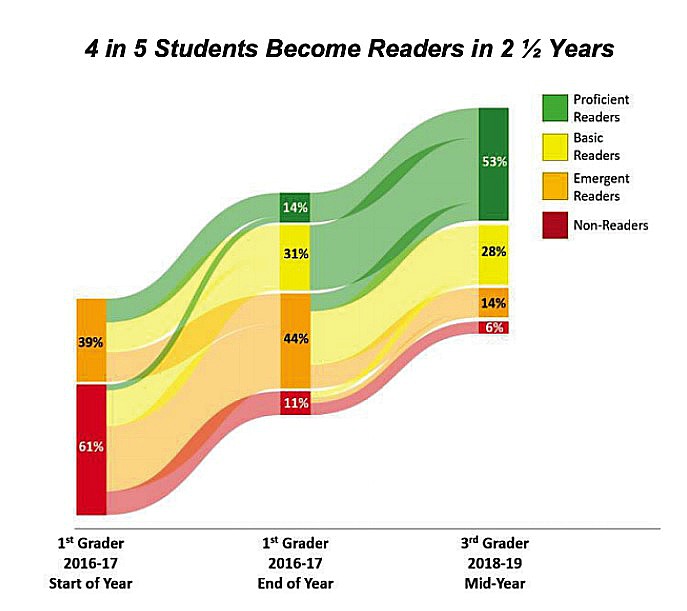
- Eighty-one percent of Bridge LEAP students are now proficient or basic readers
- Bridge LEAP students are seven times more likely to be proficient readers than their peers
UNESCO’s Vice Chair of the Education Commission and Head of Education Delivery at the Ministry of Education in Liberia, Gbovadeh Gbilia, has released Learning in Liberia a co-authored study assessing the learning progress made in Bridge supported schools as part of the Liberian Education Advancement Programme (LEAP).
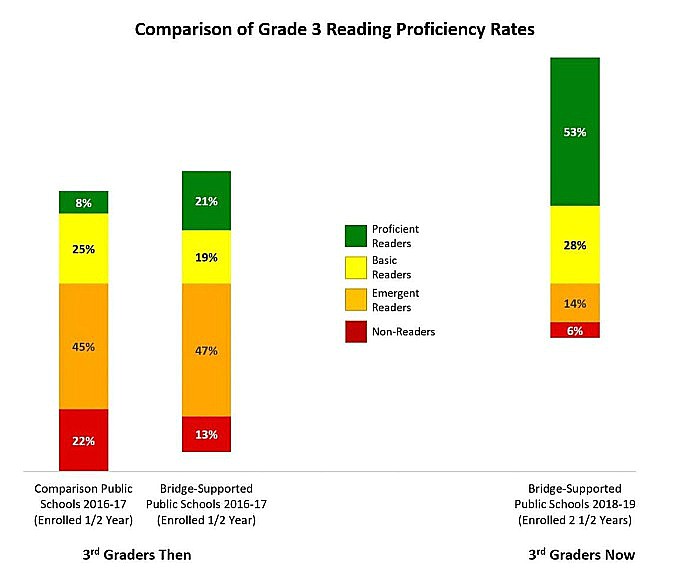
The study finds that 81% of students who joined a Bridge supported LEAP school in the first grade and have spent 2½ years in a Bridge classroom are proficient or basic readers; compared to only 33% of students in traditional public schools.
The government’s ambition is for all Liberian children to be proficient readers by the time they finish their primary school education. Significantly, the new study reveals that 53% of grade three students in a Bridge supported school have now achieved proficiency. A dramatic difference from the prevailing situation in non LEAP schools where only 8% of children in this grade reach reading proficiency.
LEAP is a bold initiative developed by the Government of Liberia four years ago to increase the quality of pre-primary and primary education across the country. Uniquely, it has thrived under two different administrations having being implemented as Partnership Schools for Liberia under President Sirleaf and continued as LEAP under the leadership of President Weah. Strong political leadership and clear focus on improving schools for Liberia’s children trumped the struggles signature policies often face with regime change.
In 2016, 62% of primary school aged children were not enrolled in Liberia. Thirty-five per cent of women and 21% of men could not read a single sentence. LEAP had a singular goal, to improve learning outcomes for Liberian children. The Ministry of Education commissioned several studies including an independent randomised control trial (RCT) to ensure that progress against the government’s vision was objectively measured to form the basis of government policy decisions.
In the first year of LEAP, Bridge supported 25 schools; in its second the Ministry allocated the social enterprise a further 43 schools with many in the remote south-east of the country. The programme was led and designed by the government—teachers remained public employees on the government payroll—school buildings were owned by the Ministry and the national curriculum was strictly adhered to.
Now, a collaborative study looking at the three year programme has been released. It focuses on Bridge—the largest of the LEAP partners—and indicates that the public-private partnership model has significantly improved learning outcomes as the Ministry of Education intended:
- Grade 3 students in a Bridge supported school—who joined in the first grade—are seven times more likely to be proficient readers than their non LEAP peers
- Overall average fluency is above 55 words per minute, compared to the 10 words per minute being achieved by third graders two years ago
- Students now in Grade 3 with 2½ years of Bridge-supported instruction, read faster than Grade 5 students did in 2017
In addition, the impact on girls’ education is particularly noteworthy in a country where previously only 39% of girls completed primary school. Results across almost all grades show a reduction in the gender gap that Bridge-supported LEAP schools inherited in its opening year. In literacy, most performance gaps have been completely eliminated.
In the past 2½ years, 5th grade girls’ average performance on passage reading fluency increased by over 27 words per minute. Once lagging by 10 words per minute, girls now outperform boys.
Equipped with evidence, and confidence of the learning gains being achieved by its children, the government has now expanded the LEAP programme into its fourth year to reach 225 primary schools across the country. Its ultimate vision of transforming learning for all 2,619 of its public primary schools is within reach.
By putting education at the heart of its public sector transformation agenda—the Liberian government has proven that poverty is not destiny.
Bridge is one of a number of independent school operators that are helping the Government of Liberia to transform basic education. After only three years of operation, the public-private partnership model is proving its worth, provided it uses a proven teaching model and is implemented with care.