Impakter
  • Environment
    • Biodiversity
    • Climate Change
    • Circular Economy
    • Energy
  • FINANCE
    • ESG News
    • Sustainable Finance
    • Business
  • TECH
    • Start-up
    • AI & Machine Learning
    • Green Tech
  • Industry News
    • Entertainment
    • Food and Agriculture
    • Health
    • Politics & Foreign Affairs
    • Philanthropy
    • Science
    • Sport
  • Editorial Series
    • SDGs Series
    • Shape Your Future
    • Sustainable Cities
      • Copenhagen
      • San Francisco
      • Seattle
      • Sydney
  • About us
    • Company
    • Team
    • Global Leaders
    • Partners
    • Write for Impakter
    • Contact Us
    • Privacy Policy
No Result
View All Result
Impakter logo
No Result
View All Result
Pre-History and Future on a Delaware Beach

Pre-History and Future on a Delaware Beach

Midori Paxton - UNDP Head of Ecosystem and BiodiversitybyMidori Paxton - UNDP Head of Ecosystem and Biodiversity
June 2, 2021
in Climate Change, Environment, Health, SDG Series, Society
0

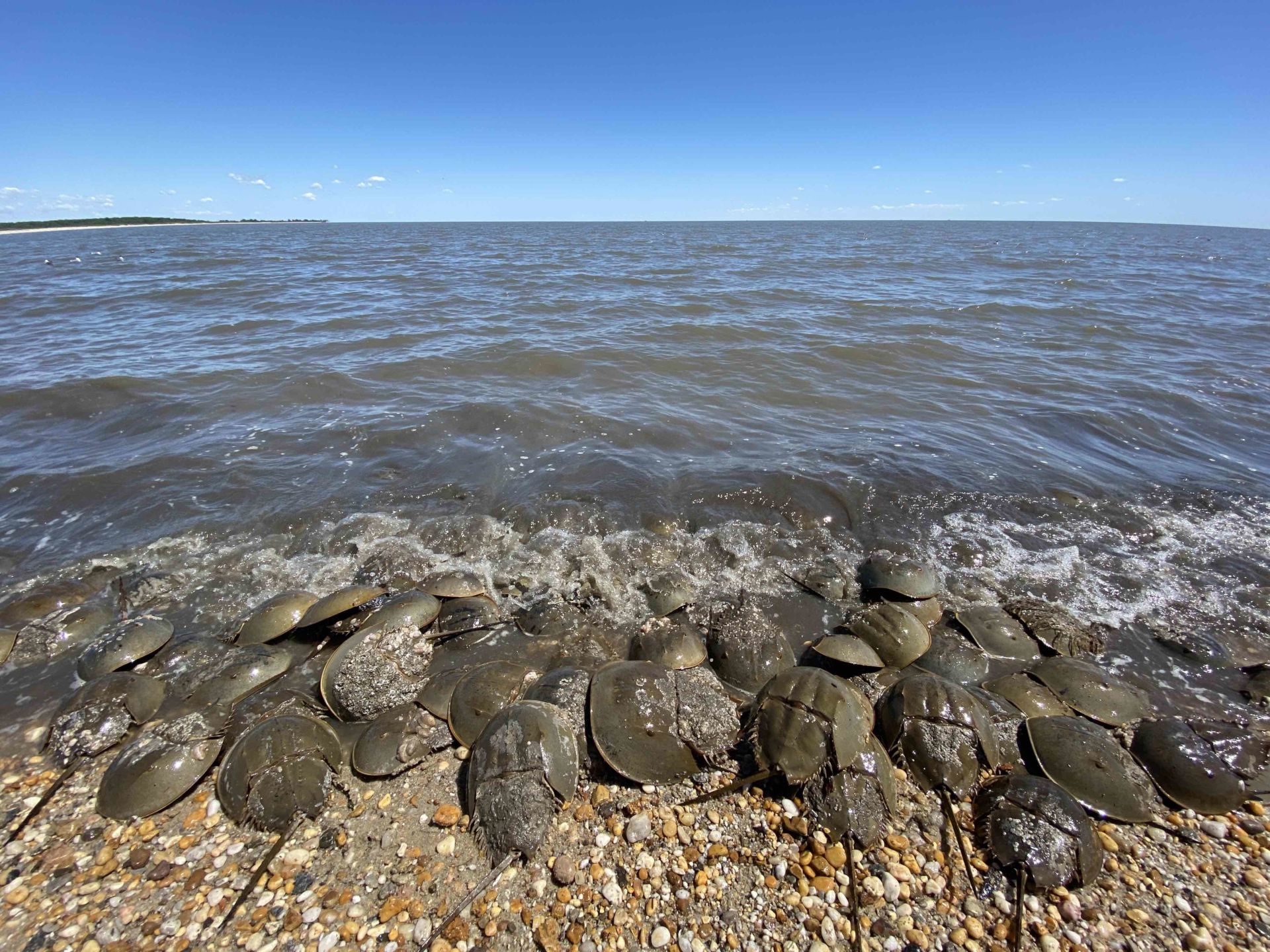
A new moon, it is almost midnight and I’m on a beach in Delaware, watching horseshoe crabs coming to the surf line to spawn. They are not actually crabs, but arachnids. Their closest biological relatives are ticks, spiders and scorpions. Their bodies flout all normal rules. They have ten eyes, or some say nine, some on their spiky tail. They look like helmets, some of their shells have crusts of barnacles or wafting wigs of seaweed.

They are my choice of ambassador for biodiversity conservation.

In the Photo: Horseshoe crabs on a Delaware beach. Photo Credit: Midori Paxton.
In the Photo: A horseshoe crab beneath the shell. Photo Credit: Midori Paxton.


The horseshoe crabs I am watching on this long Delaware beach pre-date anything I can imagine. The dinosaurs, the Himalayas, the Andes, religions and us. They have been existing on this planet for over 450 million years, and despite five mass extinctions, have not changed very much. They help millions of other living things. Their shells offer home and shelter to sponges, mussels and snails. Their eggs feed birds, fish and other marine creatures. With the massive landing of the crabs, comes the arrival of migratory birds. Red knots start in Tierra del Fuego in Argentina, fly all the way to the Arctic to breed via the crab spawning beaches of Delaware and other pit stops. They stay for one month and every minute, every egg is important. Refueled, they reach the Arctic and then they fly all the way back. Simply amazing. Bemusing nature!

I watched this event with a sense of childish excitement. It was a “wow” moment. What will happen next, I kept asking myself. And that’s what biodiversity means. It’s easy to forget it if you don’t see it; or easy to describe it in my office in official language about UNDP’s work on nature. But what I saw happening on that Delaware beach last week was ancient, present and indifferent. A horseshoe crab has its own agenda!


Related Articles: On Extinction, Food, Climate and Inequality | Biodiversity Talks: Kickstarting a Paris-style Nature Agreement?

The copper-based blue blood of horseshoe crabs stubbornly destroys bacteria. Their blood is used for testing the safety of vaccines, including COVID vaccines, as well as for assessing the safety of prosthetics, organ transplants and more. Apparently, there is no other test that can analyse the purity of medications and cleanliness of medical devices with the same accuracy as the horseshoe crab blood. Horseshoe crabs save so many lives every year, especially in this time of COVID crisis. It has very probably saved yours and mine. Horseshoe crabs “donate” 30% of their blood and get released. In South Carolina, you get a prison sentence for messing with them.

We just need to give biodiversity its space. If we do, those crabs might make another 450 million years.

I chose the horseshoe crab as my biodiversity ambassador for several reasons. One is time. They first emerged in the Ordovician Period 450 million years ago, more than 447 million years before the first human Homo habilis and 219 million years before the first ever dinosaur on Earth. My hero Sir David Attenborough and I share a birthday – May 8. He is 95 and his lament in A Life on Our Planet released last year was that so much had changed so quickly. Watching these crabs, I felt that keenly. 66% of wildlife populations have gone in my life time. In the next few decades, a million species may become extinct.

In times past, the local Delaware apple farmer paid children for a sack of horseshoes and used them for fertiliser. The crabs were forever.

While taking videos and photos on that beach, I suddenly imagined the same beach with no horseshoe crabs. If such a day becomes a reality, that would mean that we have failed. Humanity will have failed to protect biodiversity that is our lifeline and safety net. Our precious resource and source of joy, inspiration and wellbeing. We will have flicked the switch on 450 million years of survival. And when that light goes out, so do so many more.

The crabs are still coming, the birds still fly and feast, and it is not too late. We just need to give biodiversity its space. If we do, those crabs might make another 450 million years.


Editor’s Note: The opinions expressed here by Impakter.com columnists are their own, not those of Impakter.com. — In the Featured Photo: Horseshoe crabs on a beach in Delaware. Featured Photo Credit: Midori Paxton.

 

Tags: biodiversityHorseshoe CrabsInternational Day for Biological Diversity 2021UNDP
Previous Post

Are Cryptocurrencies A Sustainable Payment Solution?

Next Post

Investing in India’s Women is Crucial to Full Recovery

Related Posts

The Imperative of a Nature-Positive Future
Biodiversity

The Imperative of a Nature-Positive Future

For most of human history, survival was a gamble. Half of all children never reached puberty. Life expectancy hovered around...

byMarco Lambertini
January 16, 2026
Impakter’s Most-Read Stories of 2025
Society

Impakter’s Most-Read Stories of 2025

In 2025, as in previous years, Impakter readers turned in large numbers to stories examining climate change and pollution, environmental...

byImpakter Editorial Board
December 31, 2025
One Health: Silo Barriers to Implementation and How to Overcome Them
Biodiversity

One Health: Silo Barriers to Implementation and How to Overcome Them

The One Health concept/approach must be central for governments to adopt collaborative, cross-sector policies in order to safeguard public health,...

byOne Health Initiative
November 26, 2025
COP30: Countries’ Climate Agrifood Ambitions Undermined by Funding Gaps, Report Finds
Biodiversity

COP30: Countries’ Climate Agrifood Ambitions Undermined by Funding Gaps, Report Finds

Developing countries recognize the urgent need to adapt agrifood systems to climate change, but most National Adaptation Plans (NAPs) are...

byThe Food and Agriculture Organization of the United Nations (FAO)
November 19, 2025
The Amazon rainforest is often called “the lungs of the world.” It produces oxygen and stores billions of tons of carbon every year. The Amazon rainforest covers more than 60% of the landmass of Peru. Photo Credit: USDA Forest Service / Diego Perez.
Biodiversity

Inside COP30

The 30th United Nations Climate Change Conference (COP30) is taking place in Belém, Brazil, from November 10 to 21, 2025....

byInternational Institute for Sustainable Development (IISD)
November 10, 2025
climate change and food
Biodiversity

COP30: Climate Extremes Are Already Impacting Food Yields Today

The 30th United Nations Climate Change Conference (COP30), taking place in Belém, Brazil, brings together world leaders, scientists, non-governmental organizations, and...

byThe Food and Agriculture Organization of the United Nations (FAO)
November 7, 2025
Global Action Plan on Biodiversity and Health
Biodiversity

Global Action Plan on Biodiversity and Health: Why Implementation Can’t Wait

Last October, after six years of deliberation, the world adopted the Global Action Plan on Biodiversity and Health. The Plan...

byJessica Bridgers - Deputy CEO, World Federation for Animals
October 31, 2025
Plastic pollution coral reefs
Biodiversity

Protecting Coral Reefs From Plastic Pollution: The IUCN Congress as a Catalyst for Action and Collaboration

This week, the International Union for the Conservation of Nature (IUCN) sees its World Conservation Congress kick off in Abu...

byJanne van Eerten - Sr. Global Public Affairs Manager at The Ocean Cleanupand1 others
October 8, 2025
Next Post
Investing in India’s Women is Crucial to Full Recovery

Investing in India’s Women is Crucial to Full Recovery

Recent News

ESG News regarding EU-Mercosur deal, EU retaliatory tariffs over Trump’s Greenland bid, Bolivia to honor all contracts, and Trump losing wind farm legal battles

EU and Mercosur Sign Long-Awaited Trade Agreement

January 19, 2026
animals legal rights

From Stingless Bees to Sea Turtles: Species Around the World With Legal Rights

January 19, 2026
Sunset of the Lab Mouse Era

Sunset of the Lab Mouse Era

January 19, 2026
  • ESG News
  • Sustainable Finance
  • Business

© 2025 Impakter.com owned by Klimado GmbH

No Result
View All Result
  • Environment
    • Biodiversity
    • Climate Change
    • Circular Economy
    • Energy
  • FINANCE
    • ESG News
    • Sustainable Finance
    • Business
  • TECH
    • Start-up
    • AI & Machine Learning
    • Green Tech
  • Industry News
    • Entertainment
    • Food and Agriculture
    • Health
    • Politics & Foreign Affairs
    • Philanthropy
    • Science
    • Sport
  • Editorial Series
    • SDGs Series
    • Shape Your Future
    • Sustainable Cities
      • Copenhagen
      • San Francisco
      • Seattle
      • Sydney
  • About us
    • Company
    • Team
    • Global Leaders
    • Partners
    • Write for Impakter
    • Contact Us
    • Privacy Policy

© 2025 Impakter.com owned by Klimado GmbH