Impakter
  • Environment
    • Biodiversity
    • Climate Change
    • Circular Economy
    • Energy
  • FINANCE
    • ESG News
    • Sustainable Finance
    • Business
  • TECH
    • Start-up
    • AI & Machine Learning
    • Green Tech
  • Industry News
    • Entertainment
    • Food and Agriculture
    • Health
    • Politics & Foreign Affairs
    • Philanthropy
    • Science
    • Sport
  • Editorial Series
    • SDGs Series
    • Shape Your Future
    • Sustainable Cities
      • Copenhagen
      • San Francisco
      • Seattle
      • Sydney
  • About us
    • Company
    • Team
    • Partners
    • Write for Impakter
    • Contact Us
    • Privacy Policy
No Result
View All Result
Impakter logo
No Result
View All Result
Asteroid Bennu

NASA’s Capsule With Asteroid Bennu Sample to Return to Earth

Why the mission is important and how Brian May, lead guitarist from legendary rock band Queen, helped with the project

David BassbyDavid Bass
September 23, 2023
in Science
0

Nasa’s Osiris-Rex capsule is shortly to return to Earth carrying a vital cargo — dust samples from the asteroid Bennu that could provide scientists with important clues to the origins of the universe.

The spacecraft is set to release a capsule with material from asteroid Bennu onto the Utah desert on September 24 — arriving at speeds as fast as a bullet. Osiris stands for Origins, Spectral Interpretation, Resource Identification, Security Regolith Explorer.
Asteroid Bennu
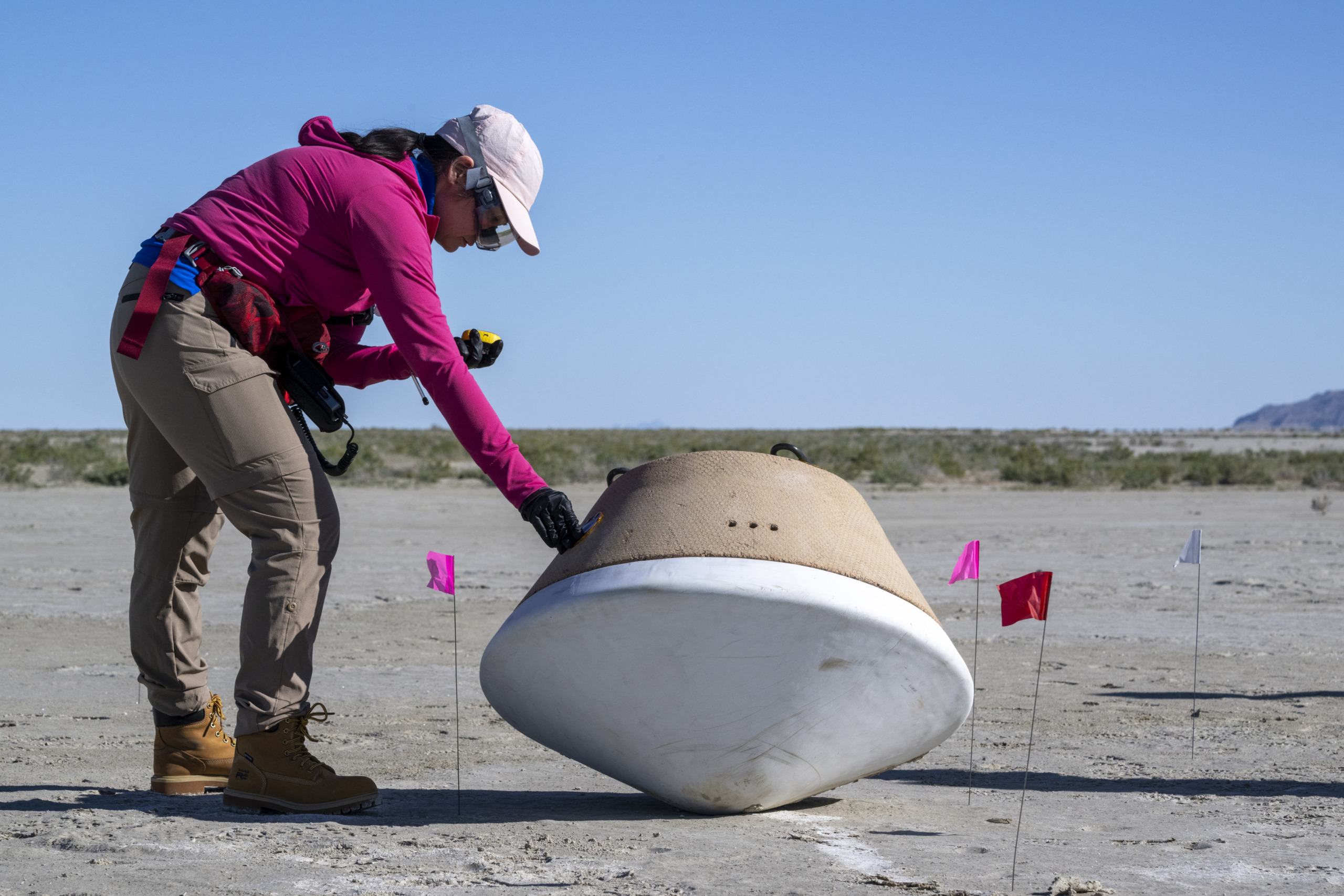
In the Photo: A recovery team member takes part in field rehearsals in preparation for the retrieval of the sample return capsule from NASA’s OSIRIS-REx mission in this image from Aug. 29, 2023. Photo Credit: NASA.

“When we get the 250g (9oz) of asteroid Bennu back on Earth, we’ll be looking at material that existed before our planet, maybe even some grains that existed before our Solar System,” says Prof Dante Lauretta, the principal investigator on the mission.

Helping with this project is Brian May, who accompanies his rockstar duties by helping out NASA.

Brian has provided his amazing ability in “stereo imaging,” where he can align two pictures of an object taken from different camera angles to give a 3D view. This image was used to plan out the best possible sites for samples on Bennu and decide the safest for the mission.

“I always say you need art as well as science,” Sir Brian told BBC News. “You need to feel the terrain to know if the spaceship is likely to fall over or if it will hit this ‘rock of doom’ that was right on the edge of the eventually chosen site, called Nightingale. If that had happened it would have been disastrous.”

Why is the mission so important?

As the dust from the asteroid could potentially be from before the formation of our solar system, the information could help scientists answer some of the most fundamental questions in science, such as how the Earth was formed and why it is habitable.

The biggest question that could be looked into with the research covers the origins of life itself — what is the source of the organic molecules that make up all life on Earth?


Related articles: Life Beyond Earth? NASA Finds Potential Signs | NASA Unveils Deepest-Ever Images of the Universe | Aliens on Mars? NASA Discovers Signs of Ancient Life

The asteroid’s contents are important because they never underwent property-changing processes as samples from other surfaces such as Mars. Osiris-Rex will arrive with an estimated 8.8 ounces or 250 grams of material, which is just over a cupful. 

The sample was originally collected by the spacecraft from Bennu on October 20, 2020. Studying it will help unlock questions about the early solar system.

Brian May – Rock Star and Astronomer

Before the legendary success of the Rock band Queen, whose memorable hits include “We Will Rock you,” “It’s a Kind of Magic” and “Bohemian Rhapsody,” their songs were used in a West End musical and at the Live Aid benefit concert in 1985 their performance was considered as one of the best in rock music history. 

Brian Harold May, a member of the band, was more than a musician: he was also an eager student of Physics, studying to be an astronomer at Imperial College London where he went on to graduate with honours in 1968.

In 2008 he returned to study being granted a Ph.D., and went on to work on projects in the field of planetary science and helping out with the Bennu mission.

These include collaborating with NASA as part of the New Horizons mission, to Pluto in 2015 and work with the Voyager Station project. 

Future work

Brian’s work on the Bennu asteroid continues in the form of a book in which he is a co-author, titled “Bennu 3D: Anatomy of an Asteroid” and that was recently published (in July 2023). This book, the world’s first complete (and stereoscopic) atlas of an asteroid, is the result of close collaboration between Brian May and Osiris-Rex mission leader Dante Lauretta. Lauretta’s colleagues include Carina Bennett, Kenneth Coles, and Cat Wolner, as well as Brian May and Claudia Manzoni, who became part of the ultimately successful effort to find a safe landing site for sampling. 

The text presents the data collected by the mission so far, and the stereo images have been meticulously created by Manzoni and May from original images collected by the Osiris-Rex cameras. 

It is expected that the book will be updated to include final findings from the Osiris-Rex mission once all the images and data collected have been analyzed. Expect to get new insights into the asteroid’s physical and chemical properties and a fascinating, potentially ground-breaking look at its potential implications for the origins of life.


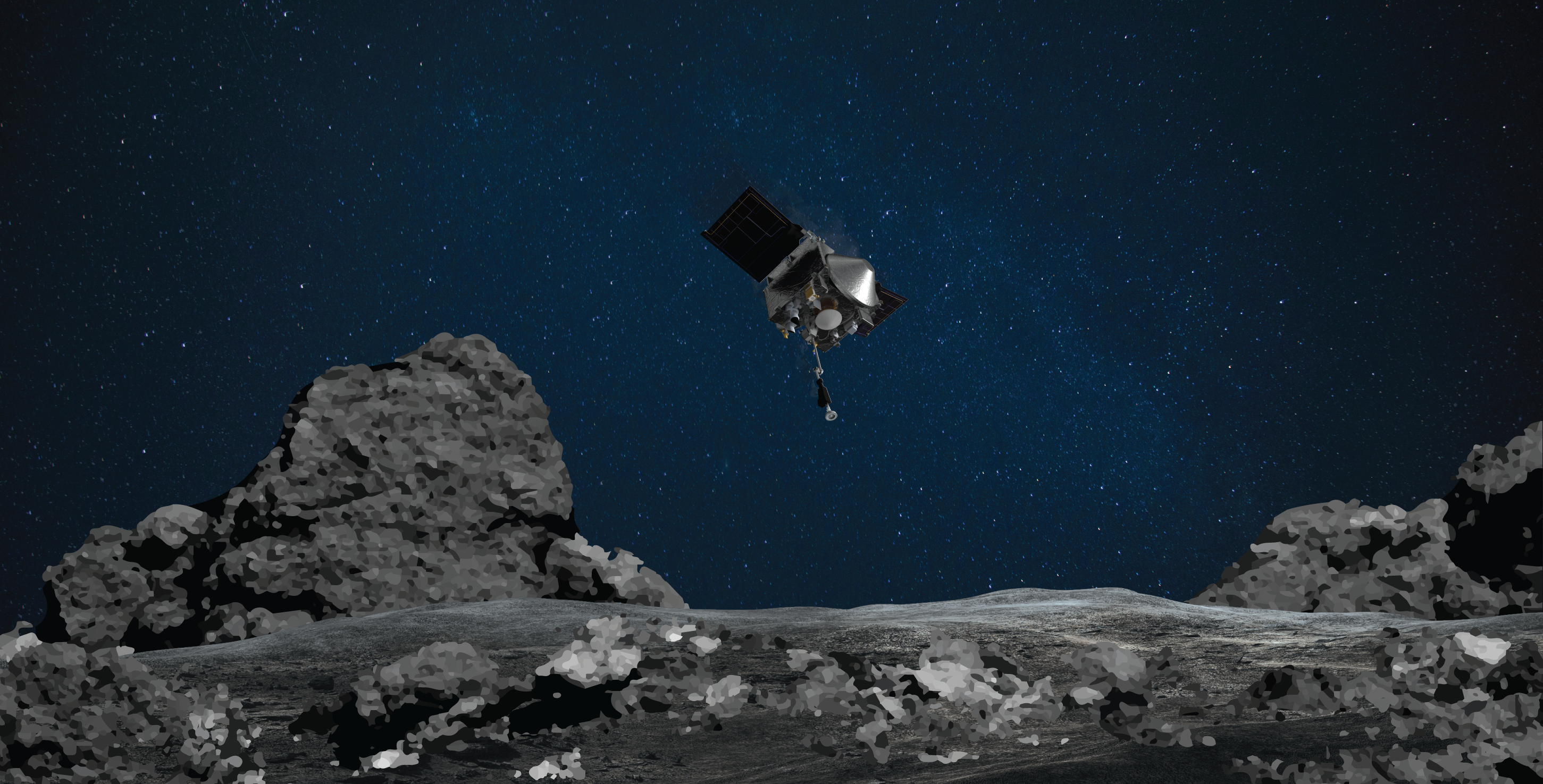
Editor’s Note: The opinions expressed here by the authors are their own, not those of Impakter.com — In the Featured Photo: NASA’s OSIRIS-REx is ready for touchdown on asteroid Bennu. Featured Photo Credit: NASA.

Tags: Asteroid BennuBrian MayNASAOsiris-Rex
Previous Post

Without Humans, Wildlife Loss Would Be 35 Times Slower

Next Post

Greenhushing: Is Silence Hindering Sustainability?

Related Posts

ESG news regarding first commercial e-methanol plant in Denmark, IFC one-hundred-million-dollar investment in electric vehicles in Mexico, EFC gas awarded five-million-dollar contract from NASA, and germany revising energy grid
Business

European Energy Opens First Large-Scale E-Methanol Plant

Today’s ESG Updates Denmark Opens E-Methanol Plant: European Energy and Mitsui launch the first commercial e-methanol plant to supply green...

bySarah Perras
May 13, 2025
methane-tracking satellite
Business

A New Era in Environmental Accountability: SpaceX Launches Methane-Tracking Satellite

SpaceX, the private aerospace company founded by Elon Musk, has launched into space nonprofit Carbon Mapper’s groundbreaking satellite aimed at...

byJacob Lee
August 23, 2024
Antarctica Sea Ice
Environment

Unravelling Antarctica’s Sea Ice Puzzle

Throughout 2023, the area of ocean around Antarctica covered by sea ice was so far below the norm that scientists...

byBenoit Legresy, CSIROand2 others
January 25, 2024
Moon landings
Science

It’s a Wonderful Year for a Moon Dance

The countdown is on for 2024, which is shaping up as the year of Moon landings. As many as 12...

byAlex Gilbert - Fellow at the Payne Institute for Public Policy at the Colorado School of Mines
December 27, 2023
NASA cat video streamed from space
Science

NASA Streams First Video From Deep Space — of a Cat

On December 11, 2023, Taters, a cat, made its broadcast debut in a 15-second video in which it chases a...

byDiana Croce
December 21, 2023
The Sky’s Not the Limit for One Health on Earth
Health

The Sky’s Not the Limit for One Health on Earth

If we can ever get a handle on the risks we face in dealing with the interface of animal, human,...

byRichard Seifman - Former World Bank Senior Health Advisor and U.S. Senior Foreign Service Officer
November 8, 2023
NASA life
Science

Life Beyond Earth? NASA Finds Potential Signs

Using the James Webb Space Telescope, NASA scientists have detected molecules containing carbon — including carbon dioxide and methane —...

byElisa Furlan
September 12, 2023
‘The World’s Most Capable Humanoid Robot’ Has Arrived
Tech

‘The World’s Most Capable Humanoid Robot’ Has Arrived

This week, the Texas-based robotics company, Apptronik, unveiled their most recent humanoid robot, “Apollo” — “the world's most capable humanoid...

byLauren Richards
August 30, 2023
Next Post
Greenhushing: Is Silence Hindering Sustainability?

Greenhushing: Is Silence Hindering Sustainability?

Recent News

ESG News regarding Tehran Dispatches Technical Team for Renewed Nuclear Dialogue; Italy Proposes Temporary Sea Entry Bans; Labour Market Slowdown in UK; India Hosts Global Tech Leaders in AI Investment Push

Iran-US Nuclear Diplomacy Returns to Geneva

February 16, 2026
AR visualization tool

Augmented Reality Preview of Your Products: Let Customers Experience Before They Buy

February 16, 2026
How an Intersectional Approach Can Help Us Address Vulnerability to Climate Change

How an Intersectional Approach Can Help Us Address Vulnerability to Climate Change

February 16, 2026
  • ESG News
  • Sustainable Finance
  • Business

© 2025 Impakter.com owned by Klimado GmbH

No Result
View All Result
  • Environment
    • Biodiversity
    • Climate Change
    • Circular Economy
    • Energy
  • FINANCE
    • ESG News
    • Sustainable Finance
    • Business
  • TECH
    • Start-up
    • AI & Machine Learning
    • Green Tech
  • Industry News
    • Entertainment
    • Food and Agriculture
    • Health
    • Politics & Foreign Affairs
    • Philanthropy
    • Science
    • Sport
  • Editorial Series
    • SDGs Series
    • Shape Your Future
    • Sustainable Cities
      • Copenhagen
      • San Francisco
      • Seattle
      • Sydney
  • About us
    • Company
    • Team
    • Partners
    • Write for Impakter
    • Contact Us
    • Privacy Policy

© 2025 Impakter.com owned by Klimado GmbH