
Impakter
  • Environment
    • Biodiversity
    • Climate Change
    • Circular Economy
    • Energy
  • FINANCE
    • ESG News
    • Sustainable Finance
    • Business
  • TECH
    • Start-up
    • AI & Machine Learning
    • Green Tech
  • Industry News
    • Entertainment
    • Food and Agriculture
    • Health
    • Politics & Foreign Affairs
    • Philanthropy
    • Science
    • Sport
  • Editorial Series
    • SDGs Series
    • Shape Your Future
    • Sustainable Cities
      • Copenhagen
      • San Francisco
      • Seattle
      • Sydney
  • About us
    • Company
    • Team
    • Global Leaders
    • Partners
    • Write for Impakter
    • Contact Us
    • Privacy Policy
No Result
View All Result
Impakter logo
No Result
View All Result
India’s Supreme Court Broadens Family Rights

India’s Supreme Court Broadens Family Rights

Same-sex parents and other “atypical” or non-traditional families in India are now eligible for the same social benefits as “traditional” families

Belinda TeohbyBelinda Teoh
September 2, 2022
in Equal Rights, Society
0

India’s Supreme Court, based in New Delhi, has widened the legal definition of a family, ruling that family benefits be extended to same-sex couples, blended families and other families the court considers “atypical.”

The decision establishes a precedent to further India’s easing of the conservative (and anti-LGBTQ+) laws from the colonial era.  

“Familial relationships may take the form of domestic, unmarried partnerships or queer relationships,” the court stated, adding that the law “must not be relied upon to disadvantage families which are different from traditional ones.”

At a time when activists are pushing for legalizing marriage for queer couples in India and providing the legitimate stamp on live-in couples, Supreme Court gave a breather with its definition of 'family' during a recent hearing.

— Shreya Mukherjee (@shreya27mukh) August 29, 2022

The case, which revolved around women’s maternity leave, ruled in favour of Ms. Deepika Singh, a nurse whose employer, a government medical institute in northern India, had rejected her request for maternity leave after she gave birth due to the fact that she had already taken time off to care for her husband’s children from a prior marriage. 

In their decision, published this week, the two-judge bench said, “[t]he concept of a ‘family’ both in the law and in society is that it consists of a single, unchanging unit with a mother and a father (who remain constant over time) and their children.”

Justice D.Y. Chandrachud wrote in the ruling that this assumption “ignores the fact that many families do not conform to this expectation,” explaining that family could be defined by various configurations of cults occupying the roles of primary caretakers with both biological and nonbiological children. 

“These manifestations of love and of families may not be typical, but they are as real as their traditional counterparts, and such atypical manifestations of the family unit are equally deserving not only of protection under law, but also of the benefits available under social welfare legislation,” Justice Chandrachud wrote.

The Supreme Court’s decision is definitive, but because of its limited enforcement powers, it is unclear how much of an immediate practical impact this ruling would actually have, especially in India’s more conservative regions. In addition, a lot of family law cases are settled outside of court. 

Nevertheless, in a nation where family matters like child custody sometimes pit unmarried parents against extended families in protracted legal fights in family court, the decision was a significant step toward equality for women and India’s LGBTQ+ population.

India’s ruling is unlike the recent ruling in Singapore, which decriminalised sex between men, but, as the policymakers made clear,  was not a step toward equal rights for LGBTQ+ people in the city-state. 


Related Articles: LGBTQ+ Rights In Europe: An Uphill Fight | Same-Sex Marriage Legalised With Resounding Majority in Switzerland

In the context of a traditional Indian family system, where several generations often live under one roof, families have the right to argue that the child is better off with the father, a right that is frequently exercised. For instance, Indian law specifies that in most cases, custody of young children should be granted to mothers. Other times, when a child’s mother works outside the house, family courts have granted custody to grandparents or other family members.

Indian family courts have received criticism from certain women’s rights advocates for being overly preoccupied with upholding the traditions of marriage and conventional nuclear families at the expense of negotiating individual rights. However, during the past ten years, the Supreme Court has slowly eroded more traditional ideas on gender, sexuality, women in the workplace, and now, family.

Parents who have children through surrogacy, adoption, or assisted reproductive technologies are not directly mentioned in the ruling. 

Dr. Ranjana Kumari, the head of the Centre for Social Research in New Delhi, said similar cases may need to be determined to establish the scope of rights of unconventional families in a nation where social realities are changing far more quickly than the legislation.

In 2014, a court ruling recognised transgender people as a third gender. In 2018, the Indian Supreme Court overturned one of the longest prohibitions on consenting gay sex and decriminalised homosexuality.
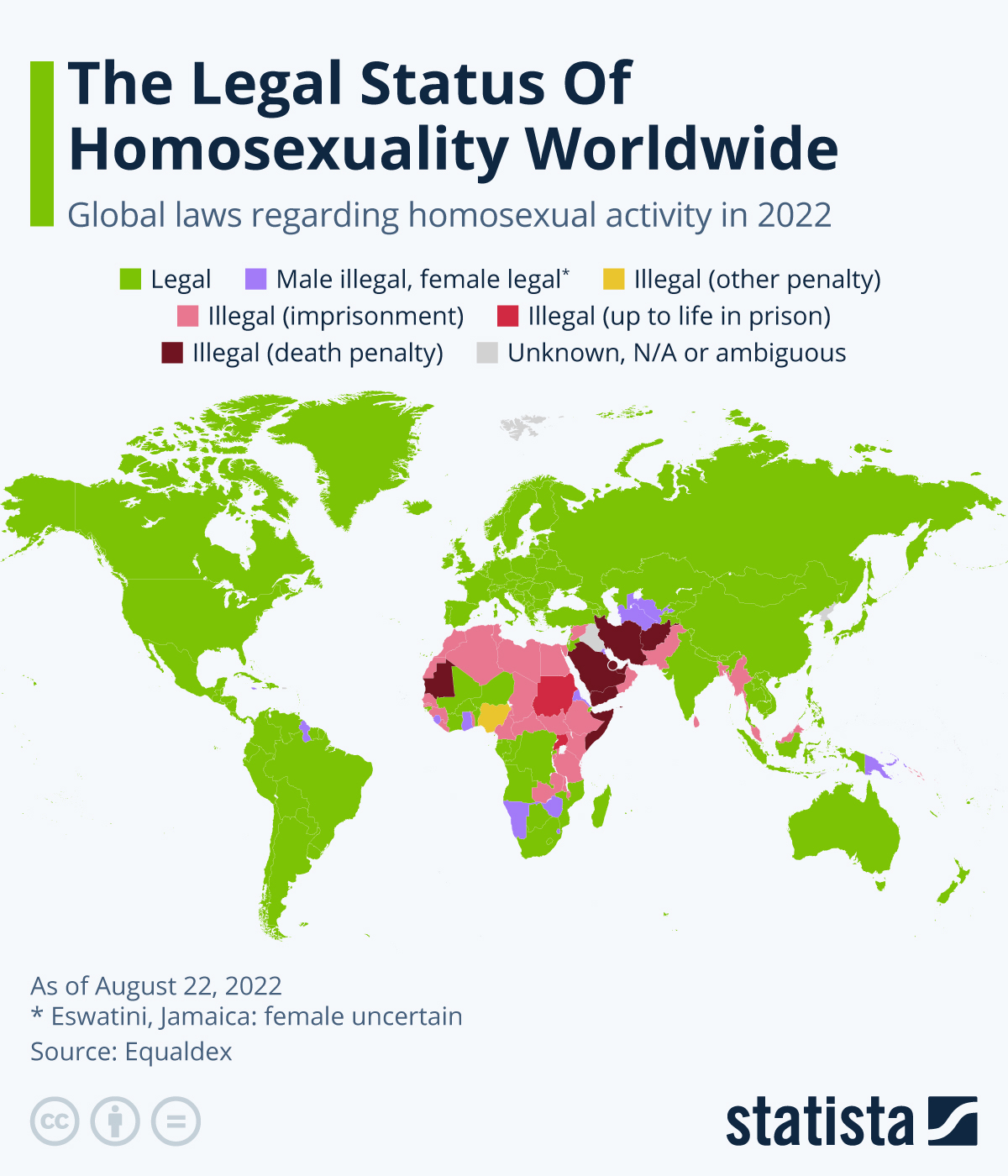
The legal status of homosexuality worldwide. Source: Katharina Buccholz/ Data Journalist/ Statista

In May this year, the court ordered the police to respect the right of women to engage in prostitution. Moreover, in September the court allowed women to enter military roles at the highest levels.

Referring to the ruling widening the definition of “family,” Ms. Anuradha Banerji, an activist with women’s rights organisation Saheli, said: “We welcome this ruling because it moves from the heterosexual ideas of the family and home that have been the bedrock of patriarchy for so long, especially for poor people.”

“This will help people not succumb to marriage because marriage is the only legally understood definition of family. So this is, I think, a very welcome change in the definition of the family.”

This effort has run into a complicated way of dealing with India’s religious diversity. In India, marriage is controlled by both a statute known as the Special Marriage Act and a series of religious regulations that belong to the colonial era and vary by faith. Both terms refer to the joining of a man and a woman in marriage. According to the Indian government, changing India’s legal structure would be necessary to make same-sex marriage legal.

“Science is changing, technology is changing. People’s relationships are changing, the whole society is undergoing social transformations. In the context of family, it needs to be recognised,” Dr. Kumari said.


Editor’s Note: The opinions expressed here by the authors are their own, not those of Impakter.com — In the Featured Photo: LGBTQ+ supporter celebrating with the pride flag. Featured Photo Credit: Indian LGBTQ Supporter/Flickr.

Tags: family rightsIndiaIndian Supreme Courtsame-sex rights
Previous Post

UN Says China’s Abuses in Xinjiang May Constitute ‘Crimes Against Humanity’

Next Post

The Threat of Atomic Catastrophe: The Saga of Europe’s Biggest Nuclear Power Plant 

Related Posts

ESG news regarding US $80 billion nuclear investment, European Ombudsman probing European Commission over transparency, India expanding solar manufacturing, and Jordan receiving $295 million from Green Climate fund for water project
Business

U.S. to Invest $80 Billion in Nuclear

Today’s ESG Updates New Nuclear Plants to be Constructed in U.S.: The Trump Administration and Westinghouse Electric Company announced an...

bySarah Perras
October 30, 2025
ESG and global news featuring the collapse of the Net-Zero Banking Alliance, India’s cancellation of rushed solar tenders, Thai industry calls for climate action, and the cement sector’s new net-zero initiative
Business

Net-Zero Banking Alliance Collapses After Wave of Member Exits

Today’s ESG Updates Net-Zero Banking Alliance Dissolves: Established in 2021 to drive banking’s climate commitments, the alliance has voted to...

byEge Can Alparslan
October 3, 2025
Intel and Nvidia partner on AI chips and datacenters, Adani Power plant operations in India, Today’s ESG Update: Australia’s 2035 Climate Target, Today’s ESG Update: Taiwan’s Banana Fibre Fabrics
Business

Nvidia to Invest $5B in Intel After Trump Administration’s 10% Stake

Today’s ESG Updates Nvidia-Intel Alliance: Nvidia will invest $5B in Intel and collaborate on AI datacenters and PC chips, after...

byAda Omar
September 19, 2025
Scientists Trace Heat Waves Back to Individual Companies
ESG FINANCE

Scientists Trace Heat Waves Back to Individual Companies

Today’s ESG Updates New Research Ties Top Emitters to Rising Heat Wave Risks: Fossil fuel and cement giants face growing...

byLena McDonough
September 11, 2025
COP30 Chief Urges CEOs to Defy Trump’s Green Backlash
Business

COP30 Chief Urges CEOs to Defy Trump’s Green Backlash

Today’s ESG Updates: COP30 Chief Calls on Private Sector: André Aranha Corrêa do Lago urges companies to attend the conference...

byLena McDonough
September 1, 2025
ESG news regarding Trump’s intel deal and government involvement in the private sector, EV production stalling in India due to rare earth shortages, a second LNG terminal to open in Germany, and French President Macron retaliates against Trump’s tariff threats
Business

Government and Private Industry: Does Trump’s Intel Deal Cross a Line?

Today’s ESG Updates: Trump’s 9.9% Stake in Intel Raises Investor Concerns: The Trump administration’s $11.1B deal with Intel is stirring...

bySarah Perras
August 28, 2025
animals personhood
Biodiversity

Should Animals Also Be ‘Persons’ in Law?

The recent Supreme Court judgment directing municipal authorities to remove stray dogs from the streets of Delhi NCR has now...

byAshima Sharma - Assistant Professor at BML Munjal University
August 27, 2025
Elon Musk’s xAI sues OpenAI and Apple over AI and smartphone monopoly claims, Marks & Spencer opens eBay store for preloved clothes with Oxfam partnership, Keurig Dr Pepper buys Peet’s Coffee owner JDE Peet’s in $18B deal, plans corporate split, India’s data centre industry expands with $6.5B in investments but faces energy and water challenges.
Business

Musk’s xAI Sues OpenAI and Apple, Alleges Conspiracy to Control AI and Smartphones

Today’s ESG Updates Musk Takes Apple and OpenAI to Court: Elon Musk’s AI startup xAI claims the companies struck an...

byAda Omar
August 26, 2025
Next Post
The Threat of Atomic Catastrophe: The Saga of Europe’s Biggest Nuclear Power Plant 

The Threat of Atomic Catastrophe: The Saga of Europe’s Biggest Nuclear Power Plant 

Recent News

Sustainable Poltrona Frau in a living room in the Tuscan country side villa

Can Design Furniture Be Sustainable? These Brands Are Rethinking Materials, Production, and Responsibility

November 17, 2025
Solar panels in China

China’s Carbon Emissions Flat or Falling for 18 Months: What’s Driving the Shift?

November 17, 2025
EU Parliament cuts corporate sustainability reporting; BlackRock relaxes ETF ESG exclusions; Aegon sets 2025 US growth targets; Google proposes adjusting EU AdTech policy.

EU Parliament Slashes Corporate Sustainability Reporting, Shaking ESG Landscape

November 17, 2025
  • ESG News
  • Sustainable Finance
  • Business

© 2025 Impakter.com owned by Klimado GmbH

No Result
View All Result
  • Environment
    • Biodiversity
    • Climate Change
    • Circular Economy
    • Energy
  • FINANCE
    • ESG News
    • Sustainable Finance
    • Business
  • TECH
    • Start-up
    • AI & Machine Learning
    • Green Tech
  • Industry News
    • Entertainment
    • Food and Agriculture
    • Health
    • Politics & Foreign Affairs
    • Philanthropy
    • Science
    • Sport
  • Editorial Series
    • SDGs Series
    • Shape Your Future
    • Sustainable Cities
      • Copenhagen
      • San Francisco
      • Seattle
      • Sydney
  • About us
    • Company
    • Team
    • Global Leaders
    • Partners
    • Write for Impakter
    • Contact Us
    • Privacy Policy

© 2025 Impakter.com owned by Klimado GmbH