India, a key player in this fight, is currently battling a confluence of climate-driven disasters. Last year’s punishing extreme heatwave, one of the earliest and most severe on record, scorched vast swathes of the subcontinent. Simultaneously, the recent, unprecedented floods in Punjab, India’s essential “food bowl,” have submerged huge tracts of farmland, destroying crops and jeopardizing the nation’s food security.
A new global assessment done by the UN now identifies India as one of the world’s largest methane emitters, driven largely by agriculture, crop-residue burning and overflowing dumpsites adding fuel to an already accelerating crisis.
This is the grim reality of climate change — extreme heat and flooding directly cause massive food loss at the farm gate, which in turn intensifies the climate threat when it rots in landfills.
Food rotting in landfills releases methane, a Short-Lived Climate Pollutant (SLCP) that is up to 86 times more potent than carbon dioxide over 20 years.
India is caught in a disastrous loop, where its colossal food waste problem is both a symptom and a significant accelerator of the climate crisis.
We are, quite literally, feeding our garbage dumps instead of our people, creating a downward spiral where wasted food heats the planet, and a hotter planet struggles to grow food.
Paradox of hunger and food waste in India
The United Nation’s latest report, The State of Food Security and Nutrition in the World 2025, states a fundamental, painful truth: millions are malnourished because safe, nutritious food is often not affordable. This global paradox finds its sharpest echo in India. While we strive for food self-sufficiency, we rank a serious 105th out of 127 countries on the 2024 Global Hunger Index. Our failure isn’t a lack of food, but a monumental crisis of waste.
The numbers are staggering. The average Indian household discards 55 kg of food annually, totalling a national loss of 78.2 million tonnes, valued at a crippling ₹92,000 crores. This waste is more than an economic failure; it’s an environmental time bomb.
Supply chain of neglect
An estimated 30-40% of total food production gets wasted, amounting to a loss of Rs. 2 lakh crore per annum, and this happens at various points along the supply chain:
The “First-Mile” Crisis (Farm): The journey of neglect begins here. Up to 16% of fruits and vegetables wilt in fields due to a critical lack of affordable cold storage and refrigerated transport. Small farmers are forced into distress sales to avoid total loss, a situation exacerbated by climate-driven crop damage from extreme weather events like the recent Punjab floods.
The “Middle-Mile” Chaos (Logistics): Produce that survives the farm hurdle faces an inefficient logistics network. Further wastage occurs due to poor infrastructure and, notably, “cosmetic filtering” — the arbitrary rejection of perfectly good produce by supermarkets for superficial blemishes.
The “Last-Mile” Disconnect (Consumption): In urban India, a growing detachment from food’s origins leads to profligate consumption. Enormous amounts of food from homes and lavish social events end up in landfills, where they are a primary source of the harmful methane emissions.
Current national food security policies like the National Food Security Act and the PM Garib Kalyan Anna Yojana, while successful in distributing staples like rice and wheat, have a blind spot: they largely overlook the colossal quantities of perishable, nutrient-rich fruits, vegetables, and dairy products. These are the very items essential for fighting malnutrition and yet, tragically, remain undistributed.
Related Articles
Here is a list of articles selected by our Editorial Board that have gained significant interest from the public:
Strategic imperatives for a resilient India
Tackling food waste is a dual imperative: it can simultaneously enhance food security and build national climate resilience by curbing potent greenhouse gas emissions. This demands a multi-pronged, policy-driven response.
While the Food Safety and Standards Authority of India (FSSAI) has published regulations for surplus food distribution, they don’t fully shield businesses from potential lawsuits under the broader Food Safety and Standards Act, 2006. This fear of litigation deters many restaurants and supermarkets from donating. A nationwide “Good Samaritan Law” is critical to protect donors from liability, empowering a robust food-rescue ecosystem.
Fragmented supply chains demand urgent, mission-mode investment. A dedicated national initiative must establish farm-level pack-houses, refrigerated transport, and modern storage facilities. This infrastructure will not only slash food wastage and curb harmful methane emissions but also provide a massive boost to farmer incomes, a triple win for the economy, environment, and society.
The final policy response must be to strictly enforce the Solid Waste Management Rules, requiring bulk generators to segregate and divert organic waste from landfills. Simultaneously, the government must act as the anchor customer for this diverted waste.
Schemes like SATAT (Sustainable Alternative Towards Affordable Transportation) can guarantee the purchase of Bio-CNG produced from organic waste. This creates the necessary market demand, as successfully demonstrated by Indore’s pioneering Bio-CNG plant under the GOBAR-Dhan scheme, which is already generating 77,400 km/day of equivalent transport fuel that is being produced for 430 buses.
Tackling food waste is not merely waste management; it is a strategic climate and food security imperative for a nourished and resilient India. The path to achieving our climate goals and feeding our population begins on our farms and ends with responsible consumption.
** **
This article was originally published under Creative Commons by 360info™.
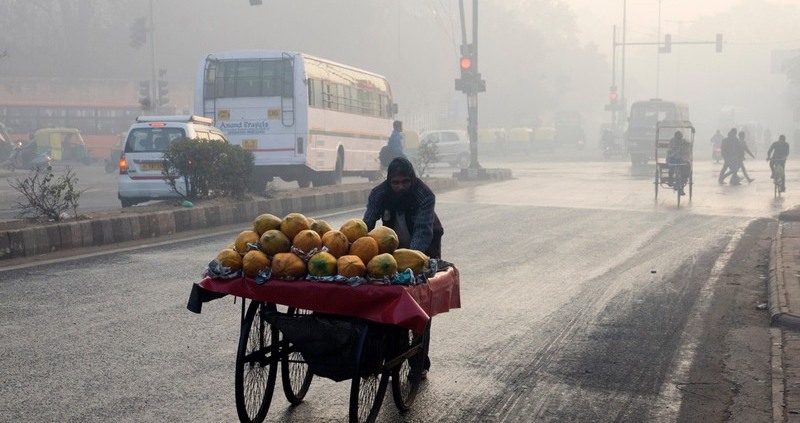
Editor’s Note: The opinions expressed here by the authors are their own, not those of impakter.com — Cover Photo Credit: A fruit seller pushes his cart along in the haze filled mornings in New Delhi, India, January 2016. Cover Photo Credit: © Subrata Biswas / Greenpeace.