
Impakter
  • Environment
    • Biodiversity
    • Climate Change
    • Circular Economy
    • Energy
  • FINANCE
    • ESG News
    • Sustainable Finance
    • Business
  • TECH
    • Start-up
    • AI & Machine Learning
    • Green Tech
  • Industry News
    • Entertainment
    • Food and Agriculture
    • Health
    • Politics & Foreign Affairs
    • Philanthropy
    • Science
    • Sport
  • Editorial Series
    • SDGs Series
    • Shape Your Future
    • Sustainable Cities
      • Copenhagen
      • San Francisco
      • Seattle
      • Sydney
  • About us
    • Company
    • Team
    • Partners
    • Write for Impakter
    • Contact Us
    • Privacy Policy
No Result
View All Result
Impakter logo
No Result
View All Result
end Hunger

How Big Companies Can Help End Hunger

International Institute for Sustainable Development (IISD)byInternational Institute for Sustainable Development (IISD)
June 17, 2021
in Environment, Food, Food and Agriculture, Philanthropy
0

The number of people who go to bed hungry was rising steadily prior to the COVID-19 pandemic due to stresses related to climate, inequality and conflict, and now stands at 690 million. The pandemic has supercharged these trends. The latest UN estimates are sobering, with an additional 130 million projected to be suffering from hunger, even before the devastating pandemic numbers we are currently seeing from India and Brazil.

Worse, official development assistance (ODA) efforts in agriculture and food security have not coped with the increasing challenges. Between 2008 and 2018, their share in total ODA grants decreased from 9% to 8%. By neglecting the root cause of hunger, the global community has had to increase their spending on emergency food aid (which rose by 25% over the same period). What’s more, no African country is on track to meet the commitment to allocate at least 10% of annual public expenditure to agriculture.

But as the ground-breaking Ceres2030 studies—backed up by another study by German organizations, the PARI Report—show, this situation can be turned around. With USD 33 billion in additional annual spending, we can reduce the number of hungry people from 690 million today to 170 million by 2030. Not quite the end of hunger, but a reduction in the percentage of people that are hungry from 9% today to 3% in 2030.
Hunger
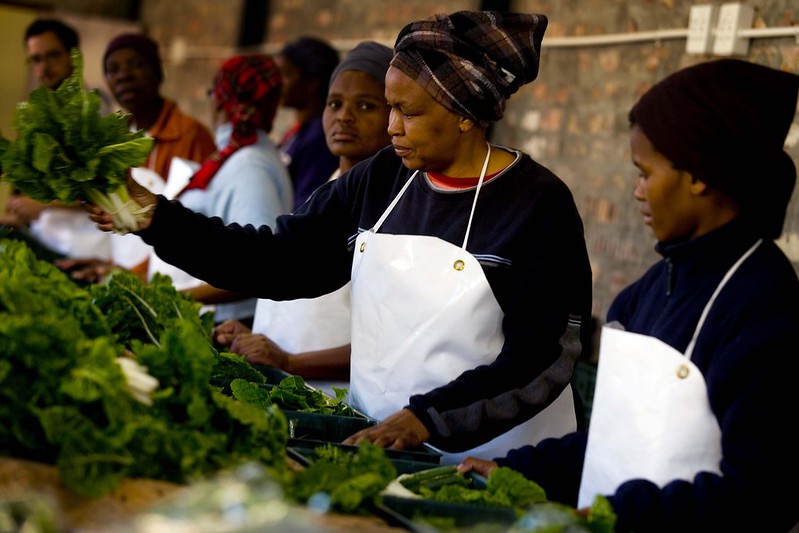
In The Photo: Women pack boxes of fresh vegetables in Guguletu, Cape Town, South Africa. They are part of the Abalimi Bezehkaya project that teaches people better farming techniques and sells fresh produce weekly to generate incomes for the farmers involved. Photo Credit: Kate Holt / Africa Practice

Most of this additional money will come from governments, which must step up their commitments to the fight against hunger—but they are under pressure from the pandemic and the associated economic downturn. Large companies can and should step in as well to play a catalytic role in this effort. So far, the private sector has been waiting and watching.


Related Articles: The Impacts of Climate Change on the Livestock Food Supply Chain  | Global Youth Start Movement to End Hunger and Transform Agri-Food Systems

Now we need visionary companies to step up and join us. While many businesses have suffered in the past 12 months, others have prospered and are in a strong position to support ending hunger by 2030. For example, the NASDAQ has risen in value by 64% in the past year and the S&P 500 by 49%.

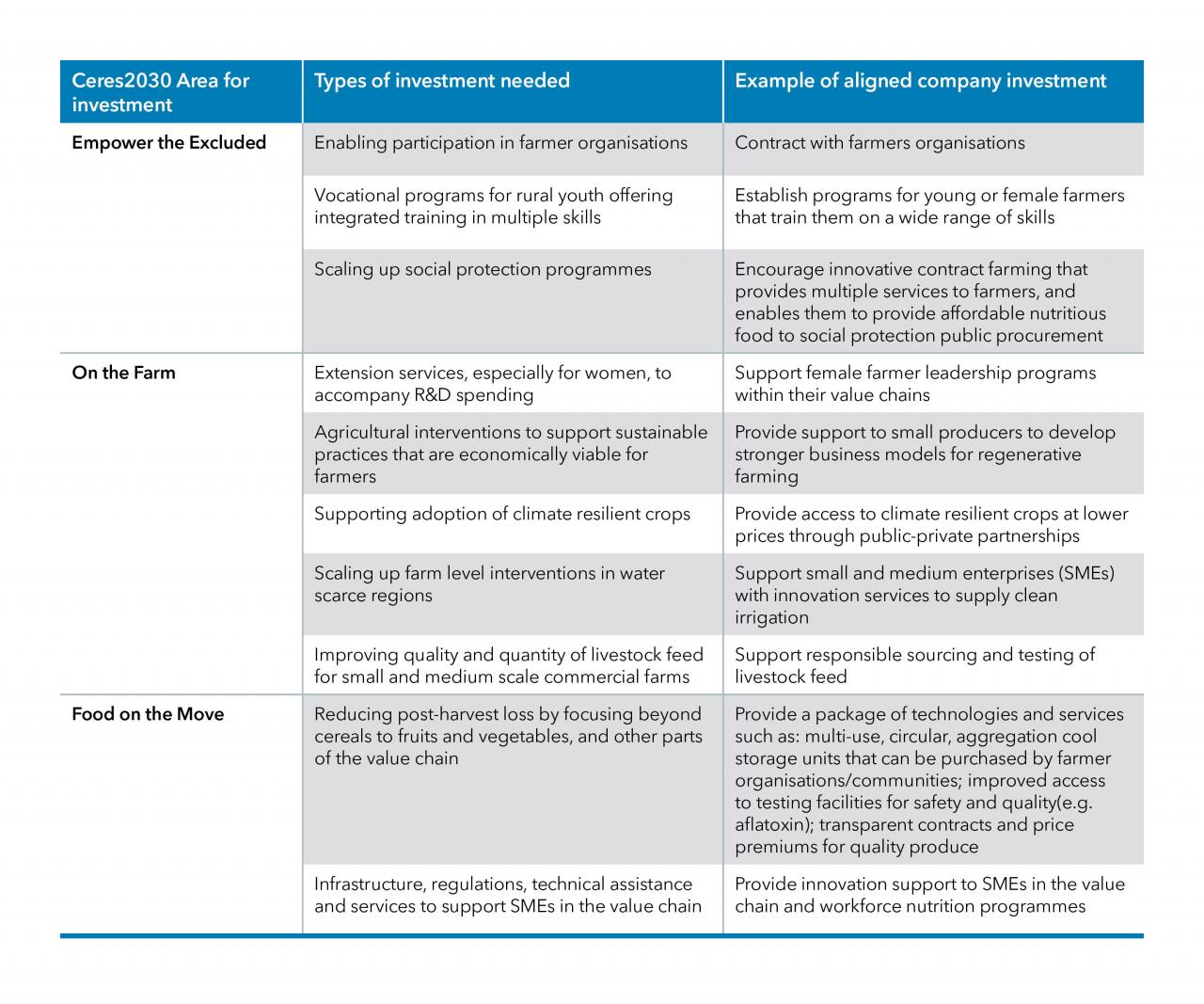
Companies will be able to signal their support by signing the End Hunger, Nourish the Future Pledge to align company investment and spending more strongly with the 10 high-impact investment areas outlined by Ceres2030 below.
2021 hunger

The End Hunger, Nourish the Future Pledge is being developed by colleagues at the International Institute for Sustainable Development (IISD), IFPRI, the Global Alliance for Improved Nutrition (GAIN), Grow Africa, and Grow Asia, working with business associations, member states, donors and others in the context of the upcoming UN Food Systems Summit.

The action outlined by Ceres2030 takes place across three broad areas: Investments to empower the excluded (for example: strengthen farmer organizations, education for rural youth, social protection); investments on the farm (for example farm extension, irrigation, finance, infrastructure, R&D, production subsidies); and investments for food on the move (for example infrastructure and technical assistance to help small and medium enterprises, investment in storage and sustainable energy and cold chains).

Business participation would be highly catalytic, helping us to arrive at the additional $33 billion investment faster, which will spur an extra $52 billion in local private investment per year. The investments would also double the incomes of 545 million food producers and their families, and help limit greenhouse gas emissions for agriculture to the commitments agreed upon in the Paris Climate Agreement.

The investments would double the incomes of 545 million food producers and their families, and help limit GHG emissions.

Investments at this level would also be a boon for the businesses themselves—helping to expand the very markets that have the most growth potential for many companies while also building important relationships with value chain actors and strengthening supply assurance.

Pledging will help them to attract top talent among young, skilled professionals who have consistently expressed a desire to join companies that have a higher sense of purpose; and can boost companies’ environmental, social, and governance (ESG) profiles, which are becoming more important to the investment community.

Here is a chance for companies to give their words action: To stimulate local private sector investment. To help new markets flourish. To build new trusting relationships with value chain actors. To give their own employees a higher sense of purpose. To be the final spark for the final effort to end the obscenity of hunger. To be the, perhaps unlikely champions that end hunger — for good.

— —

About the author: Lawrence Haddad is Executive Director of the Global Alliance for Improved Nutrition (GAIN); Carin Smaller is Director of Agriculture, Trade, and Investment at IISD.


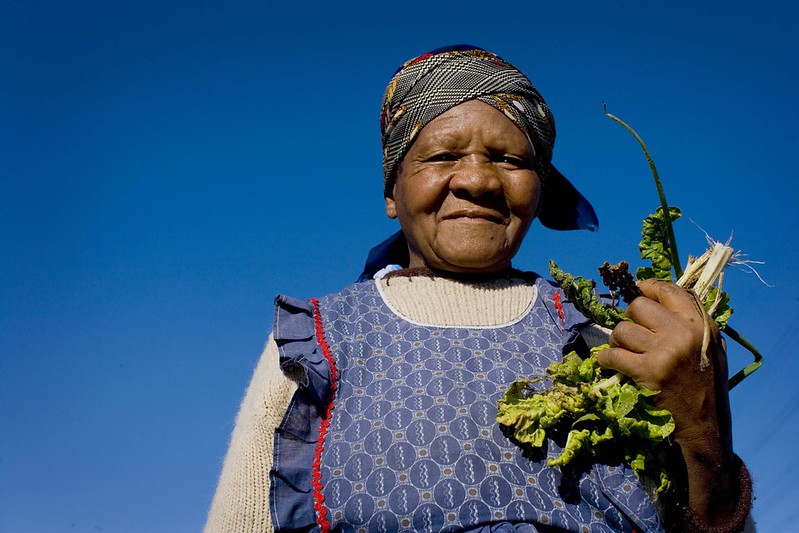
Editor’s Note: The opinions expressed here by Impakter.com columnists are their own, not those of Impakter.com.— In the Featured Photo: A woman holds up some of the vegetables she has grown in a garden in Cape Town, South Africa, made possible through the Albalami Bezehkaya voluntary association, supported with funding from Australia. Featured Photo Credit: Kate Holt / Africa Practice
Tags: Action Against HungerCeres2030Emergency food aidEnd Hunger Nourish the Future PledgeFood security
Previous Post

Generation Equality: Youth Champions For Change

Next Post

Why US Investment in Central America Should Focus on Small Businesses

Related Posts

Transboundary Animal Diseases Pose Urgent Threat to Global Food Security
Biodiversity

Transboundary Animal Diseases Pose Urgent Threat to Global Food Security

The Director-General of the Food and Agriculture Organization of the United Nations (FAO), QU Dongyu, urged Member Countries to reinforce...

byThe Food and Agriculture Organization of the United Nations (FAO)
December 1, 2025
Animal Health
Biodiversity

Better Animal Health Is the Low-Risk, High-Reward Climate Investment We Need

Imagine if there was a way to reduce emissions from the meat, egg and dairy sector by nearly a quarter,...

byCarel du Marchie Sarvaas
November 26, 2025
World Restoration Flagships
Food and Agriculture

Healthy Nature for Better Food Systems: UN Awards New World Restoration Flagships

The United Nations (UN) has named four new World Restoration Flagships under the UN Decade on Ecosystem Restoration. Recognizing global efforts...

byThe Food and Agriculture Organization of the United Nations (FAO)
October 16, 2025
Bee populations
Environment

Bee Populations Are Declining Faster Than Ever Before

The phrase "the birds and the bees" is a story many parents tell their children to deflect the question, "where...

byRichard Seifman - Former World Bank Senior Health Advisor and U.S. Senior Foreign Service Officer
April 1, 2025
Food Gaza
Food and Agriculture

Restricted Local Food Production Exacerbates the Humanitarian Crisis in the Gaza Strip

Mohamed El Yaty recalls the time before 7 October with longing and sorrow. “We used to wake up at 6...

byThe Food and Agriculture Organization of the United Nations (FAO)
August 9, 2024
Africa native foods
Food and Agriculture

Savouring Heritage Through Forgotten Foods

Africa's culinary landscape is a rich tapestry of biodiversity and tradition, holding beneath its vibrant surface a treasure trove of...

byThe Food and Agriculture Organization of the United Nations (FAO)
July 30, 2024
One Health
Health

One Health: Urgent Message to the G7 and G20

This month, on June 11, the Rockefeller Foundation made public its report, "One World, One Health. A Strategic Vision for...

byClaude Forthomme - Senior Editorand1 others
June 17, 2024
acute hunger
Food and Agriculture

Acute Hunger: 1 in 5 People in Need of Critical Urgent Action

According to the latest Global Report on Food Crises (GRFC), nearly 282 million people in 59 countries and territories experienced high...

byThe Food and Agriculture Organization of the United Nations (FAO)
April 24, 2024
Next Post
Why US Investment in Central America Should Focus on Small Businesses

Why US Investment in Central America Should Focus on Small Businesses

Recent News

A woman going through the checking account guide

How Checking Accounts Work: Simple Steps to Get Started Fast

February 20, 2026
Coal plants get reprieve on mercury limits, Striking unions fail to halt Milei's sweeping labor bill, Sweden's regulator reviews Swedbank's compliance controls, France backs INEOS decarbonization with €300M

Trump Admin Weakens Coal Plant Mercury Regulations

February 20, 2026
Crowds and filmmakers on the red carpet at the 76th Berlin International Film Festival in 2026

At Berlinale 2026, Artists Refuse the Comfort of Neutrality

February 20, 2026
  • ESG News
  • Sustainable Finance
  • Business

© 2025 Impakter.com owned by Klimado GmbH

No Result
View All Result
  • Environment
    • Biodiversity
    • Climate Change
    • Circular Economy
    • Energy
  • FINANCE
    • ESG News
    • Sustainable Finance
    • Business
  • TECH
    • Start-up
    • AI & Machine Learning
    • Green Tech
  • Industry News
    • Entertainment
    • Food and Agriculture
    • Health
    • Politics & Foreign Affairs
    • Philanthropy
    • Science
    • Sport
  • Editorial Series
    • SDGs Series
    • Shape Your Future
    • Sustainable Cities
      • Copenhagen
      • San Francisco
      • Seattle
      • Sydney
  • About us
    • Company
    • Team
    • Partners
    • Write for Impakter
    • Contact Us
    • Privacy Policy

© 2025 Impakter.com owned by Klimado GmbH