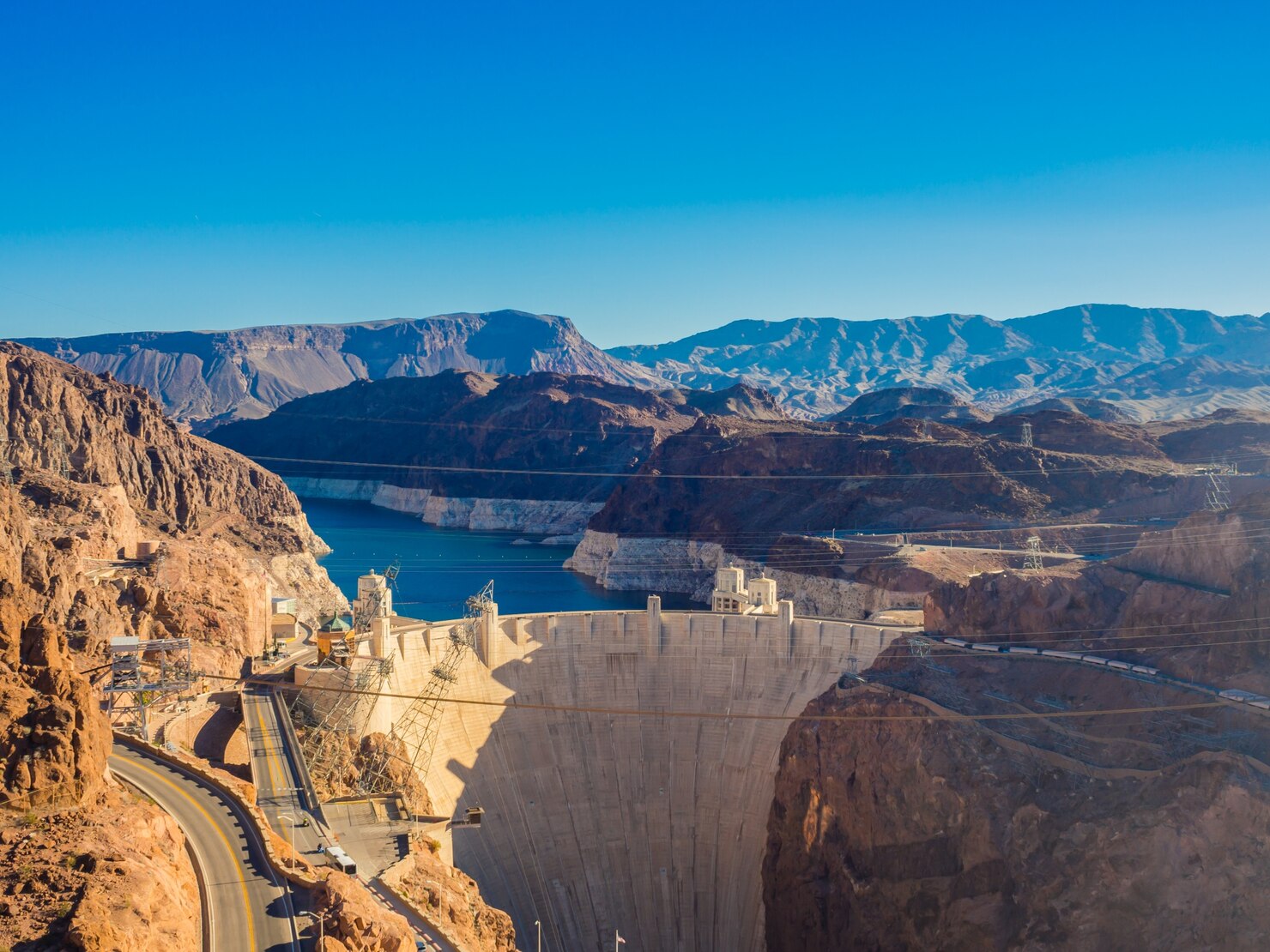
“High hazard potential” sounds like a diagnosis. It is not. FEMA defines the term precisely, and the definition has nothing to do with a dam’s current condition. A structure earns the label if its failure or mis-operation would probably cause loss of human life. That is the entire criterion, and FEMA’s own guidelines make the distinction explicit. The hazard classification “does not reflect in any way on the current condition of the dam (e.g., safety, structural integrity, flood routing capacity).” A dam in excellent repair and one crumbling toward collapse can carry the identical rating.
The distinction matters because the label is often the only thing the public ever sees. The National Inventory of Dams, maintained by the U.S. Army Corps of Engineers, documents nearly every known dam in the country and now counts about 92,000 structures with an average age of over sixty years. Its data is public, and federal records like it are republished in more usable form. ZipCheckup compiles federal environmental and safety records, including EPA and FEMA data, by ZIP code. What the hazard label omits is the harder question: how many of those high-hazard dams are deteriorating, and how would anyone know.
What the ratings actually say
Condition assessments exist to answer that question. Working from National Inventory of Dams figures current to January 2023, the Congressional Research Service found that among the 13,669 non-federal dams then classified as high hazard potential, 61 percent were rated satisfactory or fair. Another 15 percent were rated poor or unsatisfactory, and 24 percent had no condition rating at all. In raw counts, CRS puts the totals at 4,515 satisfactory, 3,881 fair, 1,758 poor, 251 unsatisfactory, and 3,265 not rated. The category behind that “unknown” share has an official definition. CRS’s Not Rated means a dam “has not been inspected, is not required to be inspected, or has been inspected but not rated.”
Nearly a quarter of the country’s non-federal high-hazard dams carry no assessment at all. That is a larger share than the dams rated poor and unsatisfactory combined. A dam with no rating has not been cleared. It has not been checked. The American Society of Civil Engineers, drawing on more recent inventory figures from August 2024, finds a similar pattern at a larger scale, with more than 16,700 dams nationwide now carrying the high hazard classification. Approximately 15 percent of them, or more than 2,500 dams, sit in poor or unsatisfactory condition. That share matches the earlier CRS count even as the recognized high-hazard inventory grew by thousands of dams. The inventory’s own bookkeeping is not always consistent either. FEMA’s page on the national inventory reports 92,075 dams at an average age of 61 years in its text, and 91,494 dams at an average age of 59 years in the infographic on the same page. The headline counts shift depending on where in the federal record a reader looks.
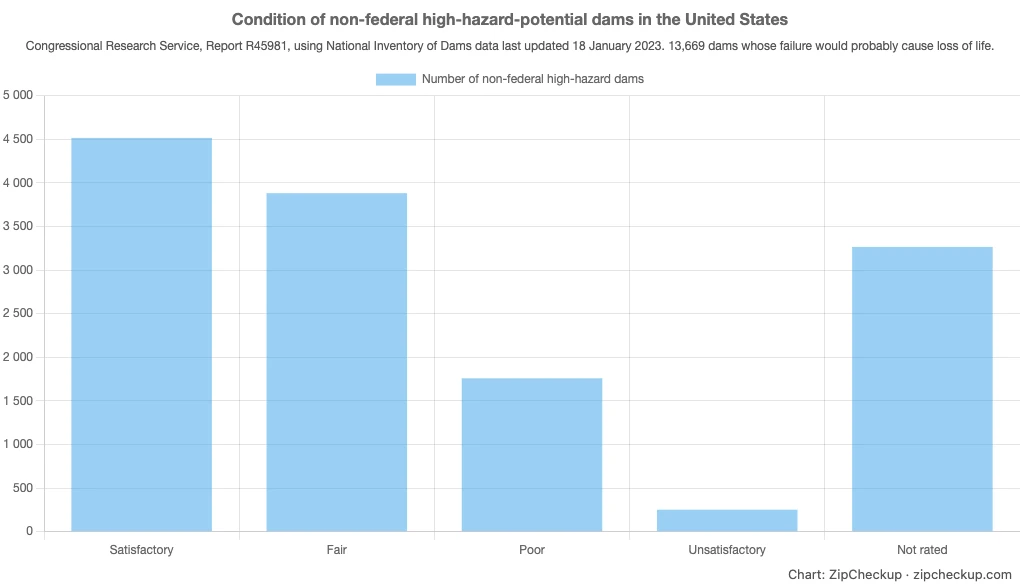
Source: Congressional Research Service, “Dam Safety Overview and the Federal Role,” Report R45981, using National Inventory of Dams data current as of January 2023.
The plan that is missing
A condition rating is not the only gap. An emergency action plan, or EAP, tells a community what to do if a dam does fail. CRS describes it as “a formal document that identifies potential emergency conditions at a dam and specifies preplanned actions to minimize property damage and loss of life.” EAPs also include inundation maps showing where floodwater would travel. ASCE reports that as of 2024 roughly 82 percent of the high-hazard dams regulated by states had one, a figure it describes as “about equal to 2021.” That leaves close to one in five without a plan, and the share has not moved in three years.
The Edenville and Sanford dams in central Michigan show what an EAP can do when it works. Both failed on May 19, 2020, after days of rain, yet no one died. Officials made “a cautious decision… to evacuate about 10,000 people” roughly eighteen hours before either structure gave way. The dam-safety group ASDSO credits that decision with saving an estimated 10 to 20 lives. The plan did not stop the failure. It stopped the failure from becoming a tragedy.
Built for a rainfall that no longer applies
Age compounds the uncertainty. The nation’s dams average over sixty years old, and ASCE puts the figure at 64, with seven of every ten older than 50 years. Structures built decades ago were engineered to the storm data available at the time, and that data has not kept pace with the storms now arriving. CRS is precise about where the gap sits: national probable maximum precipitation, or PMP, studies “have long been used for regulation and design of infrastructure, including dams.” The federal government “has not updated PMP studies or methodologies to capture precipitation patterns and events of recent decades and the potential impacts of climate change,” CRS finds. NOAA developed its original PMP methods in the 1940s and applied them nationally through the late twentieth century. Dam safety officials and engineers have since petitioned for updated tools, and, per CRS, “NOAA has not officially updated these studies or methodologies.”
The Rapidan Dam in Minnesota shows the practical version of the same gap. Its west abutment partially failed on June 24, 2024, after flows peaked at 34,800 cubic feet per second, which the Associated Press reported as the second-largest flood in the dam’s recorded history. An assessment recorded in the National Inventory of Dams in April 2023 had already rated the structure poor. Minnesota Governor Tim Walz put it plainly at the time: “The structural integrity of the dam has been in question for a long time.”
Eleven million against thirty-seven billion
Fixing what inspections do find is a separate, larger problem, and money is where the mismatch is starkest. The Association of State Dam Safety Officials estimates that repairing the nation’s non-federal dams would cost $165.2 billion in total. Of that sum, $37.4 billion is needed specifically for non-federal, high hazard potential dams, according to the ASCE 2025 Infrastructure Report Card. Against that backdrop, FEMA’s flagship rehabilitation program for high-hazard dams is authorized to spend up to $60 million a year. For fiscal year 2026, FEMA announced it would offer $11.4 million. That is a fifth of its own authorized ceiling, and three hundredths of one percent of the estimated need. Congress did inject $800 million into dam safety programs through the Infrastructure Investment and Jobs Act in 2021, a one-time boost not repeated since. The sequence is a familiar one in climate adaptation: a hazard is formally recognized, and the money to act on it is not appropriated. Impakter’s reporting on “The Cities Where Heat Has No Budget” documents the same gap in municipal heat planning.
Part of why the bill falls to so many different owners is structural. Of the roughly 91,000 to 92,000 dams in the national inventory, CRS counts 2,825 as federally owned. That is about 3 percent. The rest belong to states, local governments, utilities, and private owners. Those owners are responsible for maintenance and repair, while state agencies handle inspection, and federal dollars can supplement that system. They cannot substitute for it, not at $11.4 million a year.
What nobody counts
One number is absent from the federal record: how many people live within reach of floodwater if the nation’s high-hazard dams were to fail. No such national total exists at the Government Accountability Office, at FEMA, or within the inventory itself. The country has no baseline for how many downstream residents its planning and funding decisions are meant to protect.
Rapidan shows what happens when the missing baseline meets a dam whose condition was already known. Its poor rating was on record more than a year before the failure, and Blue Earth County officials issued an imminent threat warning before the west abutment gave way, according to the Associated Press. The condition data existed. The national accounting of who lives downstream did not, at Rapidan or anywhere else in the inventory.
The pattern across ratings, plans, standards, and funding is consistent: the problem is not missing federal data. The National Inventory of Dams knows where nearly 92,000 structures stand. Researchers can trace hazard class, condition, and emergency planning status for each one. What the country lacks is the follow-through: the inspections for the quarter still unrated, and the plans for the fifth still uncovered. It needs the money too, a $37.4 billion repair bill met so far with an $11.4 million grant. The dams are not waiting for a better definition. They are waiting for a decision about who pays to close what the data has already found.
Editor’s Note: The opinions expressed here by the authors are their own, not those of impakter.com