Impakter
  • Environment
    • Biodiversity
    • Climate Change
    • Circular Economy
    • Energy
  • FINANCE
    • ESG News
    • Sustainable Finance
    • Business
  • TECH
    • Start-up
    • AI & Machine Learning
    • Green Tech
  • Industry News
    • Entertainment
    • Food and Agriculture
    • Health
    • Politics & Foreign Affairs
    • Philanthropy
    • Science
    • Sport
  • Editorial Series
    • SDGs Series
    • Shape Your Future
    • Sustainable Cities
      • Copenhagen
      • San Francisco
      • Seattle
      • Sydney
  • About us
    • Company
    • Team
    • Global Leaders
    • Partners
    • Write for Impakter
    • Contact Us
    • Privacy Policy
No Result
View All Result
Impakter logo
No Result
View All Result
From Brazil to Cameroon, Forest Communities Fight Climate Change

From Brazil to Cameroon, Forest Communities Fight Climate Change

AshdenbyAshden
May 13, 2020
in Environment, Impact, Society, Tech
0

As the world struggles to contain the spread of coronavirus, the climate crisis still threatens us all. That’s why we need a green recovery from the pandemic – one that delivers better lives today, alongside progress towards a low-carbon future. Innovative climate solutions can help us reach both goals. That includes reliance on indigenous people and local communities to efficiently manage their resources.



Research shows that the stewarding of forested land by indigenous people and local communities offers the world greater protection from climate change than if the land is maintained by governments or businesses. But for indigenous people to survive their rights must be protected, and they must be able to earn a living. Two inspiring schemes in Brazil and Cameroon show the power of this approach.

Seeds of change

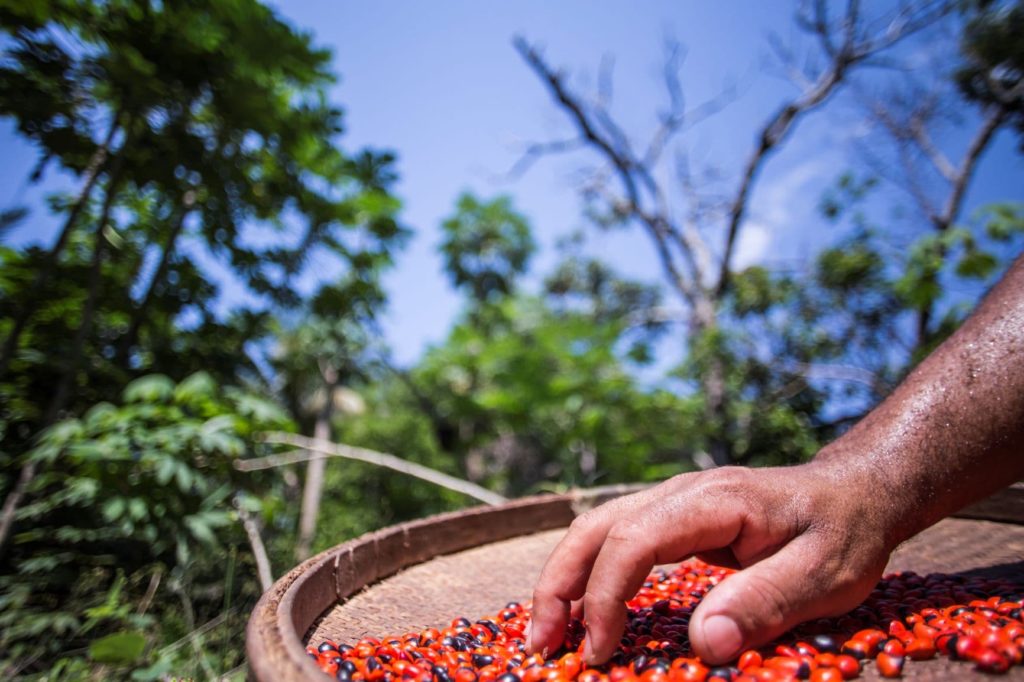
In the Amazon, seed collection is key to reforesting degraded land. Seed collection network Rede de Sementes do Xingu is playing a vital role, co-ordinating local seed collectors, administrators, and buyers in the state of Mato Grosso.

Its seeds have already boosted the recovery of more than 6,000 hectares. They are bought by landowners, including farmers and industrial companies, and planted using the Muvuca technique – which involves spreading mixed seed species. The technique makes it possible to plant up to ten times more trees per hectare and at half the cost than the more mainstream method of planting with native seedlings.

Most of the seed collectors are women, with many coming from the Yarang Women’s Movement. The Yarang are a source of pride in their village and beyond, among men and women. Chief Kampot Ikpeng says: “My daughters are collecting seeds to plant and restore what has been destroyed in our territory. We need to come together. Today we are relatives, partners, and the forest depends on us.”


RELATED ARTICLES: Shape Your Future with Harriet Lamb, CEO of Ashden |Electrifying Africa: New Research Shows Gender Focus Is Crucial |The Cubans Who Taught Us About Clean Energy |Smashing the urban myths: how clean energy builds new cities |Sustainable Energy for All: A Challenge for the Poorest Countries|

The local communities’ network also helps reduce forest fires. In 2010, in the Mid and Lower Xingu basin around 100,000 hectares were badly burned, but the scheme has reduced fires dramatically. In 2019, even with fires raging throughout the Amazon, only 1,600 hectares were lost. This is down to education and knowledge sharing between indigenous groups connected through the project – they have changed cooking methods and no longer plant trees with the most flammable sap. The scheme also allows the mapping of these important areas, with universities and other NGOs using the network’s communication channels.

This network draws on ancient knowledge, but modern technology boosts its impact – in the Amazon and beyond. The seed collectors have built a strong community and use messaging apps to share knowledge and send videos of their work. They also work with organizations like Fridays for Future and Extinction Rebellion to engage young people locally and internationally and to raise wider awareness of the need to protect the Amazon.
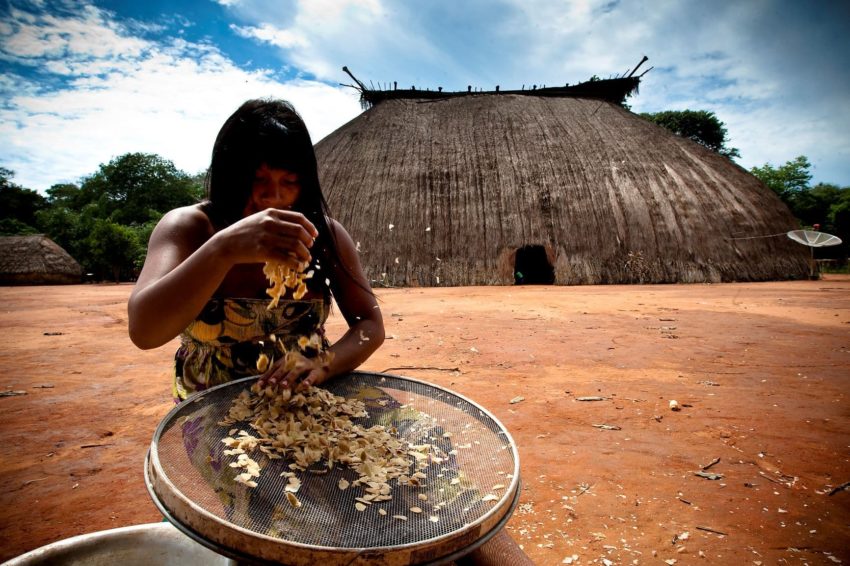
In the picture: The Xingu Project, finalist at the 2020 Ashden Awards Photo Credit: Ayrton Vignola

Holistic support helps beekeepers thrive

Slash and burn agriculture is destroying large parts of Cameroon’s rainforest. Cameroon Gender and Environment Watch (CAMGEW) has responded by helping people in the country’s Western Highlands region, particularly women, become beekeepers – a more sustainable way of earning a living. CAMGEW provides training and equipment and helps local people form co-operatives and to sell their honey and beeswax products at a fair price.

Women make up half of the CAMGEW management team. Recognizing that women in the area face many barriers to earning income, the organization offers them extra support including access to more hives and targeted microfinance and entrepreneurship programs.

In the picture: A bee near a yellow flower. Bees are in danger of extinction because of climate change. Photo Credit: Unsplash

Director Wirsiy Emmanuel Binyuy recognizes that protecting the rainforest must go hand in hand with opportunities for local communities. He said: “We did not want to just talk about policy; we wanted to do real action, and that is why we came up with the tree planting and bee farming to see how we could improve the lives of people while also protecting the environment. We had to do lobbying to make sure the [government] authorities are with us; the traditional authorities are with us; the elders in the community are with us.”

The presence of beehives in the forest reduces the incentive to clear land by starting fires and gives local communities an incentive to put out blazes started by others. There have been no serious fires since 2017, compared to seven in a single year in 2012.

The organization tries to buy supplies locally and puts local people on its posters and booklets, to reassure and reinforce credibility. Emma says: “We prefer not to use consultants, who come and go away and we never see them again.” The people benefiting include Babab Gideon Bongjo, a tailor who has been trained to make protective suits for beekeepers. He says: “I knew how to produce dresses, but I wasn’t very enlightened when it came to bee suits. Now I have been trained, and I train others. I can make a lot of money, and this is helping me and my family.”

Like Rede de Sementes do Xingu, CAMGEW’s strength flows from its close bond to the community it serves. These connections are crucial as both organizations use local skills and knowledge to tackle a global challenge.

Rede de Sementes do Xingu and CAMGEW are finalists in the natural climate solutions category at the 2020 Ashden Awards. The winner will be announced on July 2.

In the picture: The Xingu Project, finalist at the 2020 Ashden Awards. Photo Credit: Tui Anandi/ISA


Editor’s Note: The opinions expressed here by Impakter.com contributors are their own, not those of  Impakter.com

Tags: AmazonAshdenbeesCAMGEWClimate Changeindigenous peoplelocal communities
Previous Post

Data interventions and the renegotiation of the social contract

Next Post

The BCorp Tackling Fast Food with Sustainability

Related Posts

Encouraging Evidence of Momentum in Negotiations at COP30
Biodiversity

Encouraging Evidence of Momentum in Negotiations at COP30

With the second week of negotiations now underway at COP30, WWF is encouraged by an announcement by the Brazilian Presidency...

byAshden
November 18, 2025
ESG News regarding: Amazon launches projects in the US, UK, and Mexico expected to restore over 2 billion liters of water per year, Rio Tinto invests A$35m in Calix’s ‘Zesty’ green-iron demo using electric heat and hydrogen; People fish as Dukovany’s cooling towers loom; Czechia adds two new reactors after KHNP wins tender. A farmer sprays a field as France reports a small post-ban rise in insect-eating birds
Business

Amazon Launches Water Replenishment Projects Across US, UK, Mexico

Today’s ESG Updates Amazon Restores Water: New projects in the US, UK, and Mexico aim to restore over 2 billion...

byAshden
November 18, 2025
Australia’s Clean Energy Push Faces Setback for COP31
Business

Australia’s Clean Energy Push Faces Setback for COP31

Today’s ESG Updates Australia-Turkey Standoff Puts COP31 Hosting at Risk: Australia’s plan to host next year’s climate summit is delayed...

byAshden
November 13, 2025
ESG News regarding global carbon emissions, Amazon claims AI will accelerate the clean-energy transition, Australia’s opposition party states it will drop the country’s net-zero target if elected, Portugal’s utility EDP focuses its clean-energy expansion in Southeast Asia
COP30

Global Carbon Emissions Reach Record High as Planet’s Natural Sinks Falter

Today’s ESG Updates Global Carbon Emissions Hit Record High as Natural Sinks Weaken: The Global Carbon Project report intensifies the...

byAshden
November 13, 2025
Bill Gates memo
Climate Change

Climate, Gates and COP30

Bill Gates’ recent article on the “three tough truths” of the ongoing environmental changes makes an essential point: we must...

byAshden
November 12, 2025
The Amazon rainforest is often called “the lungs of the world.” It produces oxygen and stores billions of tons of carbon every year. The Amazon rainforest covers more than 60% of the landmass of Peru. Photo Credit: USDA Forest Service / Diego Perez.
Biodiversity

Inside COP30

The 30th United Nations Climate Change Conference (COP30) is taking place in Belém, Brazil, from November 10 to 21, 2025....

byAshden
November 10, 2025
ESG news regarding U.S. absence from the COP30 climate summit, Europe’s role in the U.S. absence, new euro zone loan pricing, and countries suffering from global warming speak at COP30
Business

COP30 Without the U.S.

Today’s ESG Updates Global Climate Talks Proceed Without U.S. Leadership: Lack of U.S. representatives at the UN’s COP30 talks in...

byAshden
November 10, 2025
From Caves to COP30: Comparing the Neanderthals and Modern Humans
COP30

From Caves to COP30: Comparing the Neanderthals and Modern Humans

There is much positive to be said about life in this twenty-first century; we live longer and have multiple technologies...

byAshden
November 9, 2025
Next Post
The BCorp Tackling Fast Food with Sustainability

The BCorp Tackling Fast Food with Sustainability

Recent News

ESG News regarding COP30 Declaration on Information Integrity on Climate Change, Trump’s tariff volatility, EV boom in South America, and protests at COP30

COP30 Declaration on Information Integrity on Climate Change

November 18, 2025
Business planning: engineer generating a plan

How Comprehensive Business Planning Can Drive Long-Term Sustainability

November 18, 2025
Encouraging Evidence of Momentum in Negotiations at COP30

Encouraging Evidence of Momentum in Negotiations at COP30

November 18, 2025
  • ESG News
  • Sustainable Finance
  • Business

© 2025 Impakter.com owned by Klimado GmbH

No Result
View All Result
  • Environment
    • Biodiversity
    • Climate Change
    • Circular Economy
    • Energy
  • FINANCE
    • ESG News
    • Sustainable Finance
    • Business
  • TECH
    • Start-up
    • AI & Machine Learning
    • Green Tech
  • Industry News
    • Entertainment
    • Food and Agriculture
    • Health
    • Politics & Foreign Affairs
    • Philanthropy
    • Science
    • Sport
  • Editorial Series
    • SDGs Series
    • Shape Your Future
    • Sustainable Cities
      • Copenhagen
      • San Francisco
      • Seattle
      • Sydney
  • About us
    • Company
    • Team
    • Global Leaders
    • Partners
    • Write for Impakter
    • Contact Us
    • Privacy Policy

© 2025 Impakter.com owned by Klimado GmbH