
– Exploring the effects of direct to consumer advertisements of pharmaceuticals
– Part II: Direct to consumer pharmaceutical advertisement in the United States: Is it actually toxic?
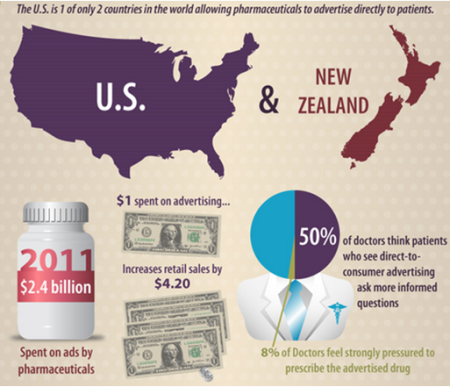 With exponential growth of Direct to consumer pharmaceutical advertisements (DTCPA), drug makers are reaching out to millions of vulnerable patients desperate for miracles. This leads us to the question whether banning DTCPA is the perfect solution? Many will argue that patient education and awareness is a big contributor to patient compliance and treatment. Big Pharma will argue that they are providing a service to consumers by spending millions on advertisements while opponents of DTCPA will argue that these only increase side effects and dependence on drugs.
DTCPA IS ACTUALLY THERAPEUTIC AND ADDS VALUE IN THE CURRENT HEALTHCARE PARADIGM

Aids patient empowerment
In the United States, emphasis has always been placed on raising consumer awareness, which is assumed to lead to consumer empowerment. The belief that consumer awareness and empowerment might be applied to pharmaceuticals and healthcare in general is often debated.
Proponents of DTPCA, usually the big pharma, argue that DTPCA provides consumers access to multiple information sources about drugs and other treatment options rather than solely relying on their healthcare practitioners. In our post-Internet era, access to these resources has been exponential and has become one of the popular sources of medical information for consumers. With almost 5 out of 10 patients utilizing free online resources to review their drug charts, this resource is exploited by big pharma. Online DTCPA, or other pharmaceutical company–sponsored Web sites, can be used to inform patients by communicating safety risks and public health information, including public and private health warnings about topics such as online drug purchasing, and adverse reactions.

Encourages patient to seek physician
Some symptoms such as minor headache or nausea, while minor enough, may be part of an underlying disease. Often, big pharma makes the point that DTCPA encourages patients to make appointments with their physicians because they suddenly realize that their minor symptoms might be symptoms for some underlying disease. An FDA consumer survey in 2004 concluded that exposure to DTCPA encouraged 27% to make appointments with their physicians to discuss their health concerns which they previously thought were minor.
Indeed, this is positive aspect of DTCPA in increasing patient interaction with their physicians as this might lead to an open dialogue about lifestyle changes that have significant impact on most of the chronic diseases and help improve preventive health, even though no drug might be prescribed. Considering that the healthcare costs are sky-rocketing and there is an urgent need to focus on preventive medicine, DTCPA advertisements might just aid in this endeavor.
DTCPA has been credited with decreasing the under-diagnosis and under-treatment of medical conditions. Drug advertisement enhances patient perceptions about conditions that could be medically treatable and encourages dialogue with health care providers. Another Harvard University/Massachusetts General Hospital/Harris Interactive study also found that 25% of patients who visited their doctor after seeing DTCPA received a new diagnosis; of these, 43% were considered to have a high-priority health condition.
Strengthens patient’s relationship with healthcare provider
Healthcare providers agree that DTCPA promotes conversation with patients, with 73% believing that consumer drug advertisement helped patients to ask more thoughtful questions and be an informed participant in the conversation with their healthcare providers. DTCPA may also benefit patients by promoting heightened awareness and detection of adverse reactions, which also may lead to a discussion with a health care provider.
There is also evidence that dialogue inspired by DTCPA doesn’t always benefit the manufacturer of the advertised drug, because physicians do not usually prescribe a medication simply because it is requested by a patient. According to a survey conducted by Prevention Magazine, of the patients who had a discussion with their doctors after seeing DTCPA, 77% reported that their doctors suggested health and lifestyle changes instead; 55% said they were prescribed a generic drug; and 51% said their doctor suggested nonprescription treatments, such as over-the-counter medicines. Studies generally agree that the patient–physician relationship is improved by participation of an informed patient in clinical decision-making.
Encourages patient compliance
Medication adherence, in particular for chronic diseases, challenges healthcare providers. It not only has a huge impact on health but also on increasing healthcare costs because, when there are poor health outcomes due to lack of compliance, physicians are forced to increase the drug dose, add other treatment regimens or, in extreme cases (such as lack of blood sugar control in diabetic patients leading to diabetic ketoacidosis), hospitalize patients.
The data consistently shows that small, but statistically significant, improvements in adherence occur among patients exposed to DTCPA. This incremental compliance is believed to be due to drug ads serving as a reminder about a patient’s medical conditions and prescriptions. DTCPA is also thought to reinforce physician recommendations and make patients more likely to follow treatment instructions.
The beneficial effect of DTCPA on patient adherence has been detected in several research studies. Considering the challenge healthcare providers face in treatment adherence and compliance, DTCPA might aid in improving the compliance which is so vital for improved health outcomes.
Encourages product competition and lower prices
DTCPA is often assumed to be a major driver of rising pharmaceutical costs; however, economic theory and evidence suggest that pharmaceutical prices are instead largely influenced by consumer, physician, and payer perceptions of product value rather than advertising costs.
Consumer drug advertisement may spur manufacturer price increases because of rising demand, but the evidence for this is mixed. Supporters of DTCPA also claim that drug advertisements stimulate increased competition, which leads to lower prescription drug prices. They argue that DTCPA also encourages early pharmacological management, resulting in cost-savings from avoiding more expensive surgical interventions.
Unfortunately, these claims are not verifiable, because data available regarding the effect of DTCPA on drug costs are limited. Further, DTCPA does not necessarily lead to prescribing branded drugs and may result in substitution with generic alternatives which are cheaper yet are essentially equally effective and safe.
Conclusion
Patients have a slightly positive view of DTCPA and physicians have a negative view. Although this may change over time; for example a recent study summarizing physician perceptions of DTCPA, found a slightly positive balance, with 24% of visits as positive, 66% neutral and 10% as negative.
The benefits of DTCPA to the patient-physician relationship in the order most often cited are: education of disease and awareness, discussion, disease detection and compliance. Overall, the effect of DTCPA on the patient-provider relationship is viewed as a positive one.
As with any story, this is just one perspective and the arguments are put forward by proponents of DTCPA. With upcoming activism and legislation towards DTCPA, it becomes critical to evaluate the toxic effects of DTCPA and why there is an urgent need for FDA to address this issue which affects millions of Americans.
Stay tuned for the next and last part of this series on direct to consumer pharmaceutical advertisement with some new insights from leading physicians and health systems.
Cover by: TaxRebate.org.uk