
Impakter
  • Environment
    • Biodiversity
    • Climate Change
    • Circular Economy
    • Energy
  • FINANCE
    • ESG News
    • Sustainable Finance
    • Business
  • TECH
    • Start-up
    • AI & Machine Learning
    • Green Tech
  • Industry News
    • Entertainment
    • Food and Agriculture
    • Health
    • Politics & Foreign Affairs
    • Philanthropy
    • Science
    • Sport
  • Editorial Series
    • SDGs Series
    • Shape Your Future
    • Sustainable Cities
      • Copenhagen
      • San Francisco
      • Seattle
      • Sydney
  • About us
    • Company
    • Team
    • Global Leaders
    • Partners
    • Write for Impakter
    • Contact Us
    • Privacy Policy
No Result
View All Result
Impakter logo
No Result
View All Result
Digital Nutrient Management Tool Reduces Emissions, Improves Crop Yields And Boosts Farmers’ Profits

Digital Nutrient Management Tool Reduces Emissions, Improves Crop Yields And Boosts Farmers’ Profits

CGIARbyCGIAR
January 27, 2021
in Food
0

New research shows that the Nutrient Expert Decision Tool is better for farmers’ fields, extension services and the environment.

An international team of scientists, led by the International Maize and Wheat Improvement Center (CIMMYT), has demonstrated how better nutrient management using digital tools, such as the Nutrient Expert decision support tool, can boost rice and wheat productivity and increase farmers’ income while reducing chemical fertilizer use and greenhouse gas emissions.

Reported today in Nature Scientific Reports, the results show how the farmer-friendly digital nutrient management tool can play a key role in fighting climate change while closing the yield gap and boosting farmers’ profits.

The researchers tested the Nutrient Expert decision tool against typical farmer fertilization practices extensively using approximately 1600 side-by side comparison trials in rice and wheat fields across the Indo-Gangetic Plains of India.

The study found that Nutrient Expert-based recommendations lowered global warming potential by 12-20% in wheat and by around 2.5% in rice, compared to conventional farmers’ fertilization practices. Over 80% of farmers were also able to increase their crop yields and incomes using the tool.


Related Articles: Playing to Achieve Sustainable Agriculture | What COVID-19 Means for Agriculture | Why Sustainable Agriculture Remains a Challenge

Agriculture is the second largest contributor of greenhouse gas emissions in India. To tackle these emissions, crop scientists have been working on new ways to make farming more nutrient- and energy-efficient. Of the many technologies available, improving nutrient-use-efficiency through balanced fertilizer application—which in turn reduces excess fertilizer application—is key to ensuring food security while at the same time contributing to the UN’s Sustainable Development Goals on climate change.

The latest study is a collaboration between scientists from CIMMYT, the Borlaug Institute for South Asia (BISA), the International Rice Research Institute (IRRI), the CGIAR Research Program on Climate Change, Agriculture and Food Security (CCAFS), the Indian Council of Agricultural Research (ICAR), the Alliance of Bioversity International and CIAT, and the former International Plant Nutrition Institute (IPNI).
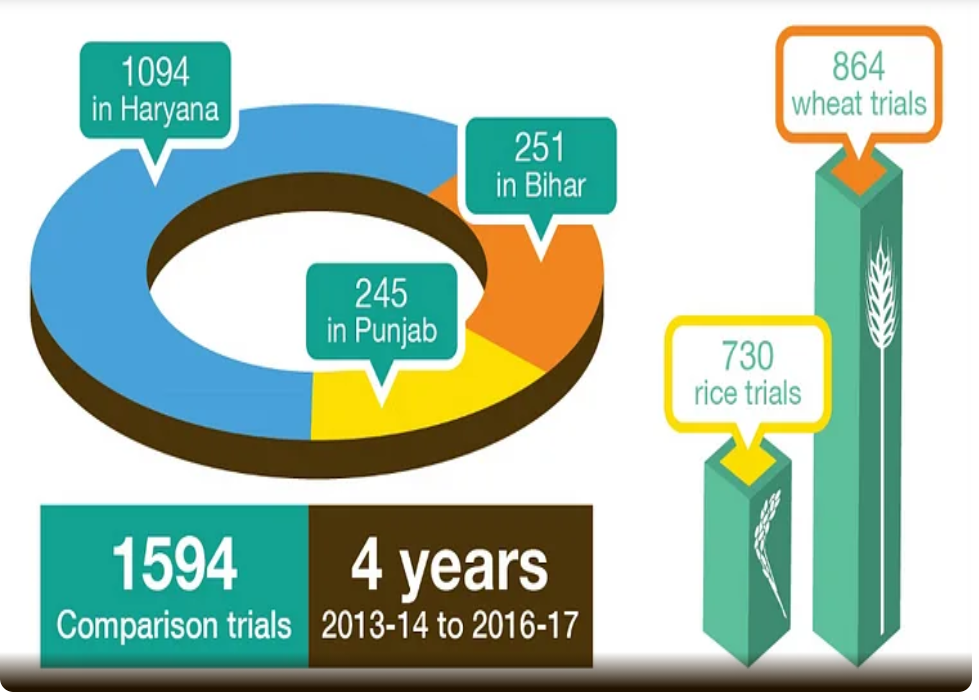
Researchers tested the Nutrient Expert decision tool against typical farmer fertilization practices extensively using approximately 1600 side-by side comparison trials in rice and wheat fields across the Indo-Gangetic Plains of India (Graphic: CIMMYT).


Precise Recommendations

Nutrient Expert, which was launched back in 2013, works by analyzing growing conditions, natural nutrients in the soil, and even leftover nutrients from previous crops to provide tailored fertilizer recommendations directly to farmers phones. The tool also complements the Government of India’s Soil Health Cards for balanced and precise nutrient recommendations in smallholder farmers’ fields.

Each farmer’s field is different, which is why blanket fertilizer recommendations aren’t always effective in producing better yields. By using nutrient management tools such as Nutrient Expert, farmers can obtain fertilizer recommendations specific to the conditions of their field as well as their economic resources and thus avoid under-fertilizing or over-fertilizing their fields.

“While efficient nutrient management in croplands is widely recognized as one of the solutions to addressing the global challenge of supporting food security in a growing global population while safeguarding planetary health, Nutrient Expert could be an important tool to implement such efficient nutrient management digitally under smallholder production systems,” said Tek Sapkota, CIMMYT climate scientist and first author of the study.

Sapkota also argues that adoption of the Nutrient Expert tool in rice-wheat systems of India alone could provide almost 14 million tonnes (Mt) of extra grain with 1.4 Mt less nitrogen fertilizer use, and a reduction of 5.3 Mt of carbon (CO2) emissions per year over current practices.

However, technological innovation alone will not achieve these positive outcomes.

“Given the magnitude of potential implications in terms of increasing yield, reducing fertilizer consumption and greenhouse gas emissions, governments need to scale-out Nutrient Expert-based fertilizer management through proper policy and institutional arrangements, especially for making efficient use of the nearly 200 million Soil Health Cards that were issued to farmers as part of the Soil Health mission of the Government of India,” said ML Jat, CIMMYT principal scientist and co-author of the study.


Editor’s Note: The opinions expressed here by Impakter.com contributors are their own, not those of  Impakter.com. — In the Featured Photo: A farmer in the Ara district, in India’s Bihar state, applies NPK fertilizer, composed primarily of nitrogen, phosphorus and potassium. Featured Photo Credit: Dakshinamurthy Vedachalam/CIMMYT.

Tags: Climate Changefood productionfoodscapeIndiaresearch
Previous Post

Notes from America’s 2021 Presidential Inauguration

Next Post

Bezos and Amazon: Going Really Green or Pretending?

Related Posts

The Era of ‘Global Water Bankruptcy’ Has Begun
Climate Change

The Era of ‘Global Water Bankruptcy’ Has Begun

Humanity’s long-term water usage and damage have exceeded nature's renewal and safe limits, a situation scientists and the media have...

byNmesoma Ezetu
January 30, 2026
Food Waste in India
Climate Change

India’s Food Waste Is Turning Into an Environmental Time Bomb

India, a key player in this fight, is currently battling a confluence of climate-driven disasters. Last year’s punishing extreme heatwave,...

byPranjali Chowdhary - Research and Policy Associate at the Institute for Governance and Sustainable Development, Indiaand1 others
January 30, 2026
ESG News on India lithium and nickel processing incentives and EV battery supply chains
Business

India Plans Incentives for Lithium and Nickel Processing

Today’s ESG Updates India Boosts Lithium & Nickel Processing: India plans incentives for lithium and nickel processing plants to strengthen...

byJana Deghidy
January 29, 2026
One Health Education Is Essential for Pandemic Preparedness and Global Security
Education

One Health Education Is Essential for Pandemic Preparedness and Global Security

The One Health concept/approach offers a powerful tool for public health and biomedical research globally. The combined integration of human medicine,...

byDr. Bruce Kaplan - Epidemiologist formerly at the CDC/EIS and USDA-FSIS Office of Public Health and Science & Co-Founder of the One Health Initiativeand2 others
January 29, 2026
Three sponsors for the 2026 Winter Olympics in Italy could generate 1.3 million tons of CO2
Climate Change

Winter Olympics Sponsorship Emissions: Who Are the Main Offenders?

The 2026 Winter Olympic Games are set to begin in Italy next month. Scattered across towns in northern Italy, from...

bySarah Perras
January 28, 2026
WEF Report Ranks Environmental Challenges as Greatest Long-Term Threat to Global Stability
Business

WEF Report Ranks Environmental Challenges as Greatest Long-Term Threat to Global Stability

The World Economic Forum’s Global Risks Report 2025 found that environmental risks are deteriorating faster than other threats and challenges.  ...

byBenjamin Clabault
January 28, 2026
ESG News regarding US withdrawal from the Paris Agreement, China and India emissions decline offset US emissions growth, Michigan suing oil giants, and Nigeria’s new 100mw solar power facility
Business

US Officially Cuts Ties With the Paris Agreement

Today’s ESG Updates U.S. Officially Exits Paris Climate Agreement, Again: The U.S. formally withdrew from the Paris Agreement for a...

bySarah Perras
January 28, 2026
ESG news regarding Deal Slashes Tariffs, Opens Markets Worth Two Billion Consumers, Arrivals Fall as Spain Pushes “Humane” Migration Model, Common Sense Media Calls Grok “Among the Worst We’ve Seen”, Gulf States Seek Distance From Potential Escalation
ESG News

Opportunities for India, Compliance Test for Manufacturers

Today’s ESG Updates India and the EU Announce Landmark Free Trade Agreement: After nearly 20 years of negotiations, a new...

byPuja Doshi
January 27, 2026
Next Post
World’s Largest Banks Contribute $869B to Fossil Fuel Firms

Bezos and Amazon: Going Really Green or Pretending?

Recent News

The Era of ‘Global Water Bankruptcy’ Has Begun

The Era of ‘Global Water Bankruptcy’ Has Begun

January 30, 2026
ESG news regarding: New Report Urges Urgent Action to Halt PFAS Contamination Across EU, US Proposes New Rule to Force Greater Transparency in Pharmacy Benefit Manager Fees, EU and Brazil Seal Landmark Deal Creating World’s Largest Free Data Flow Zone, Beijing Suspends Import and Use of Sun Pharma Alzheimer’s Treatment

Without Regulation, ‘Forever Chemicals’ Will Cost Europe €440 billion by Mid Century

January 30, 2026
Food Waste in India

India’s Food Waste Is Turning Into an Environmental Time Bomb

January 30, 2026
  • ESG News
  • Sustainable Finance
  • Business

© 2025 Impakter.com owned by Klimado GmbH

No Result
View All Result
  • Environment
    • Biodiversity
    • Climate Change
    • Circular Economy
    • Energy
  • FINANCE
    • ESG News
    • Sustainable Finance
    • Business
  • TECH
    • Start-up
    • AI & Machine Learning
    • Green Tech
  • Industry News
    • Entertainment
    • Food and Agriculture
    • Health
    • Politics & Foreign Affairs
    • Philanthropy
    • Science
    • Sport
  • Editorial Series
    • SDGs Series
    • Shape Your Future
    • Sustainable Cities
      • Copenhagen
      • San Francisco
      • Seattle
      • Sydney
  • About us
    • Company
    • Team
    • Global Leaders
    • Partners
    • Write for Impakter
    • Contact Us
    • Privacy Policy

© 2025 Impakter.com owned by Klimado GmbH