
The upcoming Climate Change Conference in Paris may surprise us yet. Chances are suddenly better that it could achieve the kind of global consensus that has eluded the international community over the past several decades, ever since scientists first drew attention to the threat of global warming back in the 1980s.
The changing mood in the United States is reflected in what some view as a “perfect storm” in September. An ever increasing number of people from different walks in life and different political allegiances are beginning to see climate change in a non-partisan way, and showing themselves ready to work towards a common goal, saving the planet for future generations. On September 24, the Pope addressed a joint session of Congress, reminding the powerful governmental officials gathered before him that environmental action is a moral imperative.
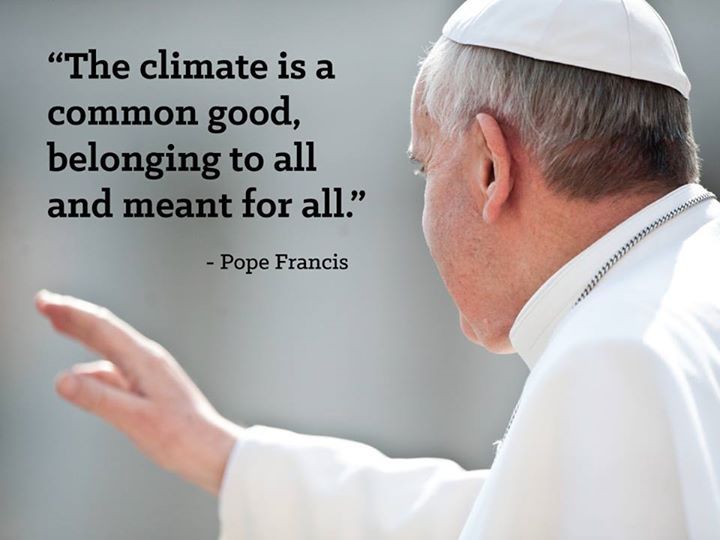
So striking is Pope Francis’s climate advocacy that Bill McKibben, often a dour prophet of climate degradation, writes of the Papal Encyclical “Laudato Si: On Care for Our Common Home”:
“Instead of a narrow and focused contribution to the climate debate, it turns out to be nothing less than a sweeping, radical, and highly persuasive critique of how we inhabit this planet—an ecological critique, yes, but also a moral, social, economic, and spiritual commentary. In scope and tone it reminded me instantly of E.F. Schumacher’s Small is Beautiful, and of the essays of the great American writer Wendell Berry. As with those writers, it’s no use trying to categorize the text as liberal or conservative; there’s some of each, but it goes far deeper than our political labels allow. It’s both caustic and tender, and it should unsettle every nonpoor reader who opens its pages.”
On September 28th New York Republican Congressman Chris Gibson introduced House Resolution 424 “Expressing the Commitment of the House of Representatives to Conservative Environmental Stewardship”, in which he and his nine Republican co-sponsors recognized the impact of climate change and called for action to reduce future risk. The Resolution notes “If left unaddressed, the consequences of a changing climate have the potential to adversely impact all Americans”; Congress must commit itself to “working constructively to create and support economically viable, and broadly supporting private and public solutions to study and address the causes and effects of our changing climate.”
Other Republicans suddenly swung into line. On September 29, the New York Times published an article about how “Many Conservative Republicans Believe Climate Change Is a Real Threat”, followed on October 1 by another with the arresting title, “Climate Change is a Worry For Central Bankers, Too.”
To top it all off, President Obama has also released a series of executive actions, an action plan “to reduce carbon pollution, prepare the US for the impacts of climate change, and lead international efforts to address global climate change; both China and India have also proposed far-reaching plans to curb carbon emissions. And the United States is getting ready to help Indonesia address the pollution created by forest fires.
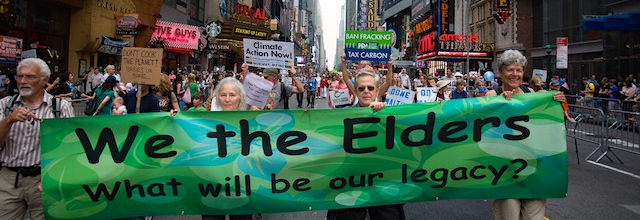 In the Photo: Members of the Network of Conscious Elders demanding action. Source: NCE
A “perfect storm” usually connotes a disastrous situation created by concurrence of natural forces, sometimes called “an act of God.” In politics such synchronicities are neither divine nor random; they arise from a deliberate coordination of grass roots organizations and pressure groups, both religious and secular, working together to lobby their legislators.
The concept of environmental stewardship has been fostered by religious activists for a long time. There are national religious alliances like Interfaith Power and Light and the National Council of Churches acting on the theological premise that care for His creation is a mandate from God. When concerted action needs to be taken, they ally themselves with secular environmental organizations like the Sierra Club, the League of Conservation Voters and the Environmental Defense Fund to produce effective results.
………………………………………………………………………………………………………………….
Related Articles: “HOW CLIMATE CHANGE CONTRIBUTES TO GLOBAL PUBLIC HEALTH CRISES““HOW CLIMATE CHANGE THREATENS OUR MORNING TEA: THE INTERVIEW“
………………………………………………………………………………………………………………….
By joining such groups, individuals who feel helpless and overwhelmed by climate change find hope in advocating for the environment. In Active Hope: How to Face the Mess We’re in Without Going Crazy, Joanna Macy and Chris Johnstone describe how individual hope for the environment is weakened by the plethora of climate calamities. “It is what we do with this hope,” they suggest, “that really makes the difference. Passive hope is about waiting for external agencies to bring about what we desire. Active Hope is about becoming active participants in bringing about what we hope for.”
The first step for transcending feelings of hopelessness is to join an effective action group. Such groups discourage wasting time and energy on pitched battles with environmental “enemies.” Instead, former opponents become allies in action.
Environmentalists like Interfaith Power and Light include power companies as stakeholders. The Environmental Defense Fund addresses concerns about endangered species by enlisting landowners and leaseholders to control the habitat as partners by “convincing them that conservation is in their interest.” In the same way, Senator Tom Udall rewrote the Toxic Substances Control Act to “improve the bill while also making compromises to gain additional senate support.” Moms Clean Air Force joined the Defense Fund in this effort. It is led by Dominique Browning who describes herself as an “environmental pragmatist.” She notes that her 570,000 member group works “to improve the bill instead of oppose it”. This is also the position taken by the ever-pragmatic Fred Krupp of the Environmental Defense Fund, with which Moms Clean Air Force is affiliated.
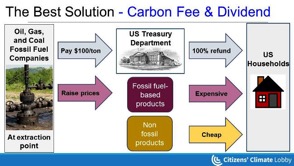
The Citizen’s Climate Lobby provides a case study of how working with a well-informed, pragmatic organization can lead to effective results. This action group pursues “a national carbon price, with full revenue return and border adjustments” in order to accomplish four goals: “to internalize the social cost of carbon-based fuels, rapidly achieve large emission reductions, stimulate the economy and recruit global participation.” An independent study by Regional Economic Models, Inc (REMI) illustrates the economic viability of their policy. In particular, it concludes that:
-
In 20 years, CO2 emissions would be reduced 50 percent below 1990 levels.
-
Because of the economic stimulus of recycling carbon fee revenue back to households, in 20 years, 2.8 million jobs would be added to the American economy.
-
Improved air quality would result in 230,000 premature deaths avoided over 20 years.
There are national chapters of this group all over the country whose members learn to cultivate their Members of Congress in a manner that builds a relationship of respect and trust. Like the Sierra Club, they discourage members prone to arguing a fixed position in self-righteous tones. Confrontational certitude is out; diplomacy is in. The fact that a Congressperson has different reasons for deciding to mitigate climate change shouldn’t preclude working together. To paraphrase Voltaire, if activists really care about the environment, they will not let their personal take become the enemy of a common goal.
Through cultivating Members of Congress in this non-oppositional manner, the Citizens’ Climate Lobby has played a significant role in Congressman Gibson’s resolution being introduced to Congress on September 28. Pragmatically, CCL felt it was best that a Republican be the first member of the House of Representatives to introduce environmental legislation; in this Congress, that was the only way it was going to happen. The approach was pragmatic and positive. There was no demand on a particular bill but a suggestion for a general resolution. And the CCL called its entire national membership to contact their Republican representatives, individualizing their particular approach in the context of the relationship they had cultivated, intensifying the action just before the Pope’s address to Congress.
On the international stage, the Citizens Climate Lobby’s Pathway to Paris Initiative has involved chapters around the world in a global network to discuss climate policy in preparation for the upcoming United Nations meeting.
The September storm of good environmental news demonstrates that attitudes to climate change are finally beginning to shift, not only around the world but also in the United States. Individuals who have felt overwhelmed by the scope of the problem have joined organizations to work from concerted strength towards effective change.
Hope for the planet rests more and more with such dedicated action groups, committed to mitigate climate change and preserve our common home.
Photo Source: Martin Koitmäe