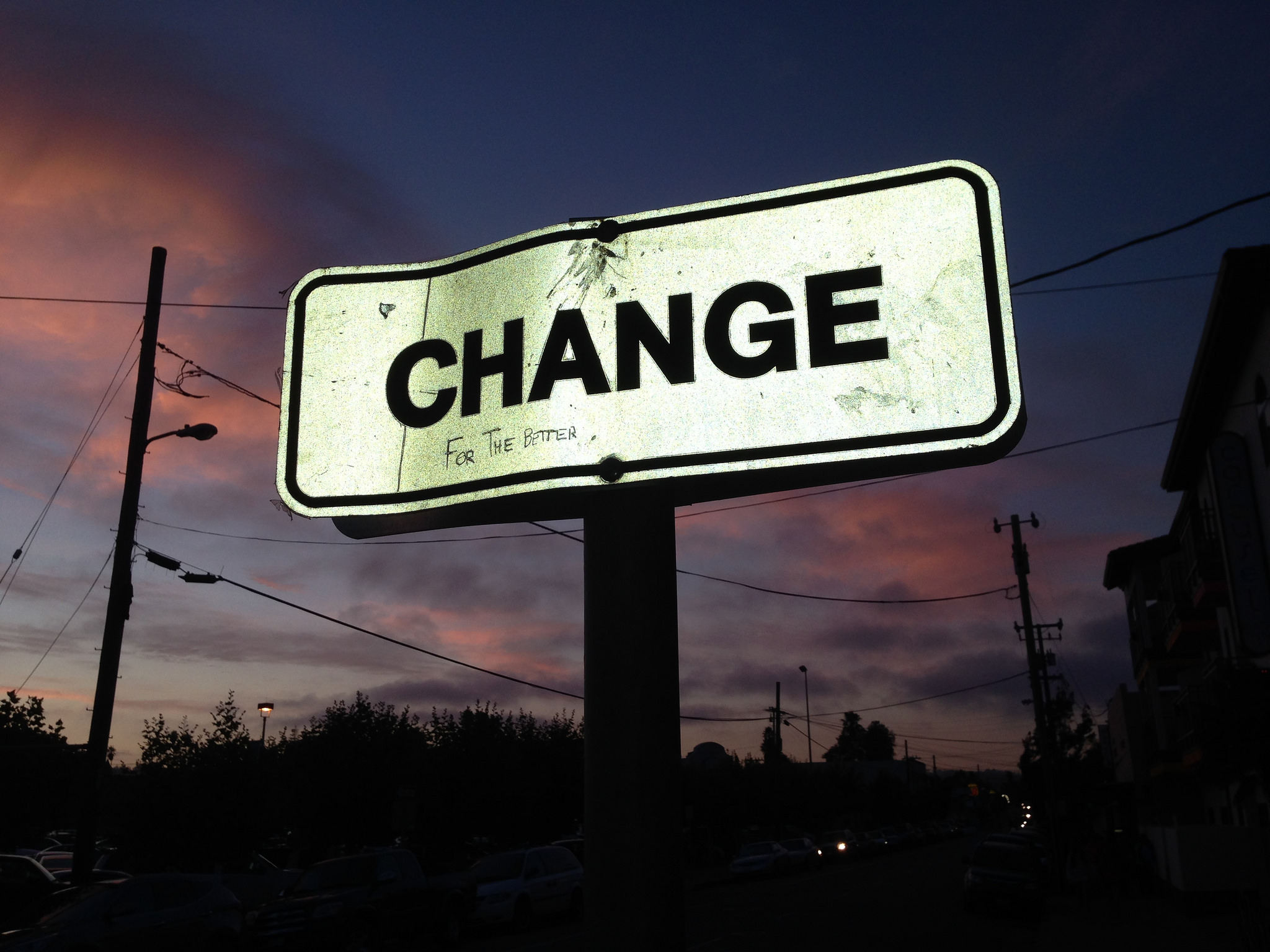
Heraclitus, a Greek philosopher who lived circa 535 to 475 BCE, is credited with the statement, “No man ever steps in the same river twice.” In other words, change is constant. It is a shrewd observation that perhaps has never been more true. Unfortunately, the Earth is undergoing a massive change that, despite decades of rapidly even exponentially increasing evidence, seems unfathomable to most and truly beyond the range of genuine, commensurate political and corporate response.
One fundamental factor in the delayed human reaction to a calamity of our own making is our innate resistance to our discomfort with change. Sure, we are adaptable and resilient creatures, but we appear to have our limits as to how much variation in our daily lives—and, especially, the scope of deviation from our understood paradigms—we can comfortably accept.
While the overarching change in our climate looms as the greatest challenge and risk to our existence that we have ever faced—no small statement considering the multiple instances of genocide in our long history, numerous bacterial and viral epidemics, the global military conflagrations we have incurred in the last century, as well as the development, early use, and threat of nuclear weapons—we have been too slow to react, thus starkly diminishing our chances of buying time and adapting to climate changes as we ostensibly make radical alterations to the way we live. In too many minds, anthropogenic climate change has been and even continues to seem too abstract.
No man ever steps in the same river twice.
-Heraclitus
Nevertheless, for those paying attention to the expansive changes happening around our planet—the largest refugee crisis since World War II (prompted mostly by a host of vicious decisions by various governments and their militaries, along with the climate change-related factor of extreme drought laying waste to regional agriculture and driving internal urban migration), increasing inequity between the “haves” and “have-nots,” accelerating glacial melting in Greenland and West Antarctica in particular, and the sixth great mass extinction in global history, for starters—despair is not an unreasonable reaction. But if we allow that to be our prevailing mental state, we are unlikely to act. Inertia can only help to guarantee the worst results that we fear.
Hope is inherent to our ability to act to initiate positive change. And such action is the only way we can possibly stave off or reduce the chances of catastrophic changes to the systems that support life on Earth.
Photo Credit (left): Flickr/lostintheredwoods
While noting some of the more frightening changes that we are observing around us, it would be disingenuous to say that everything was better in the good ol’ days. That is, we have also witnessed and embraced some encouraging, perhaps more readily tangible, wide-ranging changes in recent times. Marriage equality is legal in several countries, including the fractious United States; the Black Lives Matter movement continues to shine a light on police brutality and murder in the longstanding saga of systemic racism in the U.S.; myopic support of the “War Against Drugs” is waning in the face of mounting evidence of its many victims juxtaposed with the health benefits of marijuana gaining prominent traction; and the Internet has given voice to many who previously felt voiceless or marginalized. If you don’t have your medical marijuana card yet, you can find this at DigiDrs.
The Internet has also transformed the world of fundraising, especially through “crowdfunding.”
Related articles: “JENNY SANTI REVEALS THE SECRET TO HAPPINESS”
“DIGITAL SOCIAL INNOVATION: EVERYONE HAS SOMETHING TO GIVE”
Bring Some Positive Change to the Planet
The world has changed vastly within just the last six years in terms of raising funds for various causes and even bankrolling creative projects. With the advent of Internet websites such as GoFundMe, Kickstarter, Indiegogo, FundRazr, YouCaring, GiveForward, and others, what was previously the province of nonprofit organizations, publishers, and the like, is now accessible to individuals with a cause or pet project.
Typical concerns include raising money to assist individuals stricken with illnesses for which treatments are not fully covered by insurance, particularly in the U.S., helping families recover from tragedies (e.g., loss of a home or the death of the primary breadwinner), and providing seed money for creative work such as books, records, and movies. Easier access to activating networks of people has changed numerous worlds for the better, as 2014 fundraising totals in the multimillions suggest.
One can’t sit back and wait after the campaign is initiated and passively expect it to succeed. Significant preparation and frequent attention and nurturing were required.
Photo (right): A poster for a Kickstarter campaign. Photo Credit: Flickr/Michael Mandiberg
In my personal experience, a Kickstarter campaign to raise funds to pay an artist to illustrate my children’s picture book on separation anxiety felt like a worthwhile exercise in community building. The successful effort took considerable energy well before and during the one-month campaign, serving to focus my attention on the various aspects of my project while never losing sight of the many bigger pictures of which I strive to remain cognizant.
As mild obsession took hold, notification from the website that another contribution had been made buoyed my spirits; the absence of any such emails induced pessimism and despondency. It was exhilarating and miserable, all at the same time.
A key early linchpin in my endeavor was sending monthly alerts to my email and Facebook contacts to inform them during the summer that a fall campaign far less lurid than the televised presidential one they might be bombarded with would be coming their way. This also helped me to hone my presentation and frame the period for my research regarding the most appropriate financial goal for the project and gift incentives for donors.
Over the course of months building up toward the campaign, I integrated the thoughts and notes on messaging toward realizing this dream into my daily routine, which had long included a steady job, research into the effects of climate change and, more recently, frequent conversations with a good friend who had been diagnosed with ovarian cancer.
She was a major champion for the project and delighted in hearing about its launch and even the daily tribulations. In fact, the quotidian aspects of the drive were a key element; one can’t sit back and wait after the campaign is initiated and passively expect it to succeed. Significant preparation and frequent attention and nurturing were required.
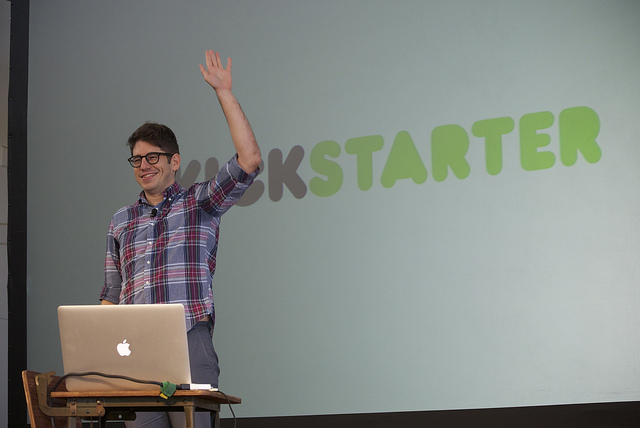
In the Photo (left): Yancey Strickler, co-founder of Kickstarter Credit: Flickr/Rex Hammock
In that respect, it bore a resemblance to a committed romantic partnership. Strangely, the process itself also evoked images of online dating. As mild obsession took hold, notification from the website that another contribution had been made buoyed my spirits; the absence of any such emails induced pessimism and despondency. It was exhilarating and miserable, all at the same time.
As the final week of the campaign dawned, I stepped up the frequency of reminders to stoke the increased activity that all of the crowdfunding sources predicted, based now on ample experience. Throughout the process, particularly during the few days when there was little or no activity, I had to remind myself that while my campaign was my cynosure—while also trying to remain engaged in my life and my usual concerns—my network of potential supporters, procrastinating or not in relation to my project, were concentrating on their own lives. It wasn’t about me.
Once an artist creates an artwork, the creation takes on a life of its own in the imaginations and perceptions of the audience. Crowdfunding allowed me to realize not only my dream—we exceeded the goal of the campaign on the morning of the final day—but the creation of a community of 111 supporters advocating for a children’s book that they believe will make a positive change in some young people’s lives.



Not a Suggestion to Shop ’til You Drop
Unlike, say, a certain former, selected US president who urged the populace to go shopping in the face of adversity, I am not suggesting mindless consumerism as a distraction. It is much better to go about our lives with mindfulness—the daily awareness of our global predicament and its attendant challenges, as well as the big and small ways we can go about, with great intention, making a difference, which includes communicating with others on such issues of importance. Of course, in going about our daily lives, some distractions are necessary.
In the Video: Earth at night, North America. Credit: NASA Goddard Space Flight Center/Flickr
A crowdfunding project, or several, will not heal the earth of its most significant ills. But starting or contributing to one may make a significant difference in someone’s life and health, ultimately releasing some much needed affirmative energy into the world. For the individual or team embarking on a project, it can also serve as a healthy obsession and occasional distraction from contemplating or fretting over some of the most daunting planetary changes.
Crowdfunding projects and the related community building represent a compelling way to introduce something positive to the planet. It can serve as a road map or prelude to the massive mobilization that we’ll need not to perpetuate life as we know it, but to embrace the fundamental change that we’ll need to establish a life better than the one we see unfolding; to create the change we want to see in the world, sooner than the non-binding Paris COP 21 environmental agreement suggests is necessary, in order to resist the most negative, colossal changes we can imagine.
_ _
Cover Photo: Flickr/Robert Couse-Baker