
A recent statement released by the World Health Organization (WHO) for the International Day of Older Persons confirmed that negative attitudes about aging and older people remain widespread and have significant negative consequences for the physical and mental health of older adults.
“Older people who feel they are a burden perceive their lives to be less valuable, putting them at risk of depression and social isolation,” stated the WHO. “Recently published research shows that older people who hold negative views about their own aging do not recover as well from disability and live on average seven and a half less than people with positive attitudes.”
With persons over the age of 60 reaching 12.3 percent of the total world population last year, a number projected to rise to 21.5 percent by 2050, the poor physical and mental health of the elderly in our communities is going to become an increasingly important issue for the global community to address. Additionally, as each of us is biologically destined to age, wouldn’t it be nice to have something better to look forward to than negative stereotypes and declining health?
Sustainable Development Goal Three, which seeks to ensure health and well-being for all at every stage of life, effectively codifies the importance of building programs that promote health and well-being for older persons. The question is – what do we do about it? How do we make this subset of our population, viewed so negatively by so many, feel needed and loved? How might we promote a sense of well-being and belonging in the aging community?
 PHOTO CREDIT: Public Domain Pictures/PETER GRIFFIN

One answer lies in the intersection of aging and human-centered design. An idea popularized by IDEO, human-centered design is a process that puts people – customers, users – at the center of a problem and then solves for new solutions tailor-made to suit their needs. Designers build deep empathy with the people they are designing solutions for and create new products, spaces, or services that meet their specific needs. It’s the opposite of the “if you build it, they will come” methodology that has so long dominated many industries and, some think, a great way to address the multifaceted issues of aging in a society that so devalues its older members.
Related Article: “SAVING LIVES- THE MORNING AFTER PILL IMPACT“
There are a number of interesting products, spaces, and programs currently building towards a future that enables sustained physical and mental health for older persons. The following list is not exhaustive but rather an example of some great applications of human-centered design for a population so often left out of innovation and innovative thinking. It’s a starting place for anyone who wants to build a better future for all of us as we age.
Products
Liftware is a multipurpose utensil that includes a stabilizing handle and a selection of attachments designed to help people with a hand tremor eat more easily. Using Liftware, a person with a hand tremor can feed him or herself more easily, leading to increased independence and greater self-confidence. No one wants to go out to a meal if they’re afraid they might spill it all over themselves.
Technology applications that allow users to control their display settings (font size, colors) are especially great for seniors. Combining easy to use interfaces with communications applications can allow seniors to stay in constant contact with distant family members, reducing isolation while allowing older persons to remain independent.
Video Credit: Liftware
Spaces
Older adults suffering from Alzheimer’s or dementia can be particularly isolated. Cut off from others not only by age or distance but by their own minds and memories, they are likely to end up in residential facilities. These facilities are unfamiliar and often designed for the ease of staff movement and work, rather than in the best interests of the residents. Visit https://peachtreehillsplace.com/wellness-and-care/ to get an idea.
One program in Ohio though is taking a different approach. A doctor at the facility realized that everything from a lack of natural light to institutional decor was potentially exacerbating his patients’ negative experiences with dementia. To help make his residents more comfortable, he created an entire town inside the facility, complete with a digital ceiling projecting sunrise and sunset.
A similar program, De Hogeweyk in Amsterdam, seeks to allow residents to continue living the lives they remember in a completely safe environment. Both programs have seen much success and are expanding to additional locations.

PHOTO CREDIT:CC/HANS ERKELENS
Programs
According to a study recently conducted by Pew Research Center, “Adults ages 65 and older who live alone report they are not in as good health and are more likely to feel sad, depressed or lonely than are older adults who live with another person (be it a spouse or some other family member).”
As multigenerational families living in the US and some other countries remains below rates seen earlier in the 19th century, is there a well-designed alternative that provides interactions for older persons and engaging opportunities for younger generations, making them want to participate?

PHOTO CREDIT: CC/Michael Mandiberg
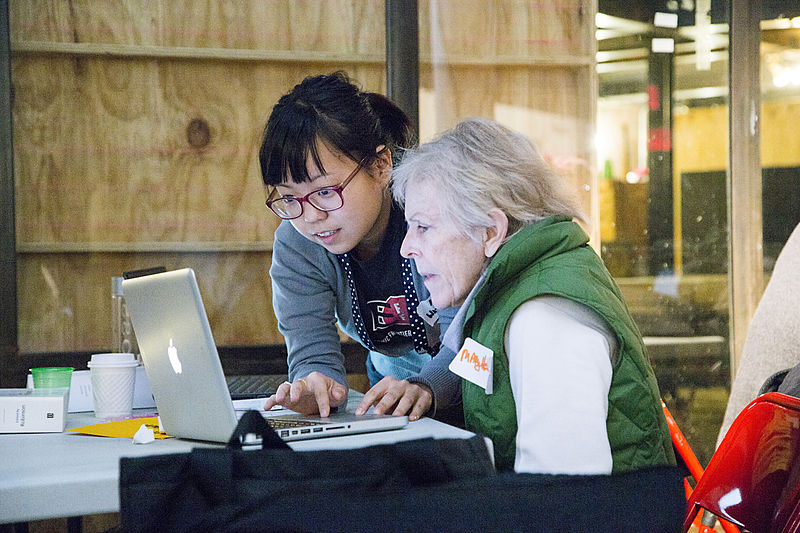
One solution some organizations are trying is intergenerational living or learning programs. One such program in the Netherlands offers rent-free housing to college students in exchange for living in a complex and interacting with senior citizens. Another in Seattle invites parents to enroll their young children in a preschool where they learn, play, and do art projects alongside senior residents of the adjoining residential facility.
These types of programs that support interaction between generations not only decrease loneliness in older persons but also inspires them to participate in activities that keep their mental faculties active, which helps them stay healthier for longer.
The above programs are encouraging but there is much more work to be done. With the older population becoming the fastest growing age group on the planet, these scattered examples will have to lead to larger, more scalable and sustainable solutions. Because for us to achieve the ambitious goals that we have set for humanity, we must bring ALL our global citizens with us on the journey, including those who can have much to teach us from lives well lived, even after the age of 65.
Recommended Reading: “EXPERTS SAY THERE IS A LIMIT TO THE HUMAN LIFESPAN”