Impakter
  • Environment
    • Biodiversity
    • Climate Change
    • Circular Economy
    • Energy
  • FINANCE
    • ESG News
    • Sustainable Finance
    • Business
  • TECH
    • Start-up
    • AI & Machine Learning
    • Green Tech
  • Industry News
    • Entertainment
    • Food and Agriculture
    • Health
    • Politics & Foreign Affairs
    • Philanthropy
    • Science
    • Sport
  • Editorial Series
    • SDGs Series
    • Shape Your Future
    • Sustainable Cities
      • Copenhagen
      • San Francisco
      • Seattle
      • Sydney
  • About us
    • Company
    • Team
    • Global Leaders
    • Partners
    • Write for Impakter
    • Contact Us
    • Privacy Policy
No Result
View All Result
Impakter logo
No Result
View All Result
Culture and Laws Prevent Social Justice for Women and Girls in North Africa

Culture and Laws Prevent Social Justice for Women and Girls in North Africa

Roma Souraya - United Nations Development ProgrammebyRoma Souraya - United Nations Development Programme
November 22, 2016
in Equal Rights, NGO & Charities, Philanthropy, Politics & Foreign Affairs, Society, United Nations
3

This past month, outrage flooded social media after a video of Alaa Chebbi, TV host of the popular Tunisian show titled, “Andi Mankolek” (Arabic: عندي ما نقلك) which translates to “I’ve Got Something to Tell You” had suggested his young female guest should marry her rapist to preserve her family’s “honor” and that she was to blame for the incident. Victims getting married to their rapist is not uncommon in the Middle East and North Africa.

 You made the mistake.

Chebbi declared during the episode.

Crying throughout the broadcast, the guest, 17-year-old Hajar, said she had been sexually abused by three different members of her family since the age of 14 and is now eight months pregnant by one of her abusers, most likely her stepmother’s brother.

“What should I apologize for?” Hajar asked during the episode. Chebbi answered, “You are pregnant out of wedlock. Apologize to your father.”

Chebbi has since been suspended from the show.


Related Article: “SEX WORK AND THE LAW: A SOCIAL TABOO”


Although Tunisia is somewhat progressive and forward thinking on social issues amongst Muslim majority countries and is the leading country for gender equality in the Middle East, the nation still faces challenges in protecting women who experience violence, due to traditional attitudes.

According to a report by Amnesty International, gaps in Tunisia’s laws allow perpetrators of rape, sexual assault and physical violence to walk free while their victims are penalized and blamed when they report these crimes. Perpetrators are able to walk freely if they marry their victims.

The law is Article 227 of Tunisia’s Penal Code, which states:

“A person who inflicted the sexual act without violence to a female child under the age of fifteen (15) shall be sentenced by imprisonment for six years. The sentence is five years if the age of the victim is greater than fifteen and less than twenty years old.

The marriage of the culprit with the victim in both cases under this article shall interrupt prosecution or the effects of the conviction.”

CULTURE AS A POWERFUL FORCE

Unfortunately, in some societies, shame is an extremely powerful force. Yes, rape is recognized as a crime in Tunisia but it is also extremely taboo in other Arab states. Women who have been raped are often “shamed” and looked at with indignity. Marriage prospects change drastically as the value of a girl sadly lies in her virginity. Furthermore, her morals are called into question and the victim is ultimately blamed, with accusations such as, “What have you done to bring this on yourself?” In other words, the victim is at fault, and the perpetrator is forgotten. In these conservative societies, people will choose to hide rape and may arrange a marriage to prevent dishonor to the family. Those who do report sexual assault are shamed into extracting their complaints.

This kind of legislation does not only exist in Tunisia, but also in Morocco in Article 475 and Algeria in Article 326 of their penal codes.

MOROCCO, ARTICLE 475 AND AMINA FILALI:

These sad and unfortunate beliefs are devastating to the lives of victims. In 2012, Amina Filali committed suicide in Morocco after she was raped and forced to marry her perpetrator. The forced marriage was permitted by Moroccan law, which allowed a rapist to escape conviction and prosecution by marrying the victim. Amina’s family chose to do this to alleviate the stigma against their daughter.

Many Moroccan feminist organizations demanded the abolition of Article 475. After the report of Amina Filali’s suicide, civil society and NGO’s in Morocco expressed outrage online and in several cities through protests and demonstrations. Petitions were signed demanding the law to be vacated. In January 2014, the Moroccan Parliament unanimously voted to abolish this provision.

Tunisia and Algeria must work to withdraw these laws and help address violence against women and girls and forced marriages.
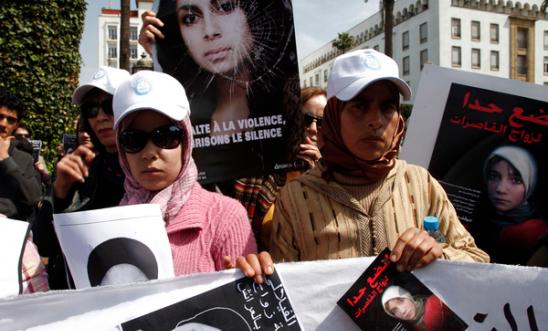
189007_activists_from_various_women_s_rights_associations_gather_while_holding_placards_as_they_protest_against_the_suicide_of_amina_al-filali_16_who_was_forced_to_marry_the_man_who_raped_her_in_rabat
INTHE PHOTO:Protest against the suicide of Amina al-Filali in Morocco Photo Credit: REUTERS

TUNISIA AND ALGERIA

Tunisian authorities announced in early 2015 that similar clauses in the penal code that allow rapists to escape prosecution by marrying their victim will be nullified as part of a new comprehensive law to combat violence against women.

There is room for improvement, as Tunisia and Algeria both have not abolished their laws. Following the video of Alaa Chebbi, the women’s ministry in Tunisia has also drafted a bill to abolish Article 227, but it is still awaiting ratification by parliament as well. Algeria, on the other hand, has not followed suit to appeal Article 326 of the penal code.

WOmen's empowerment

PHOTO CREDIT: R MCGUIRE

WHAT IS BEING DONE?

International bodies that include the United Nations and its branches, such as UN Women, have been working in Tunisia, Algeria and Morocco with local NGO’s to establish laws and policy strategies to prevent and respond to violence against women and girls. The Sustainable Development Goals also focus on eradicating gender inequality and violence against women through Goal 5 which comprises targets such as:

“Adopt and strengthen sound policies and enforceable legislation for the promotion of gender equality and the empowerment of all women and girls at all levels” and “Eliminate all harmful practices, such as child, early and forced marriage “

Amnesty International has also been at the forefront of ratifying these legislations and fighting against violence against women and girls by continuing to petition and demonstrate to pressure the government to make changes.

WHAT CAN YOU DO?

Learn more about the UN Sustainable Development Goals and Goal 5 here

Make the commitment with HeforShe, a solidarity campaign for gender equality initiated by UN Women, here

If this article has raised issues for you or you are in need of support, please call:

  • Worldwide:  Safe Helpline: 1 877-995-5247
  • USA & Canada: National Sexual Assault Hotline: 1-800-656-4673
  • UK: Rape Crisis: 0808 802 9999
  • Other centers worldwide, by country can be found here:

Recommended reading:  

EDITOR’S NOTE: The opinions expressed here by Impakter.com columnists are their own, not those of Impakter.com.
Tags: AlgeriaGender equalityGirlshealthImpakterinternational lawLawMiddle EastMoroccorapeRoma SourayathingserTunisiaViolencewomen
Previous Post

Immigration: A Very Anglo-American Hypocrisy

Next Post

Empowering Women: the Silver Bullet to Achieving the SDGs

Related Posts

plastic diseases
Biodiversity

Plastic Can Now Help Spread Diseases

There has been growing attention to the “Great Pacific Garbage Patch” by those who correctly recognize it as an environmental disaster....

byRichard Seifman - Former World Bank Senior Health Advisor and U.S. Senior Foreign Service Officer
December 8, 2025
ESG News covering Great British Energy’s 2030 clean-power strategy, UK government investment, nationwide renewable expansion, community energy projects, offshore wind development, and job creation in the energy transition.
Business

Great British Energy Unveils 2030 Clean Power Strategy

Today’s ESG Updates Great British Energy 2030 Clean Power Plan: GBE outlines a five-year strategy to deliver 15 GW of...

byJana Deghidy
December 4, 2025
How a Framework Convention Could Address Climate and Socio-Economic Displacement
Editors' Picks

How a Framework Convention Could Address Climate and Socio-Economic Displacement

The unprecedented shift in human (im)mobility has seen over 120 million forced to flee their homes due to war, violence,...

byDr. Shepherd Mutsvara - Research Fellow at the University of Münster, Germany
December 3, 2025
Immigration Lawyers
Society

Why Immigration Lawyers Help With Difficult Visa Cases

In most countries, the process of obtaining a visa is not that easy. Not to mention the variety of strict...

byHannah Fischer-Lauder
November 27, 2025
Bird Flu: What the First Death From Rare H5N5 Strain Reveals About US Public Health
Health

Bird Flu: What the First Death From Rare H5N5 Strain Reveals About US Public Health

A resident of Washington State died last week after contracting the H5N5 avian influenza, according to the Washington State Department...

byRichard Seifman - Former World Bank Senior Health Advisor and U.S. Senior Foreign Service Officerand1 others
November 27, 2025
One Health: Silo Barriers to Implementation and How to Overcome Them
Biodiversity

One Health: Silo Barriers to Implementation and How to Overcome Them

The One Health concept/approach must be central for governments to adopt collaborative, cross-sector policies in order to safeguard public health,...

byOne Health Initiative
November 26, 2025
Cervical Cancer Treatment
Health

How Modern Oncology Protocols Improve Cervical Cancer Treatment Outcomes

Modern oncology protocols are fundamentally changing the approach to cervical cancer treatment allowing doctors to combine standard and innovative methods...

byHannah Fischer-Lauder
November 25, 2025
Bridging the Retirement Gap: Using Life Settlements for Immediate Cash Flow
Lifestyle

Bridging the Retirement Gap: Using Life Settlements for Immediate Cash Flow

Many older adults enter retirement expecting Social Security, modest savings, and perhaps a small pension to cover their needs. But...

byHannah Fischer-Lauder
November 25, 2025
Next Post
Empowering Women: the Silver Bullet to Achieving the SDGs

Empowering Women: the Silver Bullet to Achieving the SDGs

Please login to join discussion

Recent News

ESG News regarding the UK unemployment rate rising to a four-year high, oil prices drop below $60 amid Russia-Ukraine peace talks, water and wheat supplies crisis in Iraq, and Neste pushes back its climate targets

UK Unemployment Rate Hits Four-Year High

December 16, 2025
Nearshore Software Developer

How Nearshore Software Development in Eastern Europe Boosts Innovation for SMEs

December 16, 2025
RFK Jr.’s Vaccine Policies: A Hoax on Citizens

RFK Jr.’s Vaccine Policies: A Hoax on Citizens

December 16, 2025
  • ESG News
  • Sustainable Finance
  • Business

© 2025 Impakter.com owned by Klimado GmbH

No Result
View All Result
  • Environment
    • Biodiversity
    • Climate Change
    • Circular Economy
    • Energy
  • FINANCE
    • ESG News
    • Sustainable Finance
    • Business
  • TECH
    • Start-up
    • AI & Machine Learning
    • Green Tech
  • Industry News
    • Entertainment
    • Food and Agriculture
    • Health
    • Politics & Foreign Affairs
    • Philanthropy
    • Science
    • Sport
  • Editorial Series
    • SDGs Series
    • Shape Your Future
    • Sustainable Cities
      • Copenhagen
      • San Francisco
      • Seattle
      • Sydney
  • About us
    • Company
    • Team
    • Global Leaders
    • Partners
    • Write for Impakter
    • Contact Us
    • Privacy Policy

© 2025 Impakter.com owned by Klimado GmbH