

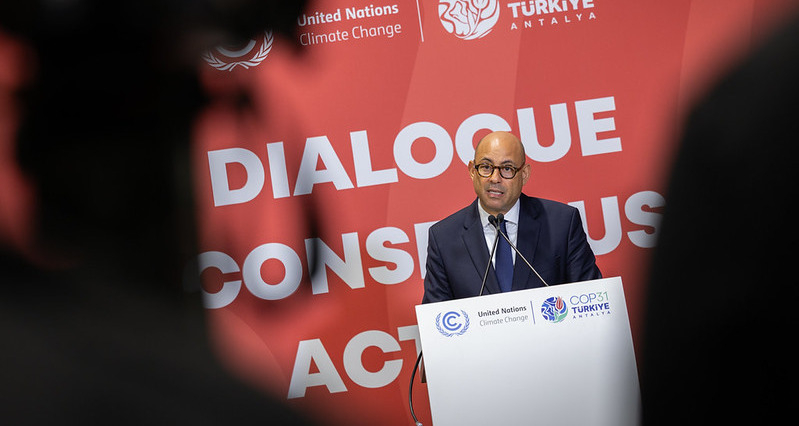
The failure of COP31 negotiations to reach an agreement in Antalya demonstrates that the world is trying to address a planetary crisis through a decision-making system that can be easily paralysed by a handful of governments. After the longest COP summit to date, COP31 ended without an agreed political pact.
As Fernanda de Carvalho, WWF Head of Policy for Climate and Energy, pointed out: “At the first COP held in a world expected to overshoot 1.5°C, consensus could not be achieved on fossil fuels, the primary driver of climate change, in the cover text.”
The draft that emerged contained no explicit reference to fossil fuels, just a mention of COP28, when countries agreed to “transition away” from fossil fuels in energy systems. European countries, vulnerable island states and other governments refused to accept a retreat from the commitments made at previous climate summits. There was no agreement on climate adaptation funds for vulnerable countries either, and negotiations ultimately collapsed. This outcome is the consequence of a few oil-producing states enabled by an undemocratic system, to censor and block the global population’s will.
A veto for the polluters
The core problem is COP’s consensus rule. Decisions require consensus from nearly 200 participating countries, so a small number can block a measure supported by the overwhelming majority. Draft rule 42, which would allow a two-thirds majority vote as a last resort when consensus proves impossible, has remained unresolved since the 1990s.
Democracy means decisions reflect the will of the majority, while protecting basic rights. What happened at COP31 was the opposite: a minority of countries was able to veto action demanded by countries facing floods, heatwaves, droughts, and other existential threats, proven to have been caused almost entirely by burning fossil fuels.
The minority deliberately damaged and disrupted efforts to prevent and mitigate these extreme events, which put billions of lives at risk (4.5 billion are exposed to climate-related hazards).
Russia and Saudi Arabia pushed to keep fossil fuels out of the final text. Russia’s delegate argued any formulation on fossil fuels could lead to shortages or price shocks. Saudi Arabia, another of the world’s largest oil exporters, led the resistance to any phasing out of fossil fuels. These governments came to Antalya to protect the very business model that negotiations have been attempting to stop from overheating the planet.
Outraged former U.S. Vice President Al Gore called for urgent reform to the system — to empower leaders supported by science and the majority of the world’s population. Global climate policy should not be blocked by a minority of governments whose national revenues and foreign power depend on keeping oil and gas flowing.
The lobbyists got in
On top of governmental obstructions, fossil-fuel interests were physically present at the summit, seeking delay. More than 100 such corporations and industry groups sent delegates, including ExxonMobil and TotalEnergies. These companies’ core products are the principal cause of climate changing emissions.
Moreover, a record 700 carbon capture and storage (CCS) lobbyists gained access to the summit: more than the combined number of national delegates from G7 countries. CCS is often used by oil and gas companies as a public-relations shield, promising future technologies (costly and unproven at scale) while continuing drilling today. The final text itself emphasized CCS, omitting earlier references to fossil fuels. When fossil fuel executives and lobbyists sit inside national delegations, they shape climate negotiations.
Trump, Xi and Putin choose oil
While negotiators in Turkey were struggling over possible mentions of fossil fuels, the leaders of the U.S., China and Russia met in Shenzhen and decided to expand the production of refined petroleum products. They issued a joint statement pledging to keep more gasoline and diesel moving through the global economy.
European Union (EU) climate commissioner Wopke Hoekstra described the pledge as an “unfortunate reality.” It was a signal from the world’s largest energy producers that short-term supplies and geopolitical leverage matter more than climate stability.
China is the world’s largest polluter, despite being a clean-energy powerhouse. The U.S., under President Trump, has stepped back from climate cooperation, and Russia remains dependent on oil and gas exports. They actively promoted oil at a time when emissions should fall swiftly.
Putin’s presence in Shenzhen was presented as proof of Russia’s continuing global importance. But Russia is not an economic superpower: of the combined $57 trillion output represented in Shenzhen, Russia’s share was 5%. Russia’s influence at COP31 should not be mistaken for strength.
Related Articles
Here is a list of articles selected by our Editorial Board that have gained significant interest from the public:
Gore’s answer: majority rule
Al Gore offered what may be the most important solution to emerge from COP31: to replace consensus decision-making with a supermajority system. While sounding democratic, consensus does not guarantee democracy, nor effectiveness. A supermajority would require broad agreement — perhaps two-thirds or three-quarters of parties — but it would prevent a small coalition of oil states from imposing a veto on the entire planet. The nations that want climate action must build a coalition large enough to reform the system.
“The climate will not wait for governments to find their courage,” said WWF Global Climate and Energy Lead, COP20 president Manuel Pulgar-Vidal. He also encouraged dialogue on strengthening the UNFCCC, since multilateralism is essential in solving this global challenge. “We will keep pushing, alongside the communities, non-state actors, sectors and countries already delivering, until commitments shield people, places and ecosystems on the front line of the climate crisis.”
COP31 exposed an ugly truth. The greatest obstacle to climate action is the political power of those who profit from delay. An undemocratic consensus rule led to a historic failure: the predictable outcome of a system that gives veto power to major polluters.
The world can’t afford another COP held hostage by oil and gas. It needs supermajority voting and a firm exit from fossil-fuel expansion. Lobbyists should not be allowed to shape the negotiations meant to control them. Until then, COP summits risk remaining vulnerable to the very interests they seek to confront.
Editor’s Note: The opinions expressed here by the authors are their own, not those of impakter.com — Cover Photo Credit: Kiara Worth