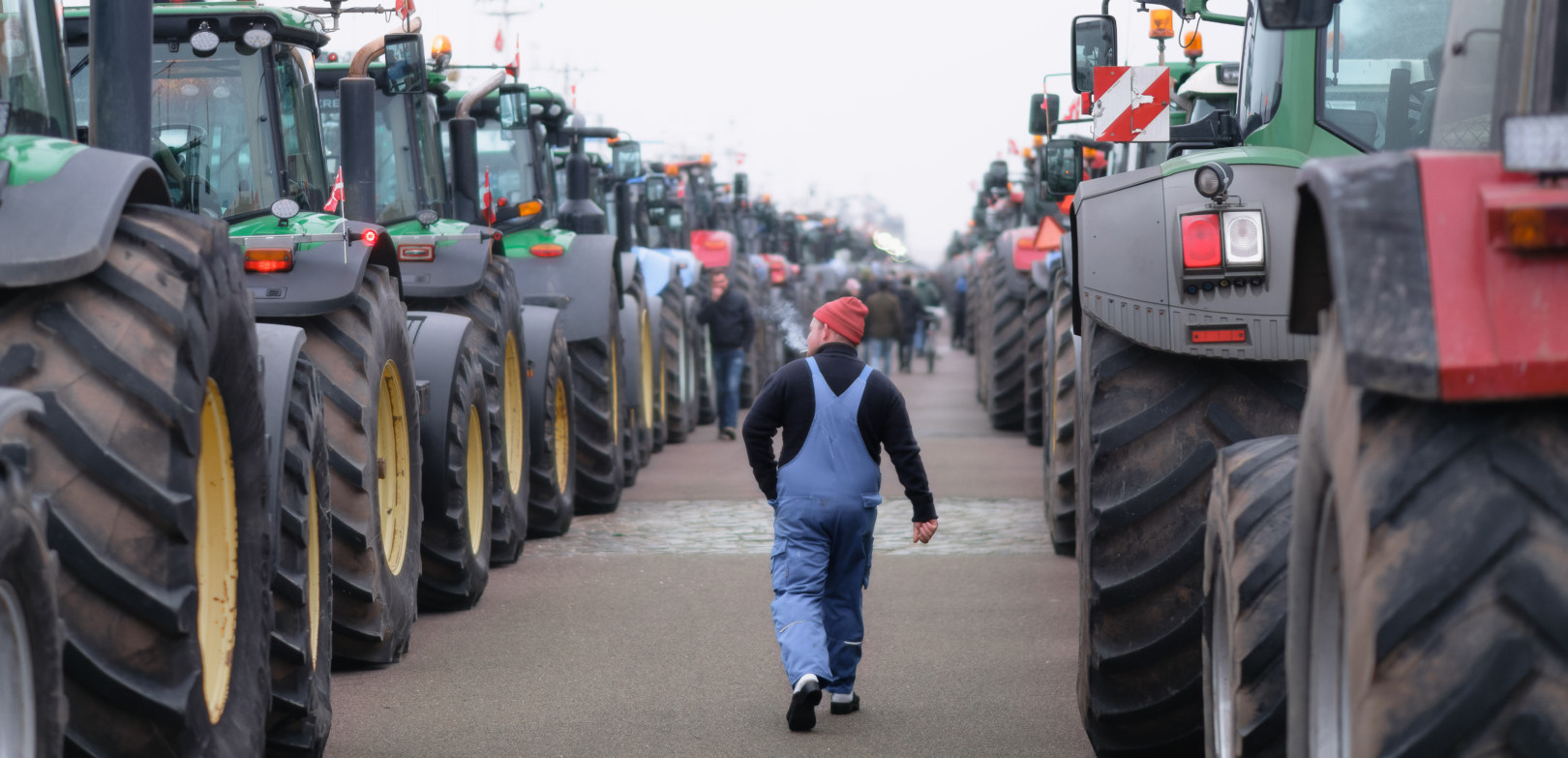
Hundreds of fed-up Germans driving tractors rumbled into Berlin and parked in a long line leading up to the stately sandstone columns of the Brandenburg Gate in mid-December. Many donned yellow vests, now the trademark garb of European populism. They blasted horns and brandished signs that said the German government had declared war on them.
The country’s center-left leaders, faced with a budget deficit, had decided to get rid of tax breaks on diesel used in agriculture, a move that would save the government some 900 million euros ($1 billion) — and one that might carry climate benefits — but would cost individual farmers as much as 20,000 euros ($21,500). Many growers and ranchers saw the cuts as the last straw in a series of events, like inflation, the war in Ukraine, and new environmental regulations, that had already made life harder for them. Protests mostly in the form of tractor blockades soon spread across the country.
Then they erupted across the continent. For the past few weeks, roads and city plazas in nearly every country in the European Union have been blocked by farmers angry about a number of regulations, including policies intended to reduce greenhouse gas emissions from agriculture. EU officials, who met earlier this month mere feet from protesters clashing with police in Brussels, scrapped plans for the bloc’s first-ever target to reduce climate pollution specifically from food production.
The protests have revealed just how tough it is for governments to curb agricultural emissions, not just in Europe but worldwide, policy analysts told Grist. Farming accounts for about 10 percent of climate pollution in both Europe and the United States, and climate scientists largely agree that curbing those emissions is key to limiting global warming. The EU’s reversal on agriculture-specific climate goals highlights the need for a meticulously-planned “just transition” — a shift toward climate-friendly farming that doesn’t ignore farmers’ economic needs, said Tim Benton, who directs research on food production and the environment at Chatham House, a think tank based in London.
“Farmers are increasingly fed up with being seen as the whipping boy of food-systems emissions, in terms of them being told they are bad people and bad managers of the land,” Benton said. “If we are going to do transitions, then we have to bring people along with us.”
With echoes of France’s populist yellow vest protests in 2018, farmers from Spain to Slovenia have been choking off highways with tractors, leaving hulking piles of dirt and manure in front of government buildings, hurling eggs and firecrackers at police, and setting hay bales and tires on fire. The farmers have a litany of complaints — high fuel and fertilizer costs, cheap imports and competition with foreign producers, volatile commodity prices — but one thing in particular has united them: the European Union’s climate policies, which they view as out of touch and overbearing.
EU officials, who agreed in 2020 on a target to make the continent carbon-neutral by 2050, were planning to make a recommendation this month to cut pesticide use in half and slash 30 percent of agricultural greenhouse gas emissions by 2040. After farmers took to the streets of Brussels, the European Commission – the EU’s executive branch — nixed the proposal, although they kept a broader target to reduce 90 percent of the bloc’s total emissions by 2040. Officials also delayed a recommendation to leave some farmland fallow to preserve biodiversity, and they abandoned a plan to promote lab-grown and plant-based meats to limit climate pollution from the livestock industry.
“We’ve seen this slide, this reversal from a really ambitious agenda a few years ago to basically nothing left,” said Patty Fong, director of the climate program at the Global Alliance for the Future of Food in the Netherlands.
The proposals would’ve needed approval by the EU parliament after elections in June, when the far-right is expected to make gains. Eyeing the polls, right-wing politicians in Europe have tried to capitalize on the farmers’ discontent as they push to dismantle the EU’s climate policies, according to Danielle Resnick, a research fellow at the International Food Policy Research Institute and the Brookings Institution in Washington, D.C. “The discourse is being hijacked in some quarters,” Resnick said.
Related Articles: How Can Sustainability Standards Do More to Ratchet Up Smallholder Farmers’ Incomes? | Informed Farmers Are Successful Farmers | How Does Climate Change Affect Agriculture?
Lacking popular support, top-down mandates and emissions targets don’t tend to work, Benton and other policy researchers told Grist. The key, they said, likely will involve investing billions of dollars to incentivize farmers to take up environmentally friendly growing practices and to ensure that they’ll make a living even if yields decline as a result of those changes.
As an example of a step in the right direction, Benton cited the Inflation Reduction Act, the landmark climate bill that the U.S. Congress passed in 2022. That legislation wasn’t accompanied by a specific target for lowering agricultural emissions, but it directed $20 billion to “climate-smart” farming and tens of billions of dollars more to spur the renewable energy transition.
In Europe, lawmakers have set ambitious climate goals, but they haven’t done the extensive planning — or investing — that the transition calls for, analysts told Grist.
“No one’s really proposing a long-term plan saying, ‘We need to transition. We need massive amounts of funding to be able to do this transition to more sustainable agrifood systems. This is how we’re going to pay for it. And this is how we’re going to support farmers in this transition,’” said Julia Bognar, head of the land use and climate program at the Institute for European Environmental Policy.
A daunting task for governments is figuring out where to get all that money to help farmers along. Bognar pointed to the vast subsidies that the EU already doles out: About one-third of its entire budget — some 56 billion euros ($60 billion) each year — goes to farmers, agricultural companies, and rural development. Bognar suggested that reallocating some of those payments would be one way to free up cash. For example, the EU could reduce funds that support environmentally harmful practices, like intensive livestock production at factory farms, and boost funds for practices that curb emissions (say, planting carbon-storing perennials like trees).
Still, dairy and meat companies probably wouldn’t let those livestock subsidies slide without a fight. And there’s no guarantee that money set aside for “climate-smart” agriculture will actually go to practices that help the planet. In the U.S., a good chunk of the Inflation Reduction Act funding, for example, could flow to equipment at factory farms, like methane digesters, which capture methane emissions from manure but still tend to pollute the air and water.
“It’s very easy to say we must have a just transition,” Benton said. “But I can’t think of an example where we’ve really managed it.”
** **
 This article by Grist is published here as part of the global journalism collaboration Covering Climate Now (CCN).
Editor’s Note: The opinions expressed here by the authors are their own, not those of Impakter.com — Featured Photo Credit: Kristoffer Trolle.