If national polls are to be believed, it would seem that next week America will shatter that ultimate glass ceiling and elect its first woman president, Trump permitted. However, this election season is exceptional, not just because it promises to set a historical new precedent, but also redefines American identity.
From its inception, America has been a nation of immigrants, readily eager to expand their horizons within its territories as well as project influence globally. The basis of American strength, however, comes from its ideological democratic legitimacy, liberal values and their successful global projection. The national narrative plays out internationally and requires a high degree of intrinsic legitimacy for credible success.
 PHOTO CREDIT: www.donaldjtrump.com
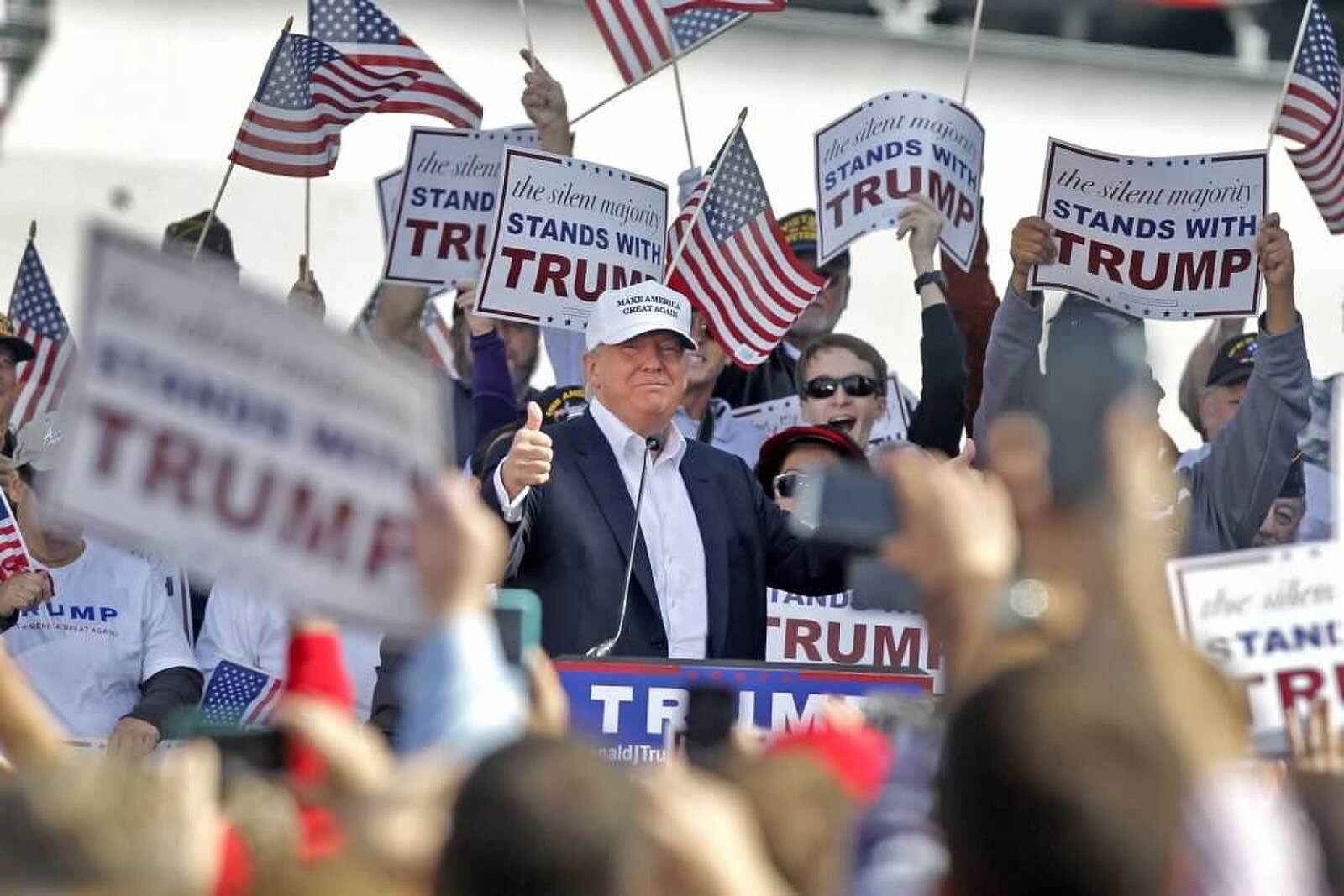
Donald Trump has amazed audiences with a flamboyant, anti-establishment narrative that has found traction with a significant population of American voters. His ability to reduce global politics to succinct “politically incorrect” repartee has won him fans and haters alike.
Without a doubt, America plays a policing role in the international arena. In an increasingly complex world, it continues to dominate and assert power to maintain the existing global order. In a nation’s international existence, interests lie supreme. Within the spectrum of interests, self-preservation tops the hierarchy. Thus, any actual perceived or potential threat, in the event of a crisis or one to deter a crisis, is significant.
An election year seems to magnify this phenomenon, and the rhetoric of national leaders follows suit. Trump has successfully focused these potential threats around the risk from immigrants, economic disadvantage, global security and international power assertion. Despite some distinct rational anomalies, Trump has successfully garnered support around these interweaving themes. ‘Make America Great again’, a widely recognized slogan, has struck a strong anti-establishment cord and cannot be shrugged off. In comparison, Hillary Clinton’s ‘Stronger Together’ seems unconvincing in the face of ever evolving global security challenges; ‘I’m With Her’ sounds decidedly personal and non-inclusive in nature.
It is easier to comment on policy analysis in hindsight, however, every real-time decision comes with its own personal set of constraints and choices. Trump has, with some credible success, painted his opponent as a stooge of insider interests, continuing to support the status quo and failing to credibly assert American strength internationally. Despite being plagued by scandals in recent weeks, the Trump campaign has struck a chord with American voters. This very visible global projection of perceived American opinions can be expected to create ripples in the international arena.
Political leaders, as defined by Dyson, fall under two broad categories: “constraint challengers” and “constraint respecters.” Constraint challengers make foreign policy based upon state goals and interests and not a mere survey of the political landscape; whereas “constraint respecters” restrict their perusal of international policies to ones consistent with key actors and domestic opinions. Most leaders walk the tight rope between these two categories. An election year puts their strategic messages under a microscope for the domestic as well as international audience.
A clear and steady strategy is the hallmark of every pragmatic state. However, the formulation and execution of that strategy uses a variety of tools that lie across a spectrum. Complete reticence is never an option, nor is the unbridled employment of political and state resources. It’s always a tight rope where nations switch between the roles of constraint challenger vs. constraint respecter.
Given its dominant global status and its willingness to maintain it, the US cannot adopt a completely reticent stance. However, political- and resource-based constraints prevent the US from taking on every potential threat. Over-extension would in fact put into jeopardy the very dominant balance of power that it hopes to preserve. Trump’s rhetoric has, convincingly for many, painted a dire state of reticence in the global arena that has rendered America weak. According to him, be it the Iranian nuclear deal, NATO Alliance or the Japan-U.S. Security Treaty, “We don’t win anymore”.
The American president plays a major part as a national spokesperson navigating and influencing geopolitics. Given its strong economic standing and adept political maneuvering, the US has navigated the international labyrinth through various treaties, alliances and proxy commitments since the end of WWII. It is naïve to believe that for America, holding the position it does today in the world order, and in fact since World War II (least a very drastic change in its dominant status, or self-perception), a choice of complete reticence even exists. However, the combination of Donald Trump’s rhetoric that plays with a dual conception of economic reticence and military extension is a fascinating combination. Ideology and globalization are broad themes that underlie American global projection of power, and political rhetoric directly influences global perceptions as well as reactions towards American power.
International Security Dynamics in the Light of Donald Trump’s Rhetoric: Freeloading Allies?
NATO & Russia, Japan-US Security Treaty & Allies in the Middle East
In the calculus of ensuring peace and safeguarding ideological liberal values, America as a global leader has historically committed to a number of treaties with international allies. These include the North Atlantic Treaty, The South East Asia Treaty, The Japanese Treaty and Republic of Korea Treaty, to name a few. The rationale behind such alliances lies in creating credible deterrence against potential threats from its global rivals, essentially Russia and China. The most significant among these is NATO, which has been a key issue in Trump’s international relations policy.
The letter of the North Atlantic Treaty states that an attack on any of its members would be deemed an attack on all, thus promising a united front against any potential threats from Russia. Trump’s sharp stance to consider not helping its allies unless they fulfill their ‘obligations’ diverges sharply from the traditional US policy. While this might sound shocking to many analysts, some have actually conceded that there is some truth in Trump’s claims. Whichever the case may be, it is important to consider possible ramifications of such a policy shift.
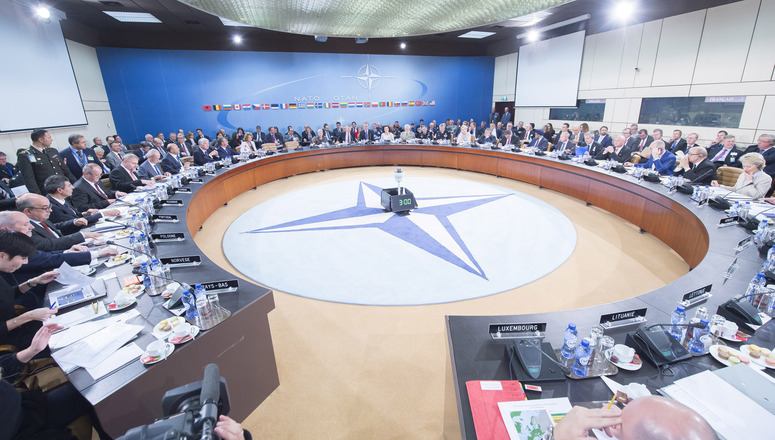
PHOTO CREDIT: NATO
Best Case Scenario-Jolt Allies into Action
Trump is not the first to come out with such criticism. President Obama in a series of interviews earlier this year voiced similar sentiments towards many international allies including NATO. In a state of global political exhaustion from and conflict, Americans would perhaps fare better under a leader who can credibly jolt international allies into pulling their weight.
Related article: “MY HILLARY: REFLECTIONS ON THE REAL CLINTON“
Worst Case Scenario- Mass Global escalation in Arms race
At its worst, Russian ambitions would have greater freedom to intimidate its neighboring regions, as well as to enhance its influence globally by offering to fill in the void of protection and support to allies in the Middle East. The New START treaty, signed between the US and Russia in 2011, promised responsible reduction in the number of nuclear weapons and launching capabilities, while still holding on to basic deterrence. However, recent reports suggest Russian ambitions are on the rise with Russia moving nuclear capable missiles closer to the Polish border while considering expansion of bases in Cuba and Vietnam.
In the absence of a strong American stance, Russian influence may increase among the vulnerable Baltic States that may become more receptive to seeking Russian favor. Also an increase in militarization and defense capabilities of European or even East Asian and Middle Eastern allies, in the face of rapidly evolving security challenges, could trigger mass global escalation in arms. This would render the world collectively less safe.
Domestic & International Security Challenges: Immigrant Crisis, Xenophobia & Race relations
In the case of immigration and security challenges, the tone of the Trump message is decidedly more aggressive. One aspect of it is regional and pertains mostly to Mexican illegal aliens in the country. According to Pew polling, there were 11.1 million unauthorized immigrants in the U.S. in 2014, accounting for 3.5 percent of the nation’s population. Another Pew survey conducted in May revealed a solid majority (72 percent) of Americans – including 80 percent of Democrats, 76 percent of independents and 56 percent of Republicans – say undocumented immigrants currently living in the U.S. should be allowed to stay. The language and rhetoric surrounding this, however, is equally significant. Trump’s description of illegal immigrants as ‘rapists, criminals and drug abusers’ has created significant sociocultural ripples.
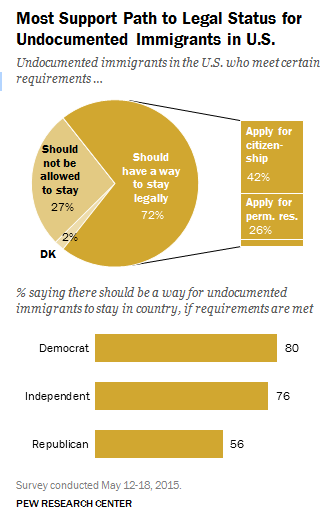
PHOTO CREDIT: PEW RESEARCH CENTER
Meanwhile, the controversial call for a “Muslim Ban” is a sharp stance from a leading political figure that gives levy to xenophobic social tendencies. This was further highlighted in the Skittles controversy involving Donald Trump, Jr. comparing Syrian Refugees to a bowl of candy in which one could possibly ‘kill you’, thus arguing to refrain from extending support in the ongoing Syrian war and the European immigrant crisis.
Racial tensions, according to Washington State University professor Richard King, has a significant correlation with Xenophobic tendencies, which is fueling Trump’s rhetoric. In a diverse nation of immigrants undergoing a severe and increasingly violent race relations crisis, the effect of sharp political language has the potential to further fuel discord. The percentage of Americans worried about race relations has doubled in the past 2 years, at a record high of 35 percent.
Best Case Scenario:
As Trump points out, a significant portion of the global Muslim population has an unfavorable image regarding America, even among many of its allies in the war against terrorism. A politically incorrect attitude in global negotiations might create a more realistic and less hypocritical environment that continues to frustrate joint efforts in global security challenges.
Worst Case Scenario:
Though issues of socio-racial discord and anti-immigrant rhetoric are very distinct in nature, there are many underlying themes that fuel the crisis. In addition to having severe sociopolitical consequences, such rhetoric has credible ramifications for international audiences. These include European allies dealing with the Syrian immigrant crisis, Muslim allies supporting efforts against the war on terror, or terrorist organizations that use rhetoric to fuel ideological sentiments among followers.
As a consequence, as Hillary Clinton promises, not only would this alienate mass populations of American Muslims but also tarnish American influence or credibility as a global leader and ally in ongoing global security challenges. The nation would thus lose its ideological legitimacy as a proponent of inclusive liberal values.
A Post-Election World
Historically the amplification of US power projection has been through strong alliances and coordinated efforts. The DNI Global Trends 2030 report recognizes that in the next couple of decades power will become more multifaceted and contextual. In most cases, US power would need to be enhanced through relevant outside networks of friends and affiliates. This is however much easier said than done given the complex and divided nature of transnational actors who actively monitor and are influenced by the hate filled rhetoric of the election.
With all eyes on America this election year, the real test will come post election. Though the current focus is on domestic partnerships, these have a direct impact on international projections of power. American pride in its institutionalized and inclusive system of governance is under the global microscope.
Despite divisiveness, the coming weeks can either have the potential to throw the entire nation into chaos or render the strongest stamp of approval through a successful transition under new leadership. For the sake of mitigating global security challenges under a united global front, one can only hope for the later.
Recommended Reading: “IMPAKTER ESSAY: THE YEAR OF THE LEAK“