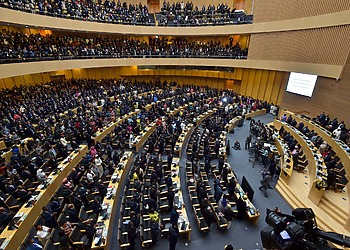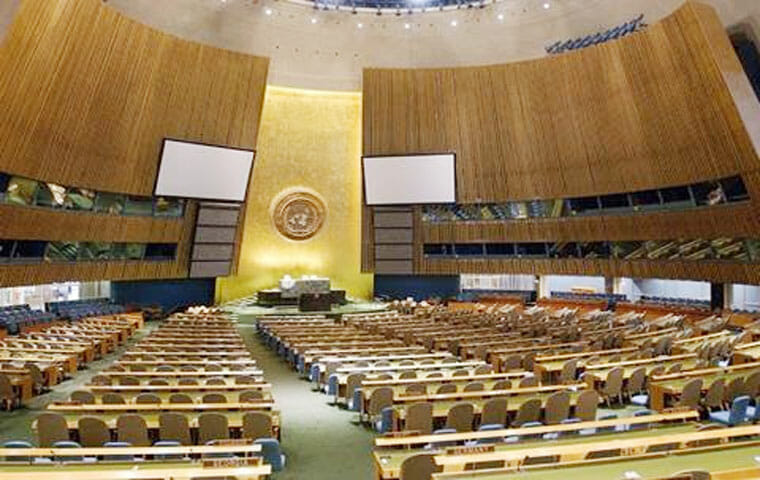
The United Nations General Assembly (UNGA) opens tomorrow September 21 in the shadow of AUKUS, the new alliance between the US, Australia and the UK announced last Thursday, September 16. That announcement, presented as a pact against Chinese aggression, predictably rankled China but it also rattled Paris. All this quickly degenerated into an enduring diplomatic row between two old allies against China, France and the U.S. By Friday, France had taken the unusual step of recalling its ambassadors from both the US and Australia over the weekend for consultations. Why is France, one of America’s oldest allies, so upset, and what is AUKUS? And how could all this affect the United Nations’ annual debates in New York?
#UNGA – A High-Level Week | The UN General Assembly starts on 21 September in a hybrid format (in-person meetings and videoconferences).
France will take part in events reflecting its current priorities:
🌍Climate emergency
🤝Commitment for strong & efficient multilateralism https://t.co/3FR6PJHgPP— France Diplomacy🇫🇷 (@francediplo_EN) September 20, 2021
: 400;”>
Note French priorities coming to UNGA: (1) Climate emergency and (2) Commitment for a “strong and efficient multilateralism”. Regarding (2), this language about multilateralism means clearing up the AUKUS mess.
Several factors contribute to drawing the world’s attention away from the sustainability issues that the UN Secretary-General Antonio Guterres would have liked to see take center stage at the UNGA debates that will last until September 27. He had presented his report laying out “Our Common Agenda” at the closing of the previous UN assembly in order to set the stage for the coming debates at UNGA.
To begin with, the Indo-Pacific region is crucial for the world: The vast area includes seven G20 members (Australia, China, India, Indonesia, Japan, South Korea and South Africa) as well as the Association of Southeast Asian Nations (ASEAN). So political disturbances in this part of the world inevitably attract attention.
Another (somewhat unexpected) contributing factor that will make it difficult for UNGA to keep the focus on Our Common Agenda is that, contrary to what the UNGA host country, the U.S., had hoped, the event will be far less virtual than originally planned. The U.S. had written last month to UN member countries to encourage them to attend virtually so that UNGA would not become a coronavirus super-spreader event.
Instead, more than 100 leaders, including several European chiefs and foreign ministers, are expected to come to New York in person, accompanied by their usual large teams. Among them, the EU’s top political leaders — Commission President Ursula von der Leyen, European Council President Charles Michel and foreign policy chief Josep Borrell — are also coming and are scheduled to meet U.N. Secretary-General António Guterres.
Most importantly, US President Joe Biden is due to meet French President Emmanuel Macron in the coming days, the Elysée said on Sunday. A State Department spokesman also said it hoped that high-level talks with the French delegation in New York could be held, “in line with our close bilateral partnership and commitment to co-operation on a range of issues, including the Indo-Pacific.”
This means that in-person meetings will play a bigger role than expected, introducing a dimension of serendipity, as people seek to meet each other and directly discuss matters of a national concern rather than the general global issues raised by Guterres in Our Common Agenda.
In this context, AUKUS, the geopolitical issue that has suddenly emerged over the past few days, threatens to grab everyone’s attention. So what is it about? AUKUS is a submarine pact between Australia, the US and the UK for the furniture of nuclear-powered submarines – replacing the €50 billion contract Australia previously had with France.
But the dispute is not just over a torn-up contract, though admittedly it is a big one. It’s about torn-up trust: It makes erstwhile allies sink into bitter disputes and raises the specter of a major geopolitical shift, with the U.S. clearly signaling that it is moving away from Europe and looking to the Indo-Pacific.
Put yourself into French President Macron’s shoes. The submarine contract with Australia might have been in trouble, there were delays in delivery. And the Australians wondered whether the submarines they were getting from France weren’t a little outdated. So Australia apparently jumped on an offer of eight nuclear-powered subs by the US, convinced it would give them a better deal.
But the story is not simply one of a commercial failure on the part of the French. For France, which has a historical and political presence in the Pacific on several islands, the Indo-Pacific is a region that matters. Moreover, France is a major geopolitical player as one of the two European nuclear powers (the UK is the other European). And its presence at the UN is key: It is one of the Big Five at the UN, with a permanent seat and veto power on the UN Security Council. And now, with the UK out of the European Union, France is the only EU member left in the Security Council. This is not a country the US should trifle with – yet that is precisely what the Biden Administration did.
The French Foreign Affairs Minister Jean-Yves Le Drian did not mince his words: he called it a “real stab in the back”.
#FutureSubmarineProgram | #FSP
Termination of the “Contract of the Century”:
❝This is a real stab in the back. We built a relationship of trust with #Australia, this trust is betrayed❞ stated @JY_LeDrian. https://t.co/Vxxm478Wib— France Diplomacy🇫🇷 (@francediplo_EN) September 16, 2021
And French-UK relations also took a hit, with the Armed Forces Minister Florence Parly canceling a meeting with her British counterpart Ben Wallace planned for this week, Reuters reported. In fact, the French tended to downplay the role of the UK. Foreign Minister Jean-Yves le Drian said on French TV that the U.K. is a “bit of a fifth wheel on the carriage” when it comes to the AUKUS pact.
If France is unhappy, so is the EU. In the space of a few hours after AUKUS was announced, EU foreign policy chief Josep Borrell entered the European Commission’s press room to present the EU’s new Indo-Pacific strategy. “We were not even consulted,” said Borrell. ‘I, as [the EU’s] High Representative, was not aware of it, and I assume an agreement of such nature wasn’t brought together overnight.”
The “EU Strategy for cooperation in the Indo-Pacific” is designed to make the EU more engaged and visible in the region. In 18 pages, a range of actions is outlined in the fields of sustainable development, climate change, trade, connectivity, research, security, defence, rule of law and democracy. The EU’s engagement is described as long-term, principled, inclusive and grounded in international law. The case for closer cooperation is made arguing the EU and Indo-Pacific are already “highly interconnected”: around 40% of the EU’s foreign trade passes through the South China Sea. In the EU Commission estimate, the Indo-Pacific region and the EU taken together hold over 70% of global trade in goods and services. A planned EU trade agreement with Australia was meant to be part of the strategy, but as mentioned below, with the row over AUKUS, that is now in doubt.
Moreover, France can count on Germany’s political support. Berlin, and many in the European parliament, are seeing America’s pivot to Asia as a signal for Europe to seriously consider building up its own defense capabilities. Politico reported that it was told by one Berlin official:
“After Afghanistan, this shows us yet again that we cannot fully rely on the U.S. It’s packaged in nicer words, it has a friendlier face than Trump, but Biden’s policy is America First.”
The reference to Afghanistan in that quote evokes the unwelcome fact that U.S. withdrawal from Afghanistan was done unilaterally, without appropriate prior consultations with European allies. Also, despite the self-congratulatory feeling in the UK that appears to have played the role of an intermediary in the deal, making Downing Street (or as it likes to call itself, No 10) a global player again, problems are looming for Australia.
‘Like a scene from le Carré’: how the nuclear submarine pact was No 10’s biggest secret
Only 10 people in #Britain knew about its plans to stand with #Australia & the #US against #Chinese aggression in the #IndoPacific
This is how the deal was done ⬇️https://t.co/vg8VQMrzGf
— Indo-Pacific News – Watching the CCP-China Threat (@IndoPac_Info) September 19, 2021
Australia appears to have followed British advice in this matter without considering that it had in the works a trade agreement with the EU under negotiation – an agreement that is now at risk. It was meant, inter alia, to provide Australian farmers preferential market access for their beef and dairy products. For Australia, that was a big part of the trade deal but, without France’s approval, it’s not likely to happen. German MEP Bernd Lange, chair of the European Parliament’s trade committee, noted that “The willingness to compromise, on the European side, has now certainly decreased,” adding that Australia’s scrapping the French contract had also hit German interests. “For example, the German company Atlas Elektronik, part of Thyssen Krupp Marine, is also affected,” Lange said.
This is all unfortunate, and playing in the hands of Moscow and Beijing. Let’s hope the US and its allies will use UNGA as an opportunity to quickly patch up their differences so that the world can move on and address the much larger issues of climate change and sustainability that affect us all.
Editor’s Note: The opinions expressed here by Impakter.com columnists are their own, not those of Impakter.com. — In the Featured Photo: UN General Assembly Hall (cc)