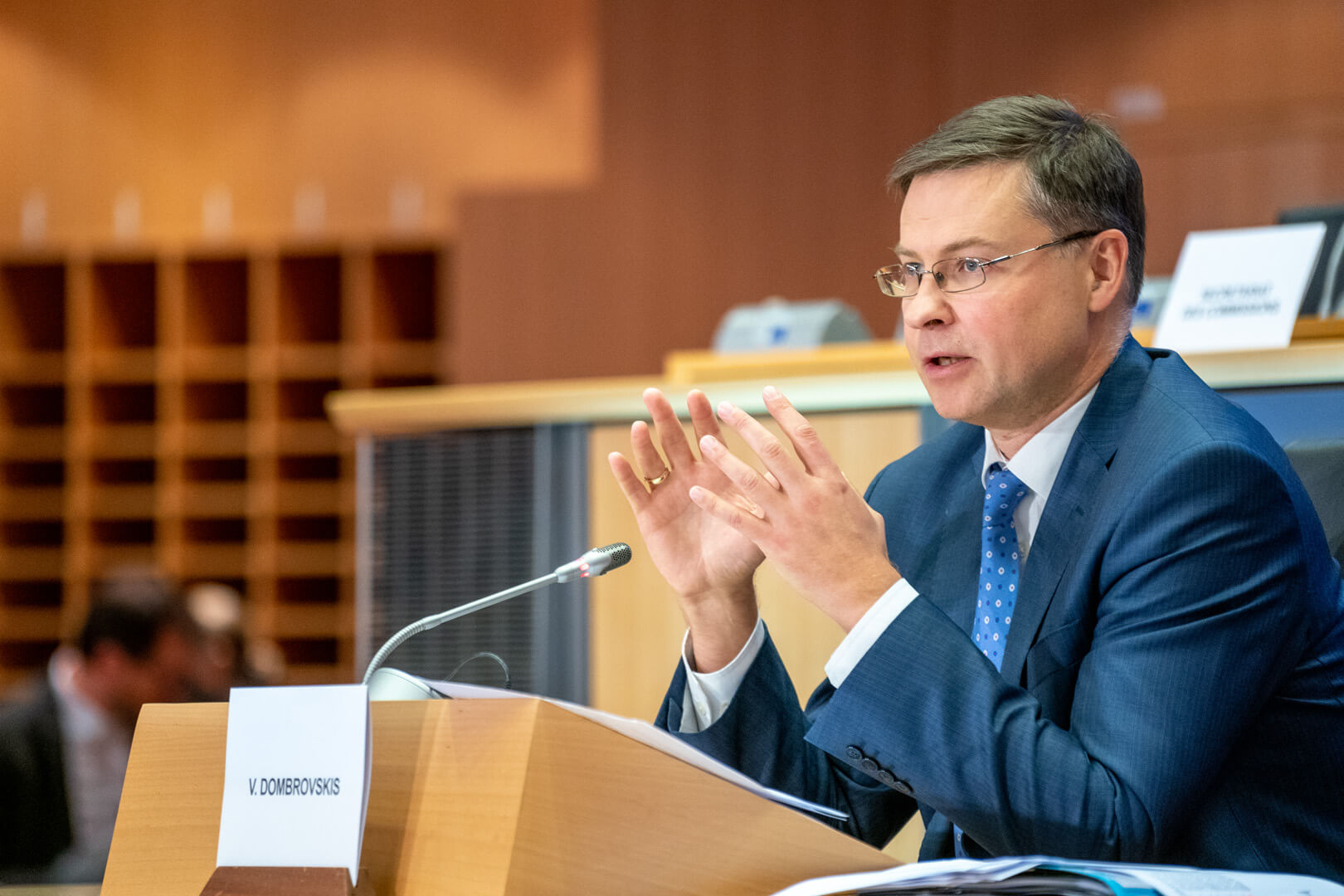
In Brussels, EU “super” Commissioner Valdis Dombrovskis – as Executive Vice-President, he is in charge of finance, economics and trade – talked to Politico yesterday, warning that if diplomatic negotiations with Putin were to follow the appeasement strategy that had characterized talks after his aggressive take-over of Crimea in 2014, then Putin would feel he has carte blanche to continue his aggressions against the EU – and that the Baltic States would be next. Belarus wants access to the Baltic Sea and Putin would only be too happy to oblige his ally.
Unless Russian President Vladimir Putin is stopped in #Ukraine, his next victims could be Lithuania, Latvia, and Estonia, – European Commission Vice President Valdis Dombrovskis. pic.twitter.com/DyPWJEoXnC
— KyivPost (@KyivPost) March 8, 2022
Dombrovskis has long been one of the strongest voices in the EU Commission to warn about the threat Putin posed. Now, he is convinced that despite the veiled threat of nuclear aggression from Moscow, it would be a mistake to give in to Putin.
Is Dombrovskis right? After all, here is a man who knows the situation first-hand; a former Latvian prime minister, he grew up in the Soviet Union. And soviet propaganda – the systematic denial of truth in order to promote one’s goals – is something he is very familiar with.
Disclosure: I also lived in the Soviet Union for a few years, first as a teenager and later, as a grownup I went back for a couple of years in the 1970s; and I remember well the extraordinary extent to which Soviet authorities would lie about the news, pasting banners on every wall in Moscow that read “Peace in the World” (Мир в мире) while building up the Russian army and its nuclear force to rival the U.S. and fomenting local wars around the world as part of its (clever) Cold War strategy. Peace in the world indeed! And we need to remember that this is the world Putin grew up in and became a KGB lieutenant: One rarely forgets one’s roots and Putin certainly hasn’t.
For context, it’s worth noting several things that are remarkable and even unique about this Russian-Ukrainian war:
- The collapse of any claim to the high moral ground by Russia: First, muzzling dissent and the free press: anyone who protests and dares to call war the Russian invasion of Ukraine can get up to 15 years in jail, in Russia, you are only allowed to call it a special operation to “denazify” Ukraine; second, promising to open humanitarian corridors to allow people to reach safety and never respecting either the necessary cease-fire such corridors entail or allowing people to reach destinations other than Russia or Belarus (who are they kidding?);
- Russian attacks on nuclear plants (after all, Ukraine has 15 reactors and the largest nuclear plant in Europe) and he is said to have around 2000 nuclear tactical weapons (designed to be used in battlefields), raising the specter of nuclear war; some observers even suggest the unthinkable: that Putin might be tempted to erase by nuclear means the whole population, creating a no man’s land in the heart of Europe, for his purposes, the ideal buffer state; but a note of caution is in order here: so far no country has used nuclear weapons since 1945 even though nine countries possess them, including North Korea, China, India, and Pakistan; when Biden was asked if Americans should be worried about nuclear weapons, he responded with just one word: “No”;
- Massive response from Ukraine: systematic conscription of the whole Ukrainian male population to fight against the invader, leaving only women, children and older people (over 60) to flee the country – which is likely to turn into a tsunami of refugees, over 4 million in just 10 days, according to UNHCR;
- Limited response from the West in line with previously meek Western responses, especially following Putin’s grab of Crimea in 2014; yet the West is mustering an unprecedented set of sanctions, including the application of SWIFT suspension, preventing the Russian Central Bank and several major banks from using the secure international payments system provided by SWIFT; and, as the war is prolonged, sanctions are increased, including a ban on Russian oil exports, the lifeline of the Russian economy – but whether that will stifle Putin’s finances enough to get him to stop the war is open to question.
If sanctions don’t work, how can we expect diplomatic negotiations to work? And that, of course, is precisely Dombrovskis’ point. As a Latvian himself, he clearly fears that after the Ukraine war, if the settlement reached is going to be of the same nature as that of the Minsk protocols, the prospect for the three Baltic countries, Estonia, Latvia and Lithuania, are grim.
The Baltic states are potentially next in line, particularly as there already exists an “anti-Baltic rhetoric” on the part of Russia. As Dombrovskis pointed out, “in Ukraine, it also started with increasing anti-Ukrainian rhetoric.”
Dombrovskis was skeptical regarding the EU’s diplomatic overtures toward Putin.
In fact, diplomatic channels appear to be wide open and rather active: Low-level delegations from Russia and Ukraine regularly meet on the Belarus border, three meetings so far, although yielding no results. French President Macron is regularly on the phone to Putin but with no results either, except for Putin strongly confirming that he will not stop and plans to achieve his goals through either “negotiation or war”. Turkey’s President Erdogan pleaded for a cease-fire and got none. Israel’s Prime Minister Naftali Bennett went to Moscow and Kyiv and nobody really knows what happened, whether there will be any follow-up to his proposed mediation.
China is also offering mediation and that would be a first for China which so far rarely wades into politics and generally prefers to stick to economic weapons like its Belt and Road Initiative. China has deplored the war and criticized sanctions as “harmful on all sides”. However, China continues as Russia’s ally and if sanctions bite, then it could turn into a major economic partner. Not the best ground to become a mediator and not likely to elicit Ukrainian trust.
Going back to what Russians are likely to do. As Dombrovskis sharply noted: “The question is whether they [the Russians] bring some tangible results in terms of stopping the war, or at least providing a ceasefire or humanitarian corridors. Currently, none of these unfortunately materialized.”
Yes, the Russians are certainly not trustworthy and Western leaders in the recent past – in particular former German Chancellor Merkel – could be accused of having shown weakness, or at least of being “too soft” on Putin (Dombrovskis in his interview with Politico stops short of saying this).
After all, Merkel also knew Russia and the Russian language, and, as a German born and raised in East Germany in Soviet times, she was well aware of the dictatorial nature of the system. How could she trust Putin? Maybe she didn’t but she certainly made no attempts to raise barriers or put limits to his demands. When you read the Minsk Protocols, it really boils down to full acceptance of the status quo: Putin took Crimea and that’s that. Some observers even argue that the failed Minsk agreement has sowed the ground for this war.
So has the EU learned the lesson of the Minsk talks? Dombrovskis was doubtful: “This still needs to sink in. Unfortunately, there are still some illusions — willingness to do some sort of appeasement of the aggressor”, he said, adding by way of conclusion: “These are lessons that should have been learned before. Appeasement of the aggressor is not working, and the aggressor needs to be stopped by all means.”
Does Putin need to be stopped “by all means”? Coming from an EU Commissioner, that is a very strong statement and it is something to ponder over. As a mere European citizen, I find it difficult to disagree with it: After Ukraine, the Baltic states; and after that?
Editor’s Note: The opinions expressed here by Impakter.com columnists are their own, not those of Impakter.com. Featured Photo: Dombrovskis as European Parliament when he was EU Commission Executive Vice President-designate at hearing in 2019 Source: Europa news