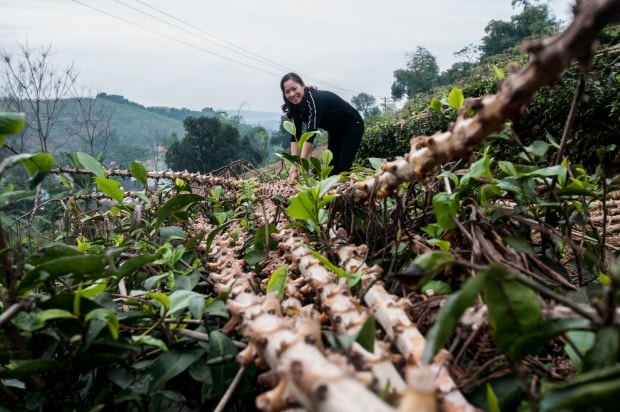
Running for almost two decades already, a local project in Vietnam has been exhibiting the economic, environmental, and social benefits of cassava-based conservation models.

By the early 2000s, the Van Yen District in Yen Bai Province, Vietnam, had experienced yield loss and food insecurity due to unsustainable practices, such as intensive farming and monocropping. These practices reduced forest coverage to accommodate agricultural production and depleted the lands of vital nutrients. The worsened condition of the lands bred pests and diseases that destroyed crops.
To restore degraded lands and boost agricultural production in the district, the Department of Agriculture and Rural Development launched an agricultural project in 2003. It introduced cassava-based conservation models to replace the resource-intensive strategies that maximized possible yield at the expense of the environment. Only a few years after its launch, farmers have already started feeling the benefits. 17 year in, the project offers a variety of learning points. Therefore, in 2019, the CGIAR Research Program on Climate Change, Agriculture and Food Security in Southeast Asia (CCAFS SEA) worked with the Vietnam National University in Agriculture (VNUA) to assess the progress of the project.
Related topics: Studying climate-smart agriculture in Vietnam – Climate-Smart Cocoa practices help farmers adapt – Nyando Climate-Smart Village
The assessment offered insights to CCAFS SEA on how to generate outcomes and impacts through vertical (policies and institutions) and horizontal (farmer-to-farmer; landscape-to-landscape) scaling. It was conducted through quantitative and qualitative methods, gathering information from 488 farmers across six communes in the district. Specifically, the farmers provided information on productivity growth, yield stability, investments, gender equity, and levels of participation in trainings and meetings, among other variables. VNUA and CCAFS SEA also collected soil samples to assess the level of soil restoration achieved in specific areas.
Cassava models introduced
The initial conservation models introduced were cassava-contoured forage barriers and cassava-contoured fallopian barriers. The former involves planting cassava on specific plots within the field boundary. Along the contour lines, forage barriers are built to serve as livestock feed and in turn reduce costs of farmers. The latter, meanwhile, consists of planting cassava and leguminous fallopian species together to control soil erosion and restore soil fertility. However, unlike forage, fallopia cannot be fed to livestock.
Eventually, more models were tested by the project, utilizing cassava stems as barriers and intercropping cassava with cowpea and trees. These are illustrated in Figure 1 below.
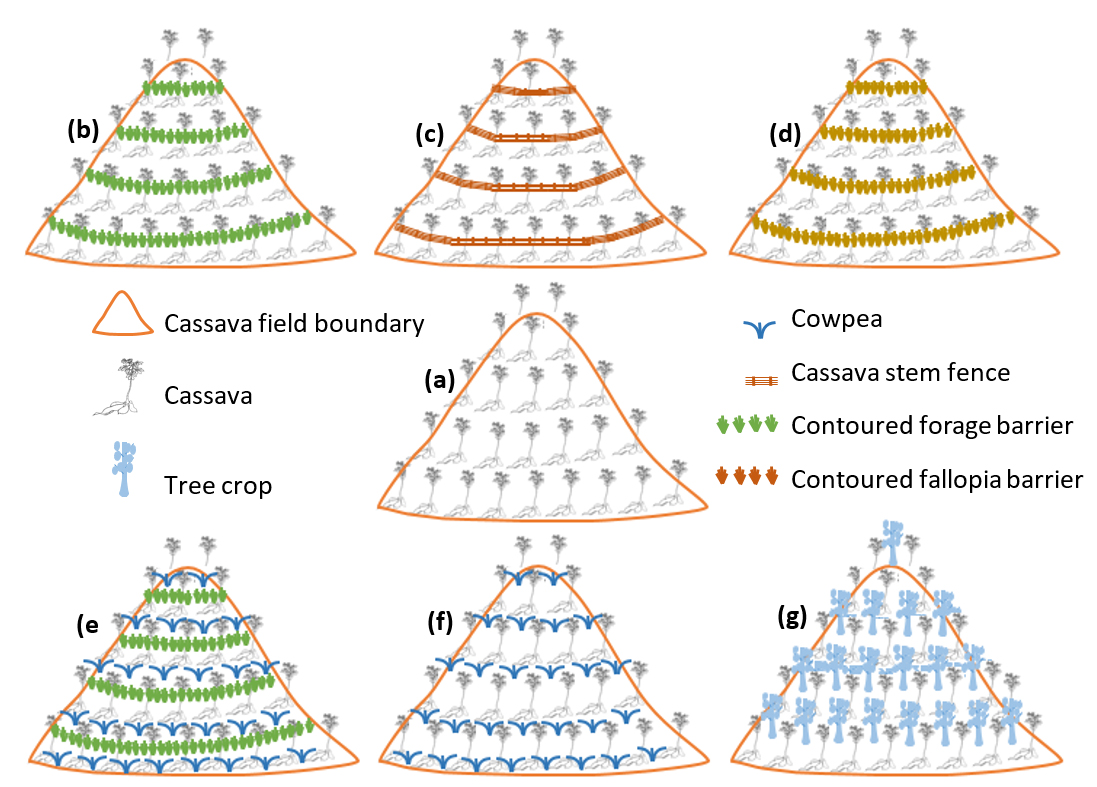
Figure 1. Illustrations of cassava-related management practices. Source: Bui et al., 2020
(a) Cassava monocrop; (b) Cassava – contoured forage barrier; (c) Cassava – contoured cassava stem fence; (d) Cassava- contoured fallopia barrier; (e) Cassava – contoured forage barrier – cowpea; (f) Cassava – cowpea; (g) Cassava – tree crops
Since adopting these models, farmers have almost doubled their income and increased their yield. Cassava-contoured forage barriers specifically raised the cassava yield by 15%-20% after five years. In another model wherein cowpea is intercropped with the barriers, the best soil infiltration rate was observed, i.e., the farmers were able to significantly limit soil erosion and consequently, improve soil quality.
This same model was deemed the most suitable and feasible by the farmers. This means that it complements their current practices and fits their farming experiences. Likewise, the materials readily available to the farmers can be used for such a model, which they perceived as easy to learn. They have learned all the conservation models during trainings and village meetings. The most attended trainings were those that discuss cassava-contoured fallopia barriers, cassava-contoured forage barriers with cowpea, and cassava-cowpea.
Download the publication: Bui LV, Nguyen HN, Nguyen TC, Nguyen DT, Trieu HL, Doan TT, Nguyen DT, Vu TB, Nguyen TH. 2020. Impact assessment of a local seventeen-year initiative on cassava-based soil conservation measure on sloping land as a climate-smart agriculture practice in Van Yen District, Yen Bai Province, Vietnam. CCAFS Working Paper No. 308. Wageningen, the Netherlands: CGIAR Research Program on Climate Change, Agriculture and Food Security (CCAFS).
About the author: Renz Louie Celeridad is the Junior Communications Specialist for World Agroforestry (ICRAF) Philippines and Communications Consultant for CCAFS Southeast Asia.
EDITOR’S NOTE: The opinions expressed here by Impakter.com columnists are their own, not those of Impakter.com. Photo Credit: G. Smith (CIAT)