Amidst the COVID-19 pandemic, Black Lives Matter (BLM) protests have been erupting across the globe for almost two months, releasing with them the frustrations of millions of Black people, fighting in what seems like a never-ending battle for equality, justice, and the right to live. The broad spread of these protests has amplified black voices and their demands for change at an unprecedented level. The magnitude of this can be seen in countries such as Tunisia, the only Middle East and North Africa (MENA) country to hold BLM protests. Stark similarities between the BLM protests and the Arab Spring place Tunisia in a unique position to pave the way for Black liberation across the region.
This article was first published on the Minority Rights Group (MRG) website and can be found here.
The murder of George Floyd at the hands of police triggered an unprecedented wave of Black Lives Matter protests. Black people and their allies took to the streets to protest a government apathetic to their social, cultural, and economic rights, in over 100 countries. Similarly, the self-immolation of Mohamed Bouazizi in 2010 sparked protests known as the Jasmine Revolution in Tunisia, the first in a chain of events that became the Arab Spring and led to major upheaval across the Arab world.
The death of Bouazizi, a street vendor protesting harassment from the authorities lasting several years, catalysed resistance that was met with government repression and police violence. This repression animated country-wide protests demanding an end to government corruption as well as an end to unemployment and food insecurity.

Saadia Mosbah, president of the Association Mnemty stated “What happens in the USA is clear, it’s being fed up, like us with Bouazizi. It’s about a spark everywhere in the world. I think Black people said to themselves stop, we don’t want that ever again”.[i]
While Black revolutions have always been part of history (with the Haitian Revolution being a pivotal example), they have often been whitewashed from history to preserve colonial narratives. Today, however, the magnitude of each protest reverberates across the Black diaspora, making them impossible to ignore.
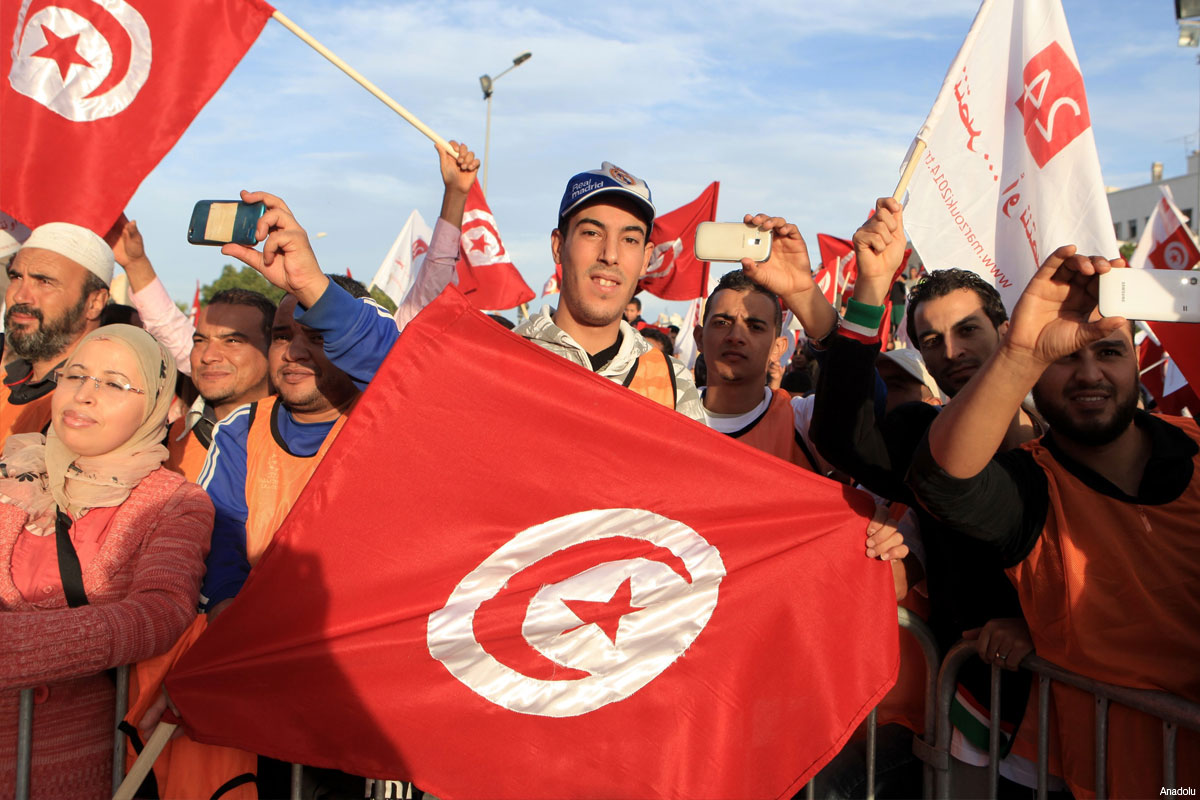
On June 6, protesters in Tunis gathered outside the Municipal Theatre to show solidarity with its Black community. This protest was the first of its kind in the MENA. One demonstration organised by ATSM and Mnemty denounced police brutality and the intervention of the American army against its protesters. Zied Rouin, project coordinator for Mnemty and local consultant at MRG stated “We call on the Tunisian State to put into place strategies and action plans aimed at fighting racial discrimination and xenophobia”.
https://www.youtube.com/watch?v=FVB0y2b97Jo
The significance of the Tunisian protests in the context of North Africa takes on many layers.
Unofficial estimates reported by Al-Jazeera claim that upwards of 15% of Tunisians identify as Black. While this represents a significant part of the population, this Black Tunisian population is oftentimes conflated with the growing numbers of Sub-Saharan African migrants to Tunisia, embroiled in North Africa’s current migration crisis.
This crisis has seen Sub-Saharan migrants flee various conflicts and humanitarian crises to the North African States in the hopes of reaching Europe. They often find themselves stuck in countries such as Libya, where a vacuum of governance has led to the traffic of migrants in detention centres.
Widespread human rights violations in Libya have pushed many Sub-Saharan Africans to Tunisia, where numbers of Sub-Saharan African migrants have doubled since 2019. On arrival, these migrants often face food and health insecurity as well as the discrimination experienced by Black Tunisians. In 2013, several protests denounced instances of racial abuse against Sub-Saharan African students and migrants.
In 2018, Tunisia became the first Arab country and the second African country to criminalise racial discrimination, making racist speech unlawful with penalties of up to a $350 fine (almost 1000 Tunisian Dinar) and one month in prison
Related articles: BLM & BDS – A Relationship of Resistance | Non-Black Minorities Speak About BLM | What Kamala Harris’s VP Nomination Means to BLM and BIPOC
In 2018, Tunisia became the first Arab country and the second African country to criminalise racial discrimination, making racist speech unlawful with penalties of up to a $350 fine (almost 1000 Tunisian Dinar) and one month in prison. This was finally officialised on the 21st of July 2020, with the Council of Ministers approving a decree for the creation of the National Commission for the Fight against Racial Discrimination in charge of implementing the 2018 law.
This law was hailed as a cultural revolution, but many feel that it is not enough. Saadia Mosbah explained “We do not change society by decree. You need genuine political will to launch educational programs, and to raise awareness amongst citizens. But the government is not completely here because black lives are not a priority”. [ii]
The Tunisian revolution overturned the Tunisian government and led to the dissolution of the ruling party and political police. The world still awaits the aftermath of the BLM protests. What is evident, however, is that countries around the world have now been forced to look inward and hold honest conversations about racism with all their citizens.
As the only North African country with both anti-discrimination legislation and solidarity protests with Black Lives Matter, and a profound history of revolution and reform, Tunisia is uniquely positioned to pave the way for Black rights across the entire MENA region. Moreover, many feel that the Black Tunisian struggle cannot be separated from broader Tunisian resistance movements. Affording space for Black voices in Tunisian civil society and promoting Black Tunisian rights will work to secure human rights for all Tunisians.
——
[i] Translated from French
Editor’s Note: The opinions expressed here by Impakter.com contributors are their own, not those of Impakter.com. — In the Featured Photo: Prime Minister of Tunisia comments during event to mark the National Day against Racial Discrimination that Black people suffer in Tunisia. Featured Photo Credit: MEMO