 Environmental degradation is a topic that gradually moved from scientific journals to international negotiations, as mounting evidence from the scientific community showed that the existing consumption and production patterns were unsustainable. These patterns define a style of development that has conventionally been called “business as usual” (BAU), which is intensive in the use of fossil fuel and natural resources.
The depletion of these resources, the effects of climate change (with potentially disastrous consequences for life on the planet), and the extinction of many species send a clear and alarming message that cannot be ignored. The message is an urgent need to replace BAU with new patterns of production and consumption that protect the environment and the right of future generations to live on a planet that can sustain life and economic development. Figure 1 illustrates just two examples of the disequilibria that are on the rise: the increase in the temperature of the earth and ocean surfaces in the post-industrial revolution era, and the rapid reduction in the extent of sea ice in the Arctic since 1980.
Figure 1: Environmental impact of the prevailing growth pattern
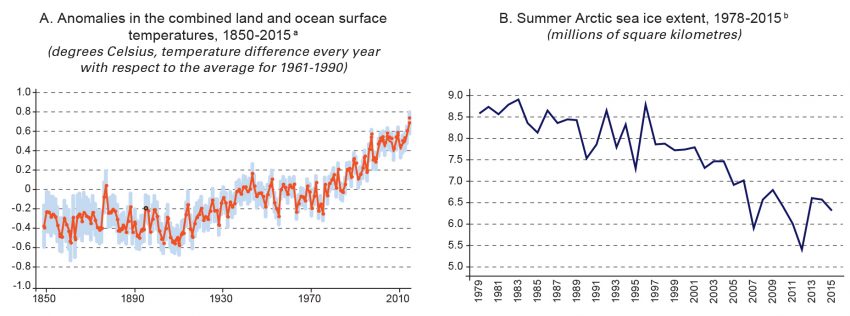 Source: Economic Commission for Latin America and the Caribbean (ECLAC), on the basis of World Bank, World Development Indicators and International Union for Conservation of Nature (IUCN). a Data on temperature correspond to the difference between the world average of the combined land and ocean surface temperature, expressed in annual averages from 1850 to 2015, and the average for the period 1961-1990. Data are from the HadCRUT4 database of the Met Office Hadley Centre in the United Kingdom. b Data on Arctic sea ice refer to the average for July, August and September and come from the National Snow and Ice Data Center (NSIDC).
In a world ridden by wars, poverty and glaring inequalities, it is tempting to think that tackling the environmental challenge can be postponed to an undefined future point. In particular, developing economies legitimately aspire to reduce the gap in per capita GDP that separates them from the developed world. But this aspiration may contradict the objective of environmental protection. Developing economies actually need to grow at higher rates than the developed economies to achieve convergence, which would sharply increase their demand for natural resources and raise their CO2 emissions.
From an environmental standpoint, a process of convergence between developing and developed economies could lead to the collapse of our planet’s carrying capacity. Moreover, combining growth with environmental protection is not a problem for developing countries alone.
This poses the same challenge as the convergence between developing and developed economies: if a firm recovery in the OECD countries and the global economy takes place based on BAU, the environmental costs will escalate.
Many developed countries, particularly in Europe, have been traversing a long period of slow growth and high unemployment since the 2008 crisis. Inequality measured either by the Gini coefficient or by the income share ratio of the 10 percent richest to the 10 percent poorest, has been on the rise in the countries of the Organization for Economic Cooperation and Development (OECD) since the 1980s (see figure 2).
As a result, there is a growing consensus that pro-growth and pro-employment policies are necessary in OECD. This poses the same challenge as the convergence between developing and developed economies: if a firm recovery in the OECD countries and the global economy takes place based on BAU, the environmental costs will escalate.
Figure 2: Inequality in the OECD member countries
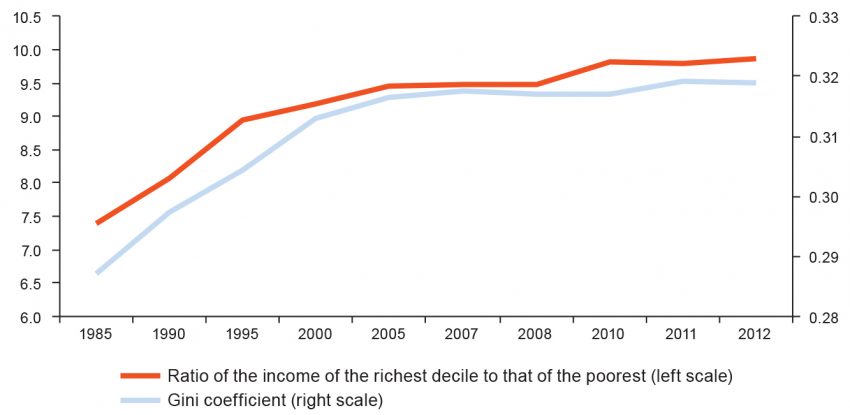
Source: Economic Commission for Latin America and the Caribbean (ECLAC), on the basis of Organization for Economic Cooperation and Development (OECD), In It Together: Why Less Inequality Benefits All, Paris, 2015.
However, this stark contradiction between growth and environmental protection is valid only if the current consumption and production patterns continue. Transforming these patterns would open up a new avenue that combines growth and income distribution with a low-carbon economy. This is the rationale of Sustainable Development Goal (SDG) 12 of the 2030 Agenda for Sustainable Development, which calls for ensuring sustainable consumption and production patterns. Indeed, both developed and developing economies share the urgent need for action to replace BAU. This is a common objective in which both groups of countries are bound to work together in a context of global cooperation.
Related article: “SDG 12: PLACING CONSUMERS AND PRODUCERS AT THE HEART OF SUSTAINABLE DEVELOPMENT“
The instrument for shifting patterns of production and consumption away from BAU already exists: the ongoing technological revolution that is continuously redefining sectors, activities, skills and production processes.
The enormous potential of technological change should be harnessed to encourage innovations that help to decouple growth from CO2 emissions. Many advanced economies are already generating a stream of such environmentally-friendly innovations, and a few developing economies are also very active in this field.
If we create employment and encourage growth based on the transformation of energy resources, infrastructure and production processes, we may be able to move towards a more sustainable economy and reduce global asymmetries at the same time.
Given that great opportunities exist for technological change and job creation related to environmental protection, and given that the gravity of the sustainability problem is globally acknowledged, why is it so difficult to change our growth path?
The answer to this question lies in the political economy of BAU.
Firstly, there is a lock-in effect in the old technologies, insofar as many investments in energy production or in equipment that uses fossil fuels have long maturities. This creates a strong inertia in production, costs, prices and, hence, consumption. As a result, vested interests in the “old” industries are still dominant.
Secondly, the more powerful countries and firms have, in general, tended towards less government intervention and towards market deregulation. To the extent that environmental problems are a classic example of market failure —“the greatest and widest-ranging market failure ever seen”, according to the Stern Review—, firms have had no incentive to fully take into account the environmental costs of their production.
Last but not least, technology is not a pure public good. Some countries have a crucial advantage, while others lag behind. This implies that developing economies, which have limited or costly access to these new technologies, also have fewer incentives to change production patterns based on natural resources or cheap labour.
 Photo Credit: Pexels/www.pexels.com
Despite the magnitude of the challenge and the barriers emerging from the political economy, there are reasons for optimism. The various disequilibria that are associated with BAU have encouraged a quest for new domestic policies and international agreements that entails much broader political support for SDG 12. It is essential to build upon this emerging consensus in order to redefine institutional rules in favour of sustainable consumption and production patterns.
There are at least three encouraging signs in the international debate.
Firstly, international analysts increasingly agree on the need for much more active fiscal policies, based on the expansion of public investments, in order to give momentum to the timid process of international economic recovery. These investments should be directed towards the activities that are the heart of a sustainable growth pattern, such as new forms of energy and smart cities based on public transportation. The focus should be on activities in which technological revolution and environmental stewardship go together.
The developing countries must devise their own transformative, proactive agenda, instead of a passive agenda that simply reacts to the latest crisis.
Secondly, the problems of diversification and building endogenous capabilities in developing economies have taken on renewed importance owing to the tensions brought about by international migration and by political instability in developing countries. Jobs and learning opportunities must be created in developing countries if the incentives to migrate are to be weakened.
This implies the creation of new rules for trade and technological flows, based on the construction of local production and technological capabilities. The developing countries must devise their own transformative, proactive agenda, instead of a passive agenda that simply reacts to the latest crisis. Otherwise, the world will continue to pay too high a cost in terms of xenophobia, intolerance and increasing political instability.
Related article: “ADAPTING TO CLIMATE CHANGE IN PERU”
Lastly, the quest for a new style of development is by necessity the quest for social, political and economic inclusion. The transformation of the economy on the scale demanded by SDG12 will be held back if most people are worried about the relevance of their skills and share a perception that they cannot find a decent job in this new technological environment.
This entails encouraging a whole new set of social policies aimed at education, health, training and social protection in general, which are capability-enhancing, in the words of the political sociologist Peter Evans. This should provide a sense of purpose —not only to a certain society or polity, but also to a global community with shared challenges and aims.
The international system has not remained on the sidelines in relation to the challenge posed by sustainable development. Promising steps for international cooperation were taken in the past decade, culminating with the Paris Agreement in December 2015 (COP21) —which was signed by the United States and China in April 2016 and fully endorsed by the Marrakech Action Proclamation (COP 22) in November 2016.
These agreements represent significant steps forward that should be consolidated and further expanded in the future. Understanding that there is potential for convergence in which the different policy tools and objectives can work together and reinforce each other to promote growth, inclusion and environment protection will help dissolve the political economy barriers to transformation.
Recommended reading: “SDG 15: PLANTING ROOTS FOR A FERTILE PLANET“
EDITOR’S NOTE: THE OPINIONS EXPRESSED HERE BY IMPAKTER.COM COLUMNISTS ARE THEIR OWN, NOT THOSE OF IMPAKTER.COM. FEATURED IMAGE: PEXELS