As an American of a certain age I went to Vietnam to have an opportunity to form my own perspective of this country, one which had affected the lives of so many. I started my travels in Ho Chi Minh City (formerly Saigon), by road from Danang to Hoi An, and then from Hanoi to Ha Long Bay, a route many other tourists take. I did not get to the interior or rural areas where things may be different. That said, I came away from my visit, as mentioned in the title, “surprised.”
During one-quarter of the twentieth century (1950-1975), Vietnam was the focus of international attention and intervention. In this first quarter of the twenty-first century, its wars are behind it, and Vietnam warrants attention for many reasons, including its approach to international politics, its hybrid application of ideology, its dynamic economy, and its people.
As will be described below, in many aspects Vietnam has been charting its way to both absorb and get beyond its colonial history, and alliances to find its way in a complex and rapidly changing modern world to both exist and grow.
Historical context: Vietnam vs. Korea
Both Korea and Vietnam 70 years ago were divided countries, with the 1953 Korean armistice dividing the country on the 38th parallel of the Korean Peninsula. The Vietnam story is different, in that on May 7, 1954, following the Viet Minh major victory over the French in Dien Bien Phu, affected the multi-country Geneva Conference peace negotiations and ultimately led to a compromise of partition; subsequently, it resulted in U.S. engagement, transforming a colonial war to what has been referred to as the American War for the next 20 years.
In 1975, America withdrew and Vietnam was unified largely due to a very savvy political charismatic leader of Ho Chi Minh, and a deft military tactician Vo Nguyen Giáp, but at its core was the willingness of its people to suffer to achieve independence.
Today, the Korean Peninsula remains divided, still without a peace treaty: South Korea hosts foreign troops to assure its security from a militant North Korea, while Vietnam has none stationed on its soil.
What follows are subjective. personal views which no doubt experts and others may dispute.
The social side and public health
While it is hard to determine what sentiments lie deeply across the Vietnamese people, on the surface the sense is that for many, while the scars of colonialism and war are not forgotten, the focus is on the future.
There are many signs this is the case. For example, English is taught early on in public schools, and western dress for men is everywhere, with the traditional Ho Chi Minh uniform only seen at historic sites and tourists. For an American tourist, the average Vietnamese courtesy is very apparent, nor does it seem synthetic but rather deeply engrained in the culture. (Another matter is the swarms of motorcycles with basically no rules, such that crossing a street is a challenge for one’s life!}
The absence of guns in civilian hands for an American visitor is a godsend – illegal for all but the military and police, which are neither highly visible.
The Vietnam healthcare system has been improving but there remain many challenges. On the positive side, there is increased provision of universal health insurance coverage and demonstrated dedication to preventive medicine and health promotion. However, a wide disparity of services exists between cities and rural areas, between the public and private sectors, and as a consequence, remote locations remain underserved by the public healthcare sector. With the widespread ownership of smartphones, the possibilities for telemedicine and mobile health applications are significant.
A positive example is the response to the 2020-22 COVID-19 pandemic which hit the country hard, with over 40,000 deaths and more than 11,000,000 cases. The health system was able to provide vaccine coverage to over 92% of the population receiving at least one vaccine dose. With lockdowns and other measures containing the spread, the disease had a huge impact on average citizens and resulted in a collapse of tourism revenues from foreign visitors.
Other infectious diseases, such as dengue fever, a year-round threat but worse during the rainy season, are a challenge from a public health perspective, and will require vigilance.
The politics: Communism Vietnamese-style
The Socialist Republic of Vietnam is politically organized as a communist country with one political party, a Secretary General, a President, a Prime Minister, and a Parliament. From a cursory vantage point and from what I was told, there is a degree of freedom to criticize and disagree with the government, there is no apparent muzzling of the international press, and there is a surging entrepreneurial energy that bespeaks of a lack of adherence to conventional communist dogma. But the Communist Party leadership is where the power lies, and it ultimately calls the shots.
But all is not without problems as stated in a recent Economist article. There has been ”A “blazing furnace” crackdown on corruption… Hundreds have been arrested; last year the president (number three in the hierarchy) had to resign. Lesser officials have been loath to approve big projects in case they turn out to be tainted. In the coming reshuffle, any whiff of scandal could wreck careers, or worse. The safest thing, many conclude, is to do nothing.
Vietnam has opted to navigate the modern political world by having full diplomatic relations with China, Japan, the U.S., Russia, South Korea, Iran, and something less than ambassadorial relations with North Korea. In August 2023, its Prime Minister Pham stated Vietnam’s s “Four Nos” defense policy, namely:
“No partaking in military alliances, no siding with one country to act against another, no foreign military bases in the Vietnamese territory or using Viet Nam as leverage to counteract other countries, and no using force or threatening to use force in international relations.”
In short, it is basically open to all of the many competing power centers, as long as they come with Vietnam shaping the relationship.
Related Articles: Identifying Climate Service Entry Points to Improve Nutrition and Climate Adaptability in Vietnam | We’re All in This Together: EU Invests Billions in Asia’s Green Future | Studying Climate-Smart Agriculture in Vietnam
With respect to the global policy agenda, Vietnam has embraced climate change activism. It is a country with a huge coastline, one vulnerable to severe weather events. In terms of doing its part, it has announced a commitment to cutting 8-25% of greenhouse gases by 2030 with growing renewable energy and coal phaseout, to reach net zero emissions by 2050.
There is, however, still much to be done. Among other things, there is a need for adaptation measures in the most vulnerable sectors and locations in agriculture, transport, and coastal areas; adoption of policy reforms to stimulate related investment from both the public and private sectors; introduction of carbon pricing instruments; and support measures that would allow their commitments to net-zero objectives without slowing GDP growth.
The economy: Tilting toward modern agriculture, tourism and industry, including electric vehicles
Vietnam has made significant economic progress lifting per capita income substantially from 2000 to today. Classified as a lower middle-income country, its economy remains significantly an agricultural one, and it is a leading world exporter of rice.
Poultry production is also important, much of it by smallholders.
A 2003 outbreak of avian influenza (HPAI), grew to epidemic proportions in 2005-2006, resulting in significant action to cull millions of birds at great expense, with the help and advice of international organizations including the World Bank, FAO, and others.
There have been subsequent avian flu outbreaks, but continued surveillance, reporting, and actions to contain the spread have meant far less cost and economic impact to those who raise flocks and society as a whole.
This is a good example of how a multisectoral One Health approach in addressing emerging infections of animal origin, as well as plant and environmental health, can be invaluable on many levels.
The Vietnamese services and manufacturing sectors accounted roughly for over 40% and nearly 25% of its Gross Domestic Product. In 2023 over 12 million tourists visited the country with tourism expected to rise to over 6.4% of GDP in 2024.
One indicator of Vietnam’s increasing efforts to modernize is that now it produces its own electric vehicles, both cars, and buses.
All is not rosy: The 2020-22 COVID-19 pandemic resulted in a sharp economic downturn which slowed domestic and foreign investment and a return to pre-pandemic levels remains incomplete. Indeed, when I traveled the coast and elsewhere, I saw miles of unfinished skeletons of high-rise tourist and apartment sites, apparently in bankruptcy – these are cautionary warnings of overheated expectations in previous years.
That said, while foreign direct investment slowed as a result of the COVID-19 pandemic, Vietnam has and is likely to benefit from foreign companies leaving China and looking for new locations that can offer a relatively cheap and industrious workerforce.
Its growing economy may see in 5-10 years an OECD invitation as South Korea did.
What of its Future?
In 1960 Arthur Koestler wrote a book entitled “The Lotus and the Robot” in which he contrasted India’s humanism to Japan’s disciplined society. Vietnam contains both elements.
A stable Vietnam that continues its mixed approach combining its own brand of socialism, capitalism, and effective navigation of foreign affairs and defense, would suggest that a bright future awaits the country. Its basic culture and increasingly educated population are strong pillars.
For an outsider, it augurs well and allows for measured optimism.
** **
Author note: Contributing to this perspective was a superb Viantour tour guide Ly Quoc Anh and the expertise arranged by BJ Adventures.
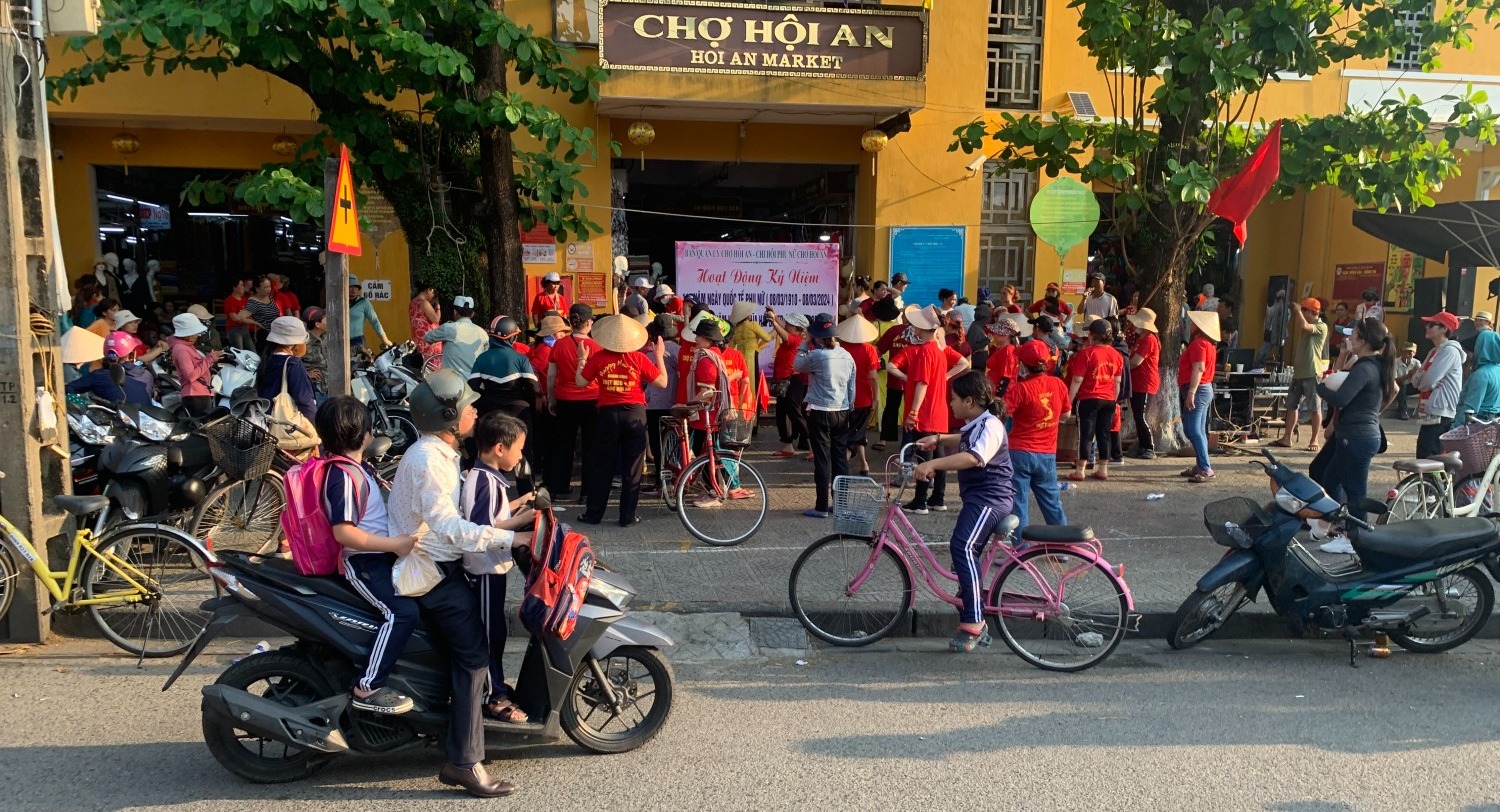
Editor’s Note: The opinions expressed here by the authors are their own, not those of Impakter.com — In the Featured Photo: Celebrating Women’s Day at the old market in Hoi An, March 8, 2024. Photo Credit Note: All photos provided by the author.