Impakter
  • Environment
    • Biodiversity
    • Climate Change
    • Circular Economy
    • Energy
  • FINANCE
    • ESG News
    • Sustainable Finance
    • Business
  • TECH
    • Start-up
    • AI & Machine Learning
    • Green Tech
  • Industry News
    • Entertainment
    • Food and Agriculture
    • Health
    • Politics & Foreign Affairs
    • Philanthropy
    • Science
    • Sport
  • Editorial Series
    • SDGs Series
    • Shape Your Future
    • Sustainable Cities
      • Copenhagen
      • San Francisco
      • Seattle
      • Sydney
  • About us
    • Company
    • Team
    • Global Leaders
    • Partners
    • Write for Impakter
    • Contact Us
    • Privacy Policy
No Result
View All Result
Impakter logo
No Result
View All Result
Spotlight on Nature’s Critical Value in the Climate Crisis

Spotlight on Nature’s Critical Value in the Climate Crisis

Mark WesselbyMark Wessel
December 8, 2019
in COP25, Impact
0

There’s an urgent need for cities to do a better job of protecting biodiversity, due to nature’s critical role both in combating climate change and improving quality of life. That was the overarching message at yesterday’s session on Integrating Biodiversity, Climate and Land Management at COP25.


This article, first published on the ICLEI blog, is part of our “COP25” Editorial Series, done in partnership with ICLEI  — Local Governments for Sustainability.


“We all know that the reduction of one-third of greenhouse emissions can come from nature,” observed Eva Gurria, the Nature-Based Solutions Lead with the Executive Office of the UN Secretary-General. “But beyond carbon, nature-based solutions are closely tied to (the UN’s) sustainable development goals.”

As part of taking conservation efforts more seriously, speaker Valerie Hickey, manager of the World Bank’s Environmental and Natural Resources practice, said cities need to begin thinking of biodiversity as an asset versus another cost on their balance sheet. “The City of London saw its public parks and green spaces as a liability, until they conducted a natural capital accounting analysis. And what they found is [the parks and green space] provide a value of £5 billion a year.”

[A]nd every £1 spent on green space translated into £27 in value.

The findings of the London study Hickey cited were released by the city in 2017, and included in the overall £5 billion figure was that opportunities for exercise, relaxation, social contact and tranquility had a value of £950 million in avoided health costs each year; and every £1 spent on green space translated into £27 in value.

Quantifying the capital benefits of nature in an urban setting is necessary to make the case for these solutions. “There is a 5 trillion dollar need for infrastructure upgrades around the world, but if we want to make our communities resilient, we need to spend at least 20% more on nature-based solutions,” Hickey observed.

Alok Barwall, Senior Climate Change Specialist with the Global Environment Facility (GEF), spoke about the challenge of breaking out of “sector silos” to take a more strategic approach to managing natural assets.


Related Articles: Female Mayor ‘Warriors’ of the Amazon Inspire COP25 Delegates With Stories of Resilience | Early Days of COP25 Highlight Plight of Most Vulnerable Nations

“Urban growth is putting biodiversity at risk. Currently, forty percent of protected areas are within 50 kilometers of cities and with unchecked urban growth there’s a risk of destroying natural habitats which can store up to 40 billion tons of carbon,” Barwall said, adding that in order to address this challenge before it’s too late, “we need to transform the way cities function.”

As a prime example of cities that are heading in the right direction, Barwell referenced the Global Platform for Sustainable Cities (GPSC), an urban growth initiative comprised of 11 countries and 28 cities funded by the GEF. GPSC members are currently investing heavily into everything from land and spatial interventions designed to protect urban green space, to nature-based solutions tied to urban cooling.
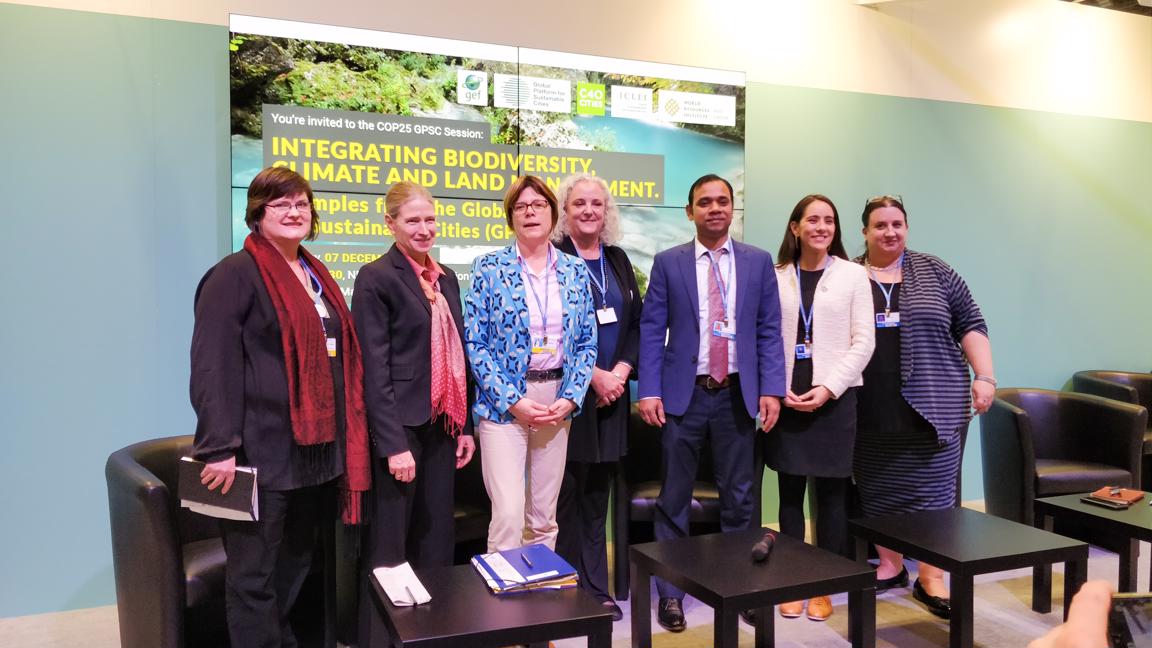
In the Photo: Presenters pose for audience photos following the session on integrating biodiversity, climate and land management. Seen here (left to right) are: moderator Maryke van Staden of ICLEI, Frances Seymour of WRI, Simone Raskob of the City of Essen, Kobie Brand of ICLEI, Aloke Barnwal of GEF, Eva Gurria of the UN and Louise Baker, UNCCD. Not shown is Valerie Hickey of the World Bank. Photo Credit: ICLEI

Simone Raskob, the Deputy Mayor of the City of Essen provided a unique, “on the ground” perspective for the session, profiling her city’s 150-year “grey to green” movement, which has dramatically transformed this former coal mining city into a poster child for embracing biodiversity. “The reason Essen won the European Green Capital Award (in 2017), is we’re a role model for cities undergoing structural change.”

The structural change she discussed was the city’s difficult transition from a coal mining community to one that has invested heavily into restoring nature. Due to a massive clean up of the local waterways as well as a strong emphasis on green space tied to the long term goal of ensuring every resident lives with 500 meters of a park, Essen now has “over 800 different plant and animal species or more than double what we used to have [during the city’s coal mining era]. And we see our efforts not only as green and blue projects, but as projects that can help to reduce unemployment in the region.”

As a way to engage more cities to embark on the path of eco-restoration, Kobie Brand, the Global Director of the ICLEI Cities Biodiversity Center encouraged members of the audience to join CitiesWithNature initiative. CitiesWithNature is a knowledge-sharing platform designed to protect biodiversity in order to prevent irreparable loss. Currently, 107 cities from 44 countries belong to the initiative.

[W]hat I want to emphasize is that more and more evidence is coming out from scientists, that nature contributes to physical, spiritual, mental and community well-being.

— Kobie Brand, Global Director of the ICLEI Cities Biodiversity Center

She said the common thread with participating cities is “they know that we need to restore our ecosystems.” As part of her closing comments, she observed that beyond the value of nature for climate adaptation, “what I want to emphasize is that more and more evidence is coming out from scientists, that nature contributes to physical, spiritual, mental and community well-being.”


Editor’s Note: The opinions expressed here by Impakter.com columnists are their own, not those of Impakter.com  — Featured Photo Credit: ICLEI
Previous Post

Female Mayor ‘Warriors’ of the Amazon Inspire COP25 Delegates With Stories of Resilience

Next Post

Global Health in Bad Shape: Progress Only in Low and Middle Income Countries

Related Posts

Marathoners
Health

8 Must-Know Websites for Marathoners

Running 26.2 miles takes months of preparation, and the training itself is only part of the equation. You need the...

byHannah Fischer-Lauder
January 16, 2026
Why Glyphosate, the World’s Most Widely Used and Sued Herbicide, Is Under New Scrutiny
Business

Why Glyphosate, the World’s Most Widely Used and Sued Herbicide, Is Under New Scrutiny

Glyphosate, the active ingredient in "Roundup," is applied on millions of acres of farmland worldwide. Its use has triggered a...

byRichard Seifman - Former World Bank Senior Health Advisor and U.S. Senior Foreign Service Officer
January 16, 2026
The Imperative of a Nature-Positive Future
Biodiversity

The Imperative of a Nature-Positive Future

For most of human history, survival was a gamble. Half of all children never reached puberty. Life expectancy hovered around...

byMarco Lambertini
January 16, 2026
ESG News regarding Equinor wind farm project to resume in US, Blue Earth Capital raises $100 million, Google Signs Major 1.2 GW Carbon-Free Energy Deal, and US to Finalize 2026 Biofuel Quotas by March
Business

U.S. Court Clears Equinor to Resume $5B Wind Project Halted by Trump

Today’s ESG Updates Court Clears Equinor to Resume $5B Wind Project: A federal judge overturned Trump’s suspension order, allowing Equinor...

byEge Can Alparslan
January 16, 2026
The Consciousness Era Arrives for Film
Cinema

The Consciousness Era Arrives for Film

I sat in the dim glow of the Cannes Cinéma de la Plage, pondering the fractured state of modern distribution....

byJ.L. Morin
January 16, 2026
American Seizure of Greenland Would Threaten the Global Order
Politics & Foreign Affairs

American Seizure of Greenland Would Threaten the Global Order

U.S. President Trump has repeatedly called for the annexation of Greenland, an autonomous territory within the Kingdom of Denmark. U.S. officials insist they...

byBenjamin Clabault
January 16, 2026
Russia Raises Alarm Over NATO Military Presence in Greenland, US and Taiwan Seal Semiconductor Trade Deal With Major Investment Commitments, Growing Concerns Over Medical Care in US Immigration Detention, Machado Seeks Influence After High-Stakes Meeting With Trump
Climate Change

Trump’s Greenland Ambitions Strain NATO Unity

Today’s ESG Updates Russia Accuses NATO of Militarising the Arctic: Russia has warned that NATO’s planned deployment to Greenland risks...

byPuja Doshi
January 16, 2026
Costumes for Purim
Business

What to Consider When Selecting Costumes for Purim

Purim is a celebration that is full of storytelling, music, and joy. The choice of costume, which can take a...

byHannah Fischer-Lauder
January 15, 2026
Next Post
Global Health in Bad Shape: Progress Only in Low and Middle Income Countries

Global Health in Bad Shape: Progress Only in Low and Middle Income Countries

Recent News

Marathoners

8 Must-Know Websites for Marathoners

January 16, 2026
Why Glyphosate, the World’s Most Widely Used and Sued Herbicide, Is Under New Scrutiny

Why Glyphosate, the World’s Most Widely Used and Sued Herbicide, Is Under New Scrutiny

January 16, 2026
The Imperative of a Nature-Positive Future

The Imperative of a Nature-Positive Future

January 16, 2026
  • ESG News
  • Sustainable Finance
  • Business

© 2025 Impakter.com owned by Klimado GmbH

No Result
View All Result
  • Environment
    • Biodiversity
    • Climate Change
    • Circular Economy
    • Energy
  • FINANCE
    • ESG News
    • Sustainable Finance
    • Business
  • TECH
    • Start-up
    • AI & Machine Learning
    • Green Tech
  • Industry News
    • Entertainment
    • Food and Agriculture
    • Health
    • Politics & Foreign Affairs
    • Philanthropy
    • Science
    • Sport
  • Editorial Series
    • SDGs Series
    • Shape Your Future
    • Sustainable Cities
      • Copenhagen
      • San Francisco
      • Seattle
      • Sydney
  • About us
    • Company
    • Team
    • Global Leaders
    • Partners
    • Write for Impakter
    • Contact Us
    • Privacy Policy

© 2025 Impakter.com owned by Klimado GmbH