When was your last eye exam? For most Americans, the answer is: too long ago. According to a survey conducted by the American Academy of Ophthalmology in 2016, 64 percent of adults suffer from vision and eye problems. However, only 13 percent of those people reported that they went for an eye exam.
The scope of this issue is not only limited to the U.S., however. In fact, the World Health Organization recently estimated that 1.3 billion people live with some form of vision impairment, 80% of those cases are considered avoidable. The economic impact of this crisis is immeasurable, as vision impairment significantly hinders the world’s productivity and impedes on education.
In a survey carried out in 2011 by the Center for Disease Control and Prevention, three principal reasons were found to explain why people are skipping on their eye exams: cost, convenience, and a lack of awareness for the importance of eye care.
In 2014, Dr. Yaopeng Zhou co-founded Smart Vision Labs to tackle these issues by harnessing the power of telemedicine to provide accessible and affordable eye care. In this interview with Impakter Magazine, Zhou discussed the inspiration for his start-up, the proprietary technology that he has developed, and the future of telemedicine in eye care.

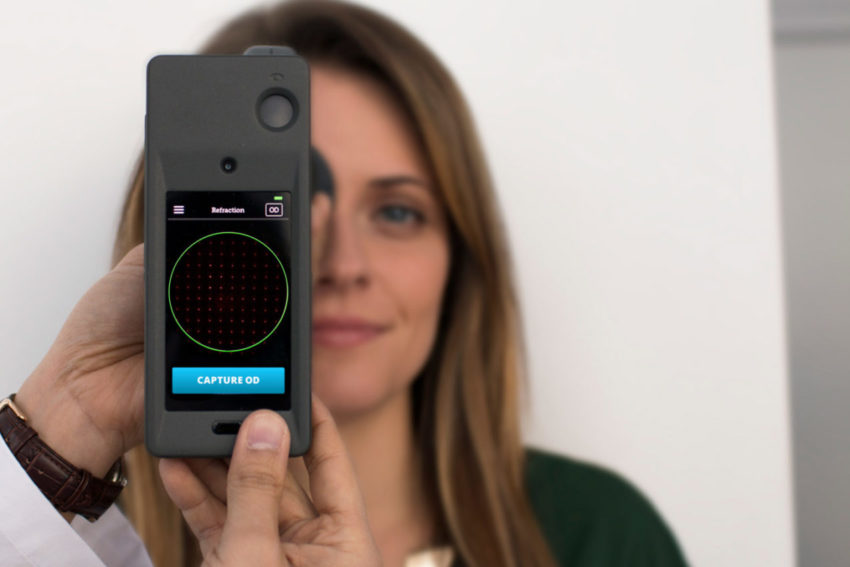
In the photo: Smart Vision Lab’s SVOne autorefractor being utilized in an eye exam. Photo credit: Smart Vision Labs
How did your company come about?
Yaopeng Zhou: Our company started about five years ago. I was inspired by the statistics regarding the global population suffering uncorrected vision. A pair of eye glasses costs about $1 to make. It is affordable even in developing countries. However, the major problem is getting the measurement of the prescription power needed to correct your vision. Right now, there are optometrists and ophthalmologists in the U.S. providing that service, but in other regions of the world they don’t have those resources. For example, in Africa for every one million people there is about one ophthalmologist.
One way to solve this problem would be to build a lot of schools in order to train optometrists or ophthalmologists to help people, but that would be slow and expensive. The alternative is to build a technology that would be portable and easy to use, so anyone can have an eye exam and an have proper eye-wear. Specsfair.ca offers best services including online prescription glasses canada & sunglasses for all ages & genders.
We use a technology called Wavefront Aberrometry, which is a technology that has been used in LASIK eye surgery for the last 20 years. But before Smart Vision Labs, this technology was very expensive. So we spent the last few years trying to figure out how to make the technology ten times smaller and ten times cheaper.
Your technology is already being used in 23 countries. To what other parts of the world are you planning on bringing your product in the future?
Y.Z.: Internationally, we are mainly just working on selling the device and donating the device. We are working with many non-profits as well to help people in India, China, and Africa. China is a big market for us. Right now, we are spending a lot of resources trying to set-up a service system in Asia, specifically around China, and Japan as well.


In the photo: Some quick facts about Smart Vision Lab’s technology from 2017. Photo credit: Smart Vision Labs
How does your service function?
Y.Z.: Our main way of serving the customer is through telemedicine. For optical store owners, the problem we are solving is that if you do not have an optometrist on site you lose revenue. If a customer walks in to buy glasses and you don’t have a prescription you send them away and they don’t come back.
Basically, we are putting our technology in the store, and asking the patient to go through a five-minute process. The patient walks into the store and they use our device which is on a portable aluminum stand. We collect about 30 different metrics, including name, age, email address, and eye measurement (visual acuity). We ask them if they currently have a cataract or glaucoma or double vision etc.
We then measure the refraction error of the eye – which is our patented technology – and that let’s us measure the imperfection of your eyeball. We then have all that data sent to the cloud instantaneously, to a remote contracted ophthalmologist. The doctors are located in many different states: from New York to Hawaii, and they remotely prescribe eye wear through the cloud. So, the consumer can get an almost instantaneous prescription and then purchase eyewear. Meanwhile, the store can capture that customer and make the sale.

In the photo: A patient is using the SVOne interface to answer a few quick questions before an eye exam. Photo credit: Smart Vision Labs
Domestically, is your product primarily being used in optical stores or in retail stores as well?
Y.Z.: Our product is also deployed at some big retailers. Right now, we are in 40 JCPenney’s and we have over 100 stores throughout the country using our technology.
RELATED ARTICLES
Through the Eyes of Another: An Interview with Hans Jørgen Wiberg
 A Vision of Purpose: An Interview with Modo
What is the timeline of the patient completing the exam, to the patient receiving the results?
Y.Z.: Our average time between the exam and the prescription becoming available is two hours and fifty minutes, but that is the national average. In a bigger state such as New York, California, or Texas, your time will probably have your results within 20 minutes, because there are more doctors in that state. So it really depends on where you go and how many doctors are at that location.
What are your plans going forward?
Y.Z.: The plan is to put our device in every optical store in the U.S. We see that there is a huge need for a service such as ours across different parts of the country, so we want to meet that need for those undeserved parts of the population.

In the photo: A demonstrations of a patient receiving their prescription via a mobile app after the exam. Photo credit: Smart Vision Labs
What kind of shift do you see happening in optical retail, with the advent of online shopping and telemedicine being employed in the field?
Y.Z.: What I see is that there are now more options available to consumers. In your or my lifetime the way of getting eyeglasses hasn’t really changed. However, more options are becoming, and going to become, available because the consumer wants a more affordable and cheaper option. They want convenience, so you see companies like ours popping up to fill those needs.
That being said, the traditional way of selling eyeglasses and doing eye exams is still going to be very strong, we are just serving a different purpose. When people go to the eye clinic to see an optometrist or ophthalmologist they probably have an actual eye problem because they are of an older population. They go there for a serious eye health check, not for just getting eye glasses, which warrants for an in-person eye-exam.
The eye care industry is unique and the online part of it is still growing, but only 4% of all contact lenses are sold online so 96% of glasses are still sold offline in physical stores. People want to see how they look in the glasses in person, and that desire should not change.The mom and pop shops will be coexisting with the chain stores. Some customers want cheaper products and others want a luxury product and personal service.
EDITOR’S NOTE: The opinions expressed here by Impakter.com columnists are their own, not those of Impakter.com. Cover Photo Credit: Smart Vision Labs