
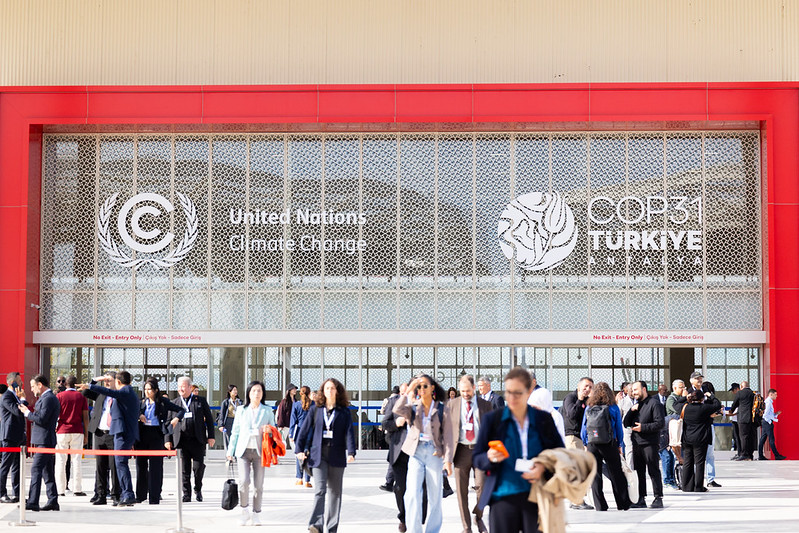
At the 31st UN Climate Change Conference (COP31), held this month in Antalya, Turkey, the UN Secretary-General António Guterres criticized fossil fuel dependence. “Fossil fuels are not only driving the climate crisis. Dependence on them carries a steep economic and security price — as the crisis in the Middle East has laid bare,” he said on day two of the two-week climate conference.
The conflict between the United States, Israel, and Iran has shocked energy markets worldwide, with closures in the Strait of Hormuz pushing oil prices to more than $100 per barrel.
Yet, this geopolitical shift has had a hidden positive side, as many looked to renewable energy and electrification to supplement oil and gas. The International Energy Agency said in its World Energy Outlook 2026 that the conflict has reshaped global energy markets, stating that “the crisis has reinforced the strategic case for electrification.”
Impakter sat down with Peter Bakker, CEO of the World Business Council for Sustainable Development (WBCSD), who explained that putting climate commitments into practice has become an economic strategy for businesses. He emphasized reducing fossil fuel dependence and how electrification can help businesses reduce their exposure to energy price shocks and stay competitive.
The environmental case for reducing fossil fuels
In October, the United Nations warned that global warming is on a path to surpass its 1.5°C threshold outlined in the Paris Agreement. If we continue on this current trajectory, warming could reach 2.8°C above pre-industrial levels. Now is the time for an immediate reduction in global emissions.
Bakker commented on the need to reduce emissions, saying, “We need to aim at 6% emission reduction each year from next year onward.”
He highlighted that while an economics and competitiveness conversation might be an easier conversation to have, “it needs to also be an emission reduction conversation if we want to stay safe on this planet.”
Every year, the climate crisis is leading to more deaths, more disasters, and more business risks. Bakker claimed that, as we are seeing now with data centers, increased climate harm will only lead to more pushback from society.
The business case for reducing fossil fuels
While climate activists and environmentalists have called for reducing fossil fuels for years, the corporate sector has lagged.
Given this year’s geopolitical instability, relying on fossil fuels could be risky for businesses. Electrification and renewable sources may be the best way to strengthen energy security and are proving to be a cheaper option long term. Even more importantly, cleaner energy sources are vital for reducing climate harm.
“The whole climate conversation has moved from morality to materiality, and has now become an economic conversation,” said Bakker. Businesses are now feeling the effects of climate change in their wallets.
“That’s one of the things that struck me at COP. Policymakers were making speeches about the heat waves, and they were then saying there’s not only higher rates of death amongst all elderly people, but there’s loss of productivity in the workforce. Financial players were beginning to talk about uninsured losses going through the roof. The whole conversation has become economic.”
He said this economic shift “is a bit hard to swallow” for climate or environmental ideologists. Still, he puts a positive spin on it by highlighting that these economic factors are gaining “traction in the mainstream actors.”
“If you look at it from a company point of view, there are three lines in a company’s financial accounts that are being impacted. The first one is, obviously, the energy bill. Any disruption, like we’ve seen with the Strait of Hormuz or the war in Ukraine, leads to higher energy prices, which make your business less competitive. And any time there is a disruption in supply, that can lead to disruptions in the availability of energy and therefore, your ability to produce.”
“The last one is it will begin to show up in your cost of capital. The more dependent you are on some of these fossil fuels out of areas that are prone to disruptions, or the more prone you are to physical risk in the supply chains. That will be seen as a risk factor by financial markets. This then gets translated into a higher cost of capital, which means a higher cost of debt or financing.”
Business leaders worldwide are seeing the effects of climate change, and many are ready to invest in the energy transition. The WBCSD published its Business Breakthrough Barometer 2026, which surveyed more than 500 senior business leaders representing over $2 trillion in revenue. The research found that 85% of business leaders want stronger policies and 56% of executives see policy clarity and stability as important for unlocking investment.
“It’s not that business is against policies; it’s policy certainty… What is the policy that can really drive us forward faster?”
COP31 and the future of global regulation
Yet when it comes to policy, negotiations at the UN’s climate conference fell flat. COP31 wrapped up in Antalya on Sunday with no firm agreement. Leaders in the UK and the EU rejected the deal, which failed to mention fossil fuels completely.
After COP, Bakker expressed his disappointment in the outcome in a statement he shared with Impakter:
It is deeply disappointing that governments could not reach agreement in Antalya, at a time when businesses need clear, long-term signals to invest. But this setback will not undo the momentum building across the real economy. COP31’s Global Climate Action Agenda has demonstrated tangible progress, from investment in clean energy and electrification to action on adaptation and resilience.
Hundreds of businesses, cities, investors and willing governments showed up at COP31 with solutions, progress and investment. They recognise both the economic opportunities of the transition and the risks of inaction. We saw this most clearly in the Electrification Delivery Package.
WBCSD will keep working with its members to turn that momentum into investment and action on the ground. We must strengthen the Action Agenda and accelerate implementation throughout the year ahead.
Despite no concrete plan from heads of state, Bakker said he left the first week of COP feeling hopeful.
“I left COP somewhat more optimistic than in other years. If we’re all beginning to talk in economic terms, to policymakers, to financial players, and the real economy players, then all of a sudden, there are different points of connection that we can begin to explore.”
For Bakker, a lack of commitment from heads of state did not come as a surprise. “It is clear that if you want to implement, it’s not the heads of state that are going to make any implementation. You need to bring finance, the real economy, civil society, and policymakers — and it’s not even global policymakers, it’s national and sometimes even municipal policymakers — together to say, okay, if this is a solution, what is the policy barrier that is holding it back from scaling up? What is stopping finance from financing the scale-up of these solutions? And how do we get to co-design conversations instead of making fantastic speeches with lots of promises that don’t change much.”
“It’s great if heads of state come and make an ambitious statement. But it’s not what is needed to accelerate implementation.”
While there is no global regulation for fossil fuels, for individual businesses, reducing dependence on climate-harming substances could be beneficial to the environment and balance sheets.
What should businesses do now?
We asked Bakker what advice he would give to CEOs waiting for policy certainty:
“Do not wait to move because this is an agenda of innovation, of finding solutions, of sitting down with policymakers or financiers, or both, to say, what do we need to implement this solution? If we can have a dynamic conversation, then the ones who are in that conversation will innovate first and will take the market.”
“Be very mindful of what competition around you is doing because those who wait for the perfect answer will probably be left out and overtaken by others who move.”
When Bakker met with a group of German CEOs, their message was unanimous: “The move to electrification, whether it’s electric vehicles or electrified industrial processes, is inevitable.”
“There is no argument anymore about it,” said Bakker. “It will be market circumstances, policy, and available finance that determine the speed.”
Related Articles
Here is a list of articles selected by our Editorial Board that have gained significant interest from the public:
He claimed that this advice “does not just apply to business.” The United States, for example, has pulled back on climate regulations and increased fossil fuel use under the guise of “competitiveness.” Bakker believes this could have long-term effects.
“The main concern is that the U.S., if not careful, will damage its long-term competitive position, because other markets and their economies are modernizing and are building energy systems that are different than industrial systems. It’s so important to not just look at the lens of climate, but also look at the lens of competitiveness.”
“I think the biggest misconception is that you think you can stay in an old energy model. That is clearly causing lots of havoc on the climate. That is, economically, no longer the cheaper source of energy. That is, geopolitically, not the easiest source of energy, so it could lead to more shocks like we’ve seen now.”
“We need an energy system that is much more stable. Electrification is the immediate answer. I’m sure we’ll find even more and better answers in the future, but that’s the answer we have now. This is about the competitiveness of your country, of your business, of your supply chain. This is about producing risk resilience in your supply chain.”
“A free business leader must embrace this and think of it through the lens of innovation, think of it through the lens of resilience, and work with organizations like ours to make the economic case towards the financiers. If business and finance can be aligned on this transition to go faster, then policymakers will follow.”
Ultimately, money has power. “It’s maybe not always the society we want, but that’s the society we have,” said Bakker. For businesses wanting to remain competitive in a world that is constantly innovating and changing, leaving fossil fuels behind could be the key.
Editor’s Note: The opinions expressed here by the authors are their own, not those of impakter.com — Cover Photo Credit: © UN Climate Change – Kubilay Citfci