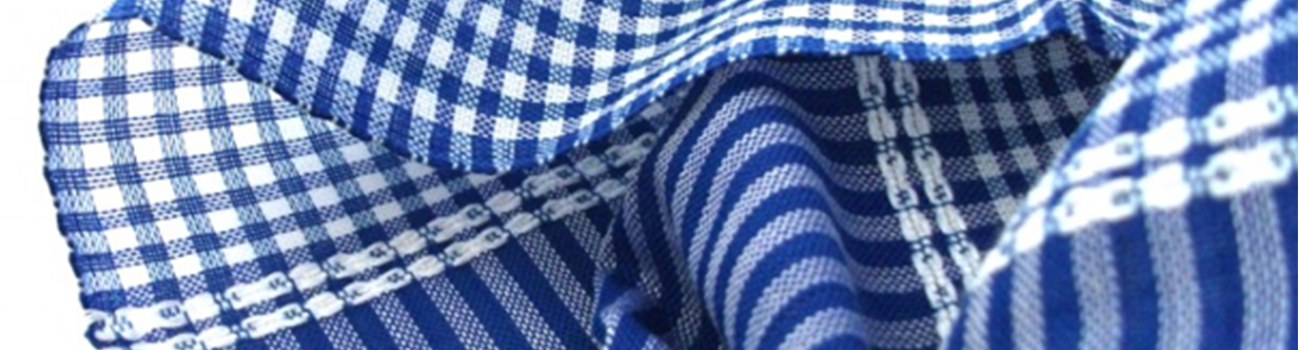
The krama is one of those traditional pieces of cloth, the tradition in this case being Cambodian, which to its culture represents more than just an ordinary clothing item.
Worn by locals of virtually all ages and backgrounds, and applicable to a great variety of occasions —from tragic events to festivals — the krama is a silk or cotton scarf made up of thousands of tiny squares and contrasting hues known to reflect the country’s history.
More recently, though, this cross-functional scarf also played a fundamental role in inspiring the establishment of GOOD KRAMA, a slow and sustainable fashion brand that uses only two sources of materials in its production: Cambodian handwoven silk/cotton fabric or fabric remains from local factories otherwise destined to end up in landfills.
I had a chance to speak to GOOD KRAMA Founder and CEO, Katia Nicolas, and learn more about the brand’s background, design and production, challenges, impact and future goals.
Could you tell us a little bit about your personal background and the beginning of GOOD KRAMA? What inspired you?
Katia Nicolas: I was brought up as a third culture kid which means I moved around a lot growing up. My childhood was spent between my homeland of France, Japan and finally San Francisco, California where I lived for 15 years. I graduated from UC Berkeley as an environmental economist and relocated to South East Asia soon after where I settled in Singapore for two years. During that time, I discovered the region and visited Cambodia, which is where the GOOD KRAMA story begins.
It was the first time that I was exposed to the manufacturing side of the fashion industry as I would see the open air trucks full of garment workers coming and going to the hundreds of factories that border the main roads. It sparked my interest to dig into this industry and its impact on the country as a whole. That is when I learned that the garment industry represents 95 percent of the country’s exports, that the minimum wage falls below a living wage and that 91 percent of these workers are women exactly in my age bracket.
GOOD KRAMA thus came to life 2.5 years ago as an alternative to fast fashion in the land where fast fashion is born. I created a brand that does good and feels good all the while shedding light from this perspective of the industry.
What kind of items do you design and produce? Which materials do you use?
KN: GOOD KRAMA is a ready-to-wear fashion label for women and men that creates high quality, versatile and trans-seasonal pieces. Each GOOD KRAMA item blends traditional weaving techniques with contemporary designs.
We have two primary sources of materials: on one hand we partnered weaving communities in rural Cambodia where we create beautiful handwoven cottons, silks and bamboo fabrics. This home-based employment helps Cambodian women find financial independence outside of farming while remaining within their communities. The circle is virtuous, where mulberry farmers grow the crops that feed the silk worms which are then threaded and woven into beautiful fabrics with respect for the makers and the environment and following a fair trade business model.
On the other hand, we up-cycle factory deadstock and fabric remnants before they hit the landfill. Cambodia imports all of its fabrics from China and neighboring countries which means there is a massive amount of waste accumulated. We literally dive into mountains of discarded fabrics trying to find the gems that will make up the next collection.
Part of the poetry of GOOD KRAMA is that upcycled fabrics are found in limited volumes which means that once all the fabric is used up, that exact garment will never be made again. There is a sense of uniqueness that comes from purchasing our garments knowing that they will never be massed produced.
On your website you mention tracking your ecological impact. What has been your total eco-impact so far and how have you gone about measuring it?
KN: As an environmental economist, it was important for me to measure our impact and compare it to current industry standards. I believe that coining the brand with words like “ethical” and “sustainable” is great, but backing that up with data is even better. We analyzed our entire supply chain, from the raw material to the end product and calculated our impact in CO2, waste, and water usage along every step. We then compared our data to similar garments made following current industry standards. The results were staggering as we were able to save tremendously in each resource and translate that info to our customers. This also allowed us to find room for improvement and we have since then developed a closed-loop system to become a zero waste brand!
The next step was to have a third party verify our data which is why we partnered with a Canadian firm last year that did exactly that. Now we can confidently relate that information to our customers with the help of punchy graphics so that they can feel empowered to understand that each purchase can and does make a difference.
Since the beginning of GOOD KRAMA 2.5 years ago, we have already saved the equivalent of 56 years of drinking water — and we’re just getting started!

In terms of environmental impact, how does the production of GOOD KRAMA products compare to that of conventional clothing companies?
KN: One massive difference to note is that working with existing fabrics means that we avoid using all the resources it takes to create new fabrics and transport them to us. We avoid using water and pesticides to grow the raw material, toxic chemicals to dye the fabrics and carbon emissions to transport them to manufacturing. There are literally truck loads full of discarded fabrics dumped into landfills every single day that it simply didn’t make sense for us to add on to that issue.
All of our handwoven fabrics are made the traditional way with no electricity, non toxic dyes and in close proximity to us so we are really working to bring back this artisanal luxury that is often overlooked nowadays.
In comparison to other ethically conscious fashion labels around the world, what sets your brand apart?
KN: I think our radical transparency in regards to ecological impact tracking is definitely something that sets us apart. We really tried to tick all the boxes in terms of ethical practices and ecological impact within a single country/region. Being a zero waste brand and finding fun ways to utilize our own scraps is an exciting challenge that creates really original products as well.
What would you say are the greatest challenges your brand is facing?
KN: Working from Cambodia we are swimming against the fast fashion current which is monopolizing the industry here. The concept of social enterprise is quite new here so we are not helped much on a policy or funding level. Our goal is to really spread this concept and alternative to a local and international market and make GOOD KRAMA a brand that both locals and foreigners are proud to wear.
Editor’s Picks — Related Articles:

“The Harmful chemicals in Fast Fashion”
“Slow Fashion, Ethical Fashion”
What are your thoughts about the SDGs (Sustainable Development Goals)? How do you think your company can give a positive contribution in that sense?
KN: I am definitely all for the SDGs and feel that GOOD KRAMA stands by them 100 percent. We do think our practices have already shown to be going in that direction but there is always room for improvement! As a company putting goods into this world, I feel it is our duty to produce responsibly and engage our community about responsible consumerism.
It is a fine balance between the two as you need to make money for the business to survive but its equally important to encourage people to buy less and choose better. This pushes us to be better and to continue telling our story and sharing our mission with the public.
I am also a firm believer of SDG 17 which is to create partnerships to reach these goals and I have personally experienced that to be true. It is through partnerships with like-minded individuals, NGOs and social enterprises that GOOD KRAMA has evolved over the course of its young existence.

Where would you like to see GOOD KRAMA in five years?
KN: GOOD KRAMA is working hard to open up to larger international sales channels, wholesale markets and make its products readily available to a wider audience. We want to democratize eco fair fashion with accessible price points as we already find ourselves to be 15 percent to 20 percent cheaper than most of our fellow eco designers.
My personal goal would also be to develop a sustainable carbon cycle for GOOD KRAMA to become entirely carbon neutral in the future. Cambodia is in a really interesting time of fast pace development. There is so much growth going in all directions which is exciting and also terrifying.
In the three years living here I have seen so much change from growing urban infrastructures to destructive ecological practices. GOOD KRAMA will continue to operate with the highest ethics and we hope that the country will support such initiatives and grow alongside us.