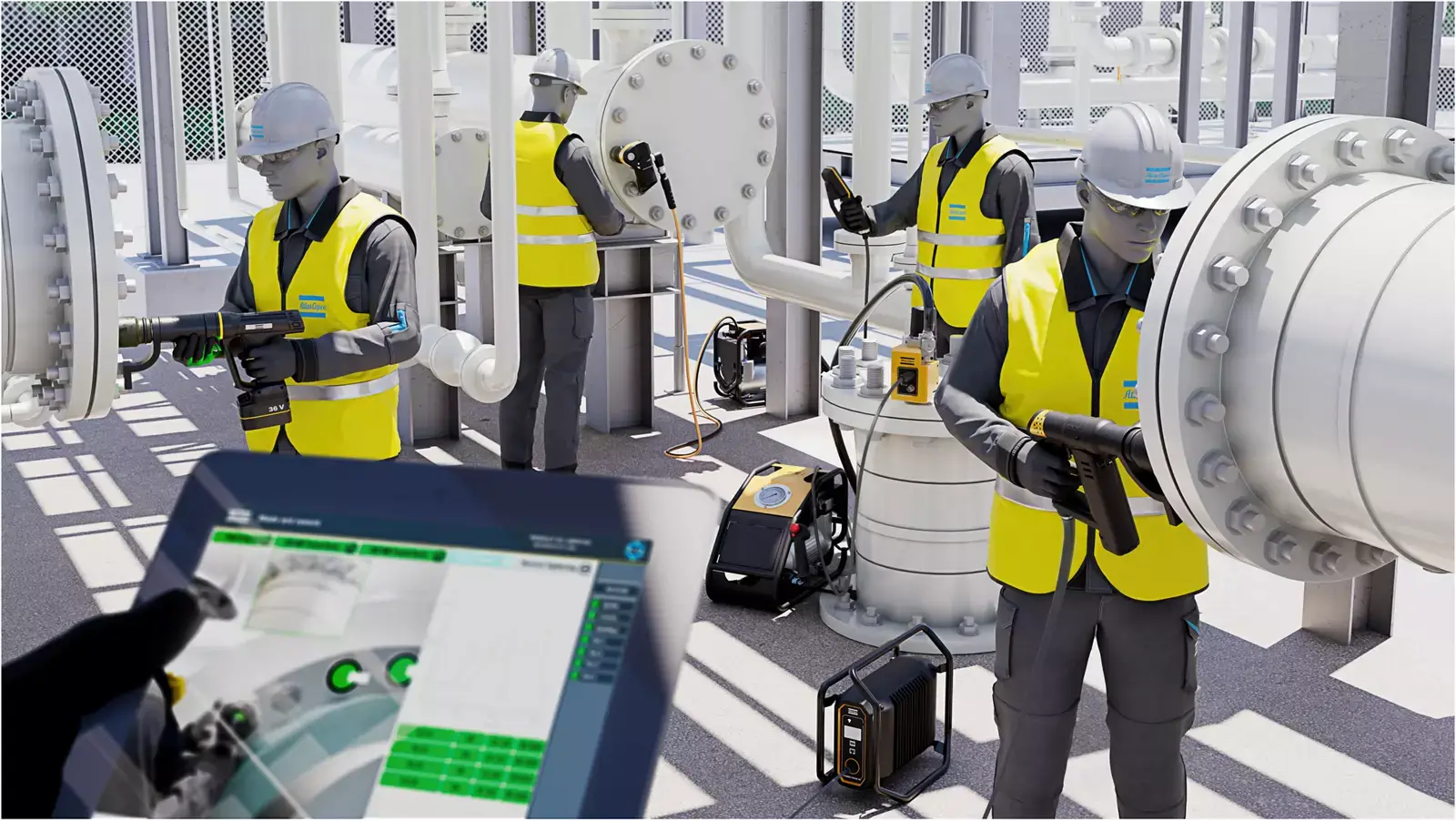
Take a walk through a refinery, a wind farm, or a processing plant.
See all that steel? All those rotating systems? High-pressure processes? And what about the bolts? Unless one has backed off or failed, you might not ever see them. Little is known that this relatively small part is, in fact, what holds everything together. Without them, most processes in any industry wouldn’t be able to perform at all.
So why are we, as an industry, starting to pay attention to something that seems so small? Simple really. Having the right bolting solution can be the difference between it performing well or not at all.
Why “Tight Enough” Isn’t Good Enough
For years, operations have been conducted with manual or rudimentary tightening practices. The problem? “Tight enough” is in the eye of the beholder. One tech might feel one way about it, while another might feel differently. When that feeling occurs across a flange or joint, then problems arise.
Industrial bolting solutions serve to eliminate guesses like those. They bring precision and repeatability to environments where the slightest human error can mean leaks, fatigue, or process downtime.
A Smarter Way to Apply Force
Consider the hydraulic bolt tensioner; rather than screwing a bolt into its final resting place, it provides controlled stretch on the bolt, then fastens it. It’s a subtle difference, but it changes the whole ball game.
Because the load is spread equally, there are fewer “hot spots” that can fail and far less rework. In industries where every hour of unscheduled downtime can cost tens of thousands of dollars, that kind of performance isn’t a luxury; it’s a requirement.
Torque, But Make It Precise
Then there are your hydraulic torque tools. These aren’t any old spanners. They are designed to deliver accurate, repeatable torque across many bolts. They work in unpleasant places.
This is actually very important. A slightly out-of-tolerance joint can mean unplanned emissions, especially in oil and gas. So, better bolting not only means better doing of stuff, but it can also be said to reduce fugitive emissions and save the planet.
The Sustainability Angle Most People Miss
When most people think of sustainability, they usually conjure images of new, high-tech solutions: renewables, electrification, carbon capture. But there are enormous benefits from even modest gains in reliability.
Better bolting means less leakage and wasted fluid, reduced waste, and better equipment utilization up and down the supply chain. A wind turbine operating with its steel tower bolted down in place may require fewer seasonal visits by remote maintenance crews. This means more availability and less downtime to produce clean power, lowering the levelized cost of electricity.
It’s a soft sustainability. But a strong one.
From Tools to Intelligence
What’s different now is that bolting technology is getting smarter. Current systems can now measure load, assess performance, and contribute data to planning maintenance.
It’s that shift away from reactive responses to predictive planning where industrial work is heading. And bolting is emerging as a point in fact, however surprising.
Where It All Comes Together
For firms looking to modernize, the trend toward more joined-up thinking in bolting is logical. Instead of treating tools, procedures and data as distinct entities, steps are now being taken to ensure that these elements dovetail together. Through this approach, it is possible to harmonize practices, improve the measurement of performance, and enable the right decision to be made with the requisite level of insight in a broad cross-section of industrial scenarios.
Small Detail, Big Consequences
They are not exciting. They are not newsworthy. They are not the center of attention. Then again, when they break, so does, if only gradually, everything else.
And applying the right technologies, simple, exact, dependable, and engineering-caliber, can’t help but improve safety, economics, efficiency, and long-term value.
In an industry where all of those matter more all the time and already are subject to narrow tolerances, that is anything but a little advantage.
Editor’s Note: The opinions expressed here by the authors are their own, not those of Impakter.com — In the Cover Photo: Advanced Bolting Solutions. Cover Photo Credit: Atlascopco