Impakter
  • Environment
    • Biodiversity
    • Climate Change
    • Circular Economy
    • Energy
  • FINANCE
    • ESG News
    • Sustainable Finance
    • Business
  • TECH
    • Start-up
    • AI & Machine Learning
    • Green Tech
  • Industry News
    • Entertainment
    • Food and Agriculture
    • Health
    • Politics & Foreign Affairs
    • Philanthropy
    • Science
    • Sport
  • Editorial Series
    • SDGs Series
    • Shape Your Future
    • Sustainable Cities
      • Copenhagen
      • San Francisco
      • Seattle
      • Sydney
  • About us
    • Company
    • Team
    • Global Leaders
    • Partners
    • Write for Impakter
    • Contact Us
    • Privacy Policy
No Result
View All Result
  • Environment
    • Biodiversity
    • Climate Change
    • Circular Economy
    • Energy
  • FINANCE
    • ESG News
    • Sustainable Finance
    • Business
  • TECH
    • Start-up
    • AI & Machine Learning
    • Green Tech
  • Industry News
    • Entertainment
    • Food and Agriculture
    • Health
    • Politics & Foreign Affairs
    • Philanthropy
    • Science
    • Sport
  • Editorial Series
    • SDGs Series
    • Shape Your Future
    • Sustainable Cities
      • Copenhagen
      • San Francisco
      • Seattle
      • Sydney
  • About us
    • Company
    • Team
    • Global Leaders
    • Partners
    • Write for Impakter
    • Contact Us
    • Privacy Policy
No Result
View All Result
Impakter logo
No Result
View All Result
Pets and the Pet Industry During the Covid Era

Pets and the Pet Industry During the Covid Era

How animal companionship has evolved B.C.(before Covid), DC (during Covid)-- and may evolve in A.D. (after Covid)

Richard Seifman - Former World Bank Senior Health Advisor and U.S. Senior Foreign Service OfficerClaude Forthomme - Senior EditorbyRichard Seifman - Former World Bank Senior Health Advisor and U.S. Senior Foreign Service OfficerandClaude Forthomme - Senior Editor
September 9, 2022
in Health, Society
0

The Covid Era has affected many aspects of life, one of which has been the growth in the pet industry. When we first experienced social distancing and lockdowns it triggered an initial surge in having animal companionship, especially cats and dogs, but also more exotic pets. 

Old and new companies in the business of food, all manner of paraphernalia, toys, veterinary services, animal trainers, and the like, were in high demand, became star performers on global stock markets.

“…pet ownership sharply grew in the last year (2020-2021)— 11.38 million households in the United States got pets during the pandemic”, according to the American Pet Products Association. So did the workload for veterinary practices, many of which simultaneously grappled with COVID-19 safety protocol, concerns of thinning staff, and growing pressure to see as many patients as possible.

Research also shows that nearly half of the British families that owned a pet added one during the lockdown. And animal shelters everywhere were left nearly empty, which is good news.

A study done in May 2021 using Google Trends search data and methodology found that in conclusion, “the global interest in pet adoptions surged in the early phase of the pandemic but not sustainable. With the launch of COVID-19 vaccines, there is a concern for separation anxiety and possible abandonment of these newly adopted pets when the owners would leave their homes for work in the future.”

That conclusion is interesting and raises a serious concern: One might assume that the combination of vaccines, therapeutics, and fewer COVID cases, made it seem as if we were coming out of the pandemic phase; and that this would allow some to reconsider if they really wanted a permanent house pet partner. And such considerations would result in a flattening of demand for new pets, an increasing return to pet shops or foster adoption places, or simply abandoning these domesticated animals to fight for themselves. 

However, we now know that such optimism was premature. As a result of Omicron and possibly future variants, we are in the midst of a new wave, and there is the prospect we will be living with COVID for some time. As will pets.

Why we sought and still seek pet companionship?

In times of isolation and fear, having a four-legged companion, a living creature that doesn’t talk about the latest rise in cases and hospitalizations, the environment or world politics, which doesn’t answer back in words, and is expected to be appreciative for petting, regular meals, and attention can make all the difference in terms of quality of life. 

This is especially true for those who live alone, the elderly or infirm, or whose human emotional partner has not been there when needed.

An additional spur to pet ownership during the pandemic is that household pets are relatively immune to Covid (though not entirely – they may get a mild infection if exposed to the virus):

The American Pet Product Association (APPA) reported that 75% of pet owners they surveyed told them that spending time with their animals, new or old, helped reduce stress and improve well-being amid COVID-19. Similar trends were found in Europe, with surveys showing that more than 70% of pet owners reported a stronger relationship with their pets during the pandemic.”

Such connections have not been the only way modern people have sought to relate to other species. Comfort viewing is another one: Consider the huge numbers of “hits” by viewers of cat or dog antics on YouTube, or the success of virtual zoo watching, whether we observe a panda chomp on bamboo and especially a pregnant one, or frolicking primates.

There is a long history of when and why mankind sought animals beyond their utilitarian hunting, protection, or other uses. But now there are some differences, at least two new factors are notable: 

  • First, the growth and impact of urbanization, as described in “Metropolis: A History of the City, Humankind’s Greatest Invention” (by Ben Wilson) with global urban population growing by nearly 200,000 people every day; 
  • second, with COVID, we see how a pandemic is easily transmitted and spreads the most among large concentrations of people – i.e. in urban areas. 

This is why the companionship factor became the primary raison d’etre. People living in urban settings are the ones who crave the most such emotional support.  

What is interesting is that despite the economic challenges caused by the pandemic, with many losing their jobs, animal owners in the United States have not cut spending on their pets. The APPA estimates that Americans spent close to $100 billion on their pets in 2020, which is more than ever before:
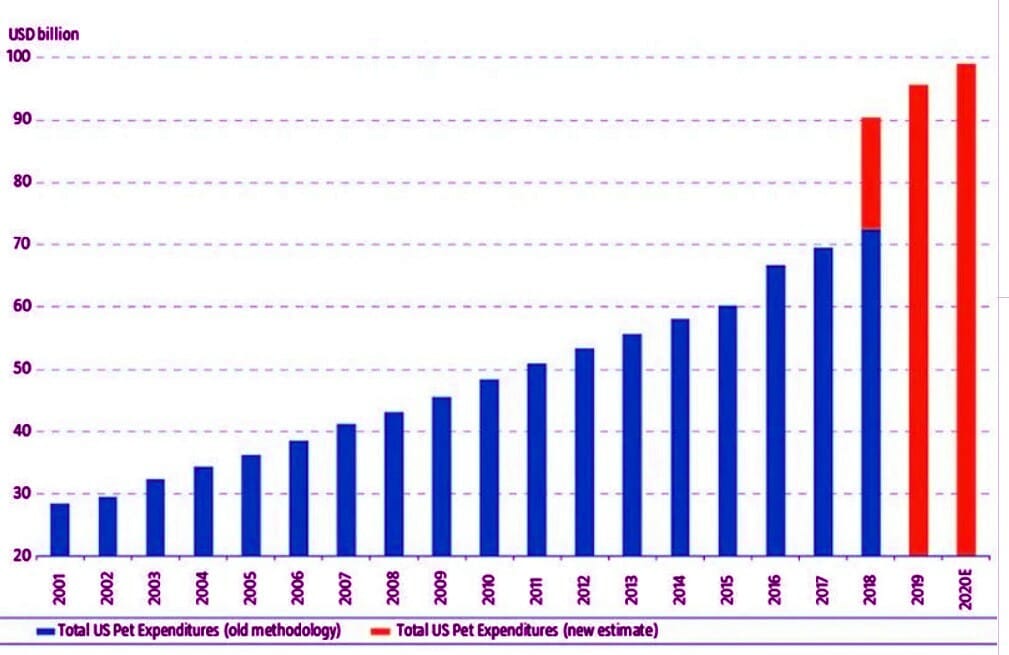
This graph shows extraordinary growth since the turn of the century. The upward trend was steady and highly resilient; it didn’t even slow down during the 2008 Great Recession. And it suggests that our love story with pets is not about to end any time soon.

Six months ago, as mentioned above, many thought that prevention and containment measures meant it was “mission accomplished” and that our social lives could return as they had been in the “Before Covid” (B.C.) Era – and therefore, that there would be less need for a pet.

In short, it was time to move on. They have been sadly mistaken at least as of today, in our “During Covid” (D.C.) period. As to A.D. (after Covid), let’s hope we get there as soon as possible, with all our pets around us


In full disclosure, the co-authors both grew up with dogs; Richard Seifman has had a cat in his life since marriage, and “Leo”, his foster cat, is a crucial member of his family; Claude Forthomme has two dogs, a slim Cirneco dell’Etna and a long-haired (almost hirsute) Border Collie, added during the pandemic.


Editors Note: The opinions expressed here by Impakter.com columnists are their own, not those of Impakter.com

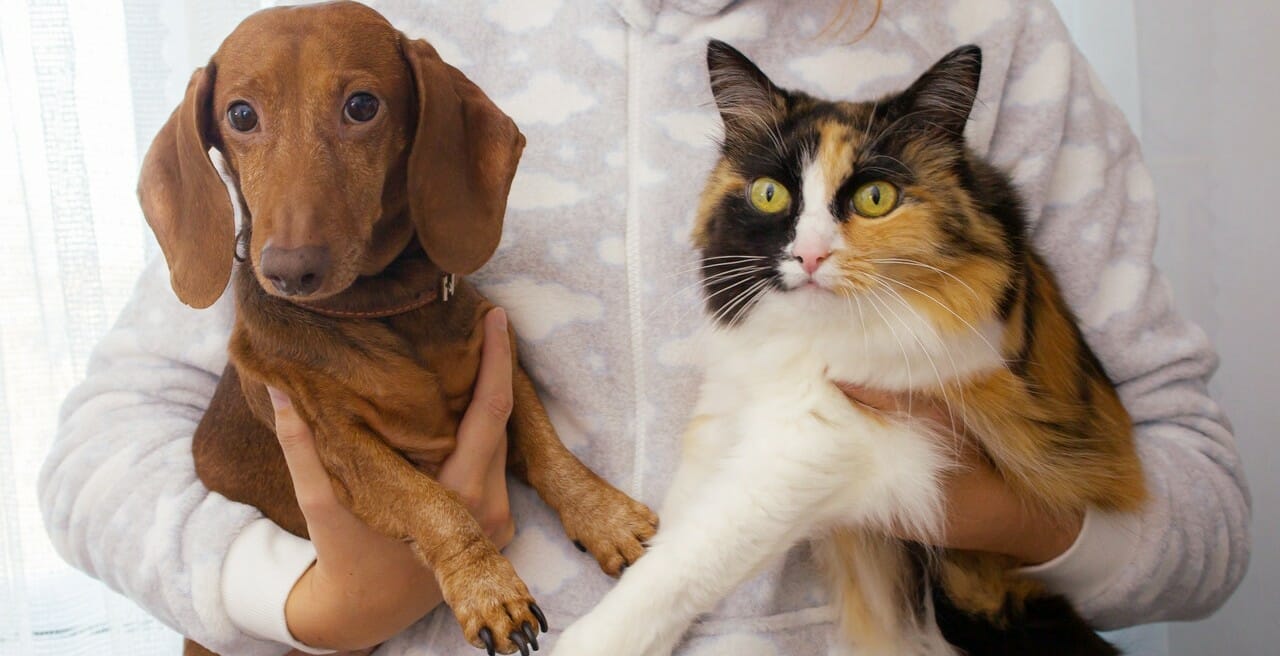
Cover Photo: Person holding her pets Photo by Nadya Vasil’eva from Pexels


Tags: catsCOVIDdogshousehold petspandemic
Previous Post

Planet Earth:  Averting  ‘A Point Of No Return’?

Next Post

The Rise of Omicron: How Serious Is It?

Related Posts

financial bubble
ESG FINANCE

Waiting for a Bubble to Burst: Decoding the Next American Financial Crisis

For much of the last century, financial logic was governed by a simple, foundational rule: equities for growth, representing a...

byDeepanshu Mohan - Professor of Economics and Dean, IDEAS, Jindal School of Liberal Arts and Humanities, O.P. Jindal Global Universityand1 others
November 4, 2025
Avian Influenza
Health

Avian Influenza: First Global Dialogue Targets the Rising Pandemic Threat

In an unprecedented response to the rapid global spread of high pathogenicity avian influenza (HPAI), stakeholders and experts from across...

byThe Food and Agriculture Organization of the United Nations (FAO)
September 12, 2025
animals personhood
Biodiversity

Should Animals Also Be ‘Persons’ in Law?

The recent Supreme Court judgment directing municipal authorities to remove stray dogs from the streets of Delhi NCR has now...

byAshima Sharma - Assistant Professor at BML Munjal University
August 27, 2025
How Prepared Are We for the Next Pandemic?
Health

How Prepared Are We for the Next Pandemic?

While there appears to be no single study that definitively predicts a surge in pandemics, the scientific consensus is clear:...

byAndrej Pavicevic - Managing Editor
February 3, 2025
Cats well-being
Society

J.D. Vance’s Comment About Childless Cat Ladies Generates Lots of Meows

J.D. Vance, the current U.S. Republican Vice Presidential nominee, created a firestorm when he said in 2021 during his Senate...

byRichard Seifman - Former World Bank Senior Health Advisor and U.S. Senior Foreign Service Officer
October 28, 2024
bird flu
Editors' Picks

Could Bird Flu Lead to the Next Pandemic?

The detection of a case of the widespread H5N1 strain of avian influenza in Australia is a cause for concern. On Wednesday,...

byDr Vinod Balasubramaniam - Associate Professor of Molecular Virology at Monash University Malaysia
June 5, 2024
NASA cat video streamed from space
Science

NASA Streams First Video From Deep Space — of a Cat

On December 11, 2023, Taters, a cat, made its broadcast debut in a 15-second video in which it chases a...

byDiana Croce
December 21, 2023
animals pandemics
Health

The Central Role of Animal Welfare in Pandemic Prevention

The next pandemic could be closer than we think, and a key to preventing it lies in redefining our relationship...

byInternational Institute for Sustainable Development (IISD)
September 16, 2023
Next Post
The Rise of Omicron: How Serious Is It?

The Rise of Omicron: How Serious Is It?

Recent News

ESG news regarding SBTi proposes flexible Corporate Net-Zero Standard V2 with new Scope-1/2/3 pathways and strict credit guardrails, COP30 in Belém during the UN climate summit, Simon Stiell addresses COP30 in Belém, warning governments to act on climate or face famine, conflict and inflation, Carbon Direct acquires Pachama to add AI and satellite MRV for forest-carbon projects

SBTi Draft Plan Gives Companies More Ways to Reach Net Zero

November 11, 2025
ESG news regarding U.S. absence from the COP30 climate summit, Europe’s role in the U.S. absence, new euro zone loan pricing, and countries suffering from global warming speak at COP30

COP30 Without the U.S.

November 10, 2025
The Amazon rainforest is often called “the lungs of the world.” It produces oxygen and stores billions of tons of carbon every year. The Amazon rainforest covers more than 60% of the landmass of Peru. Photo Credit: USDA Forest Service / Diego Perez.

Inside COP30

November 10, 2025
  • ESG News
  • Sustainable Finance
  • Business

© 2025 Impakter.com owned by Klimado GmbH

No Result
View All Result
  • Environment
    • Biodiversity
    • Climate Change
    • Circular Economy
    • Energy
  • FINANCE
    • ESG News
    • Sustainable Finance
    • Business
  • TECH
    • Start-up
    • AI & Machine Learning
    • Green Tech
  • Industry News
    • Entertainment
    • Food and Agriculture
    • Health
    • Politics & Foreign Affairs
    • Philanthropy
    • Science
    • Sport
  • Editorial Series
    • SDGs Series
    • Shape Your Future
    • Sustainable Cities
      • Copenhagen
      • San Francisco
      • Seattle
      • Sydney
  • About us
    • Company
    • Team
    • Global Leaders
    • Partners
    • Write for Impakter
    • Contact Us
    • Privacy Policy

© 2025 Impakter.com owned by Klimado GmbH