
The One Health concept/approach offers a powerful tool for public health and biomedical research globally. The combined integration of human medicine, veterinary medicine and ecology has documented science-based proof of efficacy. It allows for addressing complex global health challenges, including epidemic and potential pandemic developments as well as climate change. Advocates have focused recently on efforts to harmonize cooperative programs.
Infectious diseases remain among the most significant global health challenges, responsible for millions of deaths annually and substantial economic losses. Approximately 60% of all human infectious diseases originate from animals, and 75% of emerging infectious diseases are zoonotic. One Health is a collaborative, multisectoral, and transdisciplinary strategy that recognizes the interconnectedness of human, animal, and environmental health, underscoring the need for interdisciplinary education that bridges human medicine, veterinary medical science, and environmental health.
Today, however, the degree of emphasis on infectious diseases varies significantly across these disciplines as shown in a rough comparative sense below:
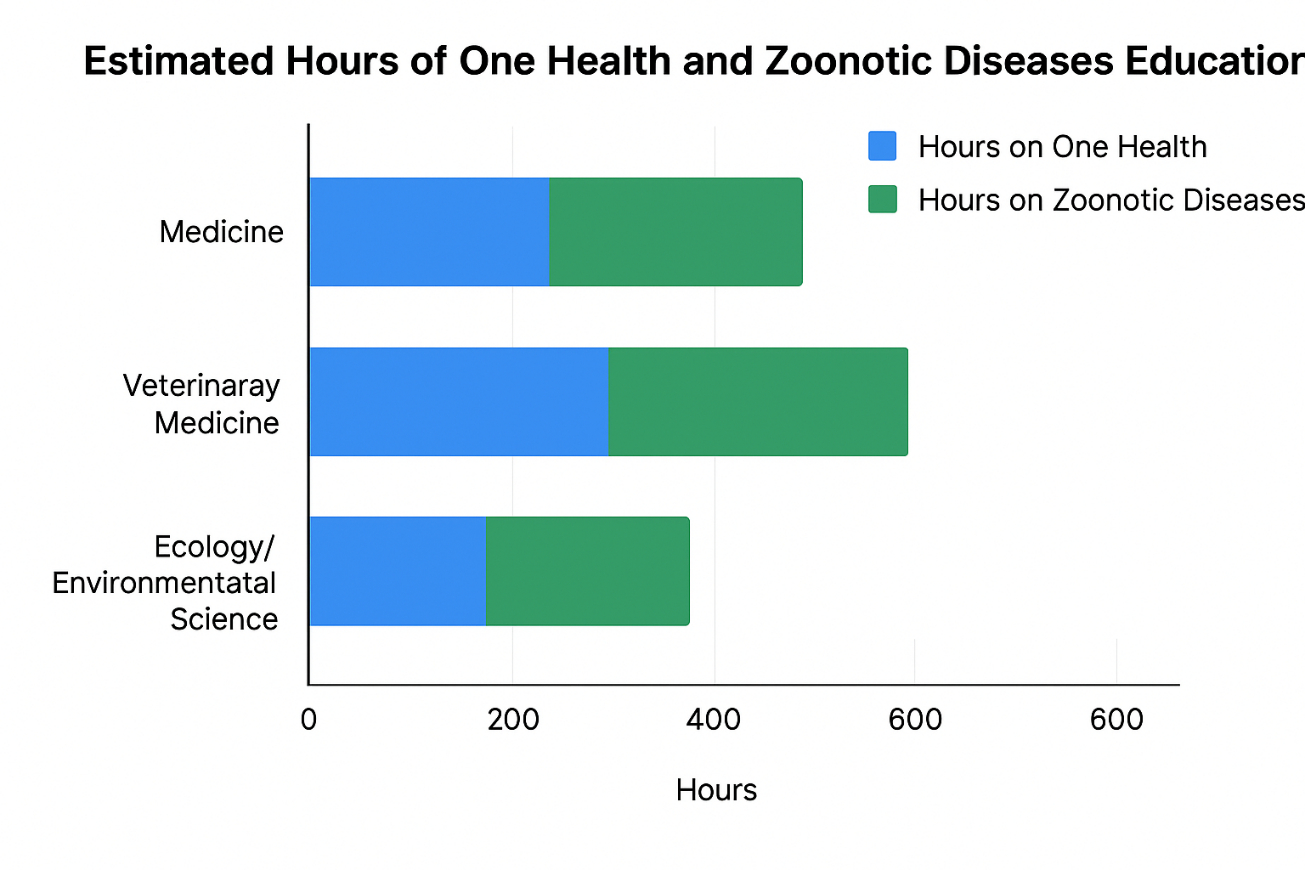 Embedding One Health principles into the curricula of these disciplines is essential for pandemic preparedness and sustainable health systems, and a critical element of global security. “Harnessing the power of One Health education to tackle Emerging Infectious Diseases (EIDs) and [many] other global health challenges” is the essence of expeditious, efficacious public health and clinical biomedical research advancement in today’s and tomorrow’s civilization.
Schools of veterinary medicine have served as the principal foundation fostering animal, human and environmental user interfaces. The Association of American Veterinary Colleges (AAVMC) has promoted One Health proficiency for all veterinary medical students. Dual degrees with DVM and/or VMD graduates combined with Masters of Public Health (MPH) and Masters of Environmental Studies (MES) have been encouraged at institutions such as Penn Vet. High-profile issues, including antimicrobial resistance (AMR), food safety and zoonotic disease surveillance techniques for veterinarians, help ensure better-trained first responders at large.
Since the COVID-19 pandemic, medical school interest in One Health has risen. For instance, a “One Health Certificate of Distinction” (2022/2023) program was inaugurated at Hawaii’s John A. Burns School of Medicine (JABSOM). This engaged students in clinical rotations at local zoos and One Health research projects.
Georgetown University and other medical schools began offering elective One Health courses. UC Davis provides a “Doctoring” curriculum” facilitating collaboration between medical and veterinary medical students. Case studies together included selecting management of Toxoplasmosis (Toxoplasma gondii) infection because of the “potentially different perspectives that medical and veterinary medical practitioners may have on advising a pregnant woman about exposure with regard to risk factors, prevention, testing, and treatment.”
The University of Florida’s (USA) One Health Center has begun jointly associating its College of Veterinary Medicine with ecological (environmental) science and agricultural departments to study wastewater surveillance and harmful algal blooms. East African Rwanda manages a One Health Field School that trains students in real-world environmental health assessments at the University of Global Health Equity (UGHE).
These specialized programs demonstrate increased recognition and form mainstay models for other environmental and ecosystem schools’ participation. “Landscape immunity,” deforestation habitat degradation and climate change educational focuses help elucidate aspects of disease spillover.
Notably, one longstanding online platform was devised by one of the co-authors of this article, Dr. Laura H. Kahn. Kahn created a specific comprehensive One Health course, “Bats, Ducks, and Pandemics: An Introduction to One Health Policy” when she was a physician and research scholar on staff at Princeton University. Currently, in 2026, this course remains available worldwide.
Related Articles
Here is a list of articles selected by our Editorial Board that have gained significant interest from the public:
Other universities with One Health programs
A comprehensive Map of Academic Institutions, organizations, groups, and labs identified around the world as actively working to further One Health is presented on the One Health Commission website.
The highest profile university One Health programs that integrate human, animal and environmental health disciplines include the following:
United States
- Auburn University: A BS in Public and One Health and a graduate certificate in One Health while having a partnership between its schools of Forestry, Wildlife, and Veterinary Medicine.
- Berry College: Its One Health Center was among the first to offer an undergraduate minor in One Health.
- Colorado State University: Its One Health Institute focuses on interprofessional education and infectious disease research.
- NC State University: Its Global One Health Academy offers scholarship programs for undergraduates to develop One Health leadership.
- Purdue University: Has a One Health Initiative program with online and hybrid certificate programs for professional development.
- University of Arizona: Its Zuckerman College of Public Health provides an undergraduate track, a minor, and a certificate in One Health.
- Other Institutions with One Health programs:
- Cornell University (Center for Wildlife Health)
- Ohio State University (Graduate Certificate in Global One Health)
- University of Alaska Fairbanks (Offers Master of Science (M.S.) in One Health)
- University of Tennessee (One Health Initiative)
- Virginia Tech (One Health graduate programs)
- Wayne State College (Bachelor of Science in One Health)
International
- University of Edinburgh (UK): Its Royal (Dick) School of Veterinary Studies Offers postgraduate awards and a Master of Science in One Health.
- Western University (Canada): Part of its Health Sciences program offers an Honours Specialization in One Health.
- University of Helsinki (Finland): One Health features an interdisciplinary research network “established to coordinate research activities in One Health, a strategic profiling research area of University of Helsinki.”
- Massey University (New Zealand): Offers specialized One Health research programs.
Breaking down “disciplinary silos” at schools requires various pedagogical strategies. In Case-Based Learning (CBL) for historical health crises, interdisciplinary medical and veterinary medical student teams examine past events, e.g., what happened with Covid-19.
Another is the classical 2014–2016 West African Ebola outbreak, the largest and deadliest epidemic of Ebola Virus Disease (EVD) since the virus was first discovered in 1976. Students identify how these health crises move through different societal regions. This fosters critical thinking by examining real-world scenarios.
Emerging threats such as antimicrobial resistance (AMR) are focused on by Problem-Based Learning (PBL). Existing major barriers involve geographic distances between medical schools and veterinary medical schools on college campuses, inadequate funding for joint faculties and incongruent academic schedules.
Fortunately, several global educational networks provide One Health training across borders, such as SEAHUN in Southeast Asia which connects more than 115 universities that provide training in infectious diseases. ISOHA, an international student One Health alliance, aims to “connect students across the world interested in the connections between animal health, human health, and environmental health. ISOHA serves as an umbrella for International and National student organizations, One Health Clubs, BSc, MSc and PhD students (18-35) and provides education and opportunities related to One Health, through partnerships and collaborative projects.”
Sum and substance: As global health threats intensify, embedding One Health principles into all curricula is not optional — it is essential for pandemic preparedness and sustainable health systems.
Editor’s Note: The opinions expressed here by the authors are their own, not those of impakter.com — Cover Photo Credit: Rashid Tajuar