Impakter
  • Environment
    • Biodiversity
    • Climate Change
    • Circular Economy
    • Energy
  • FINANCE
    • ESG News
    • Sustainable Finance
    • Business
  • TECH
    • Start-up
    • AI & Machine Learning
    • Green Tech
  • Industry News
    • Entertainment
    • Food and Agriculture
    • Health
    • Politics & Foreign Affairs
    • Philanthropy
    • Science
    • Sport
  • Editorial Series
    • SDGs Series
    • Shape Your Future
    • Sustainable Cities
      • Copenhagen
      • San Francisco
      • Seattle
      • Sydney
  • About us
    • Company
    • Team
    • Global Leaders
    • Partners
    • Write for Impakter
    • Contact Us
    • Privacy Policy
No Result
View All Result
Impakter logo
No Result
View All Result
Migrant Deaths in the Atlantic Highest Since 2007, as EU ‘Big Wall’ in the Mediterranean Is Avoided

Migrant Deaths in the Atlantic Highest Since 2007, as EU ‘Big Wall’ in the Mediterranean Is Avoided

Isaac Castella-McDonaldbyIsaac Castella-McDonald
August 11, 2021
in Equal Rights, Global Leaders, NGO & Charities, Politics & Foreign Affairs, Society
0

So far this year, 7,418 migrants and refugees have arrived in the Canary Islands. While 210 people lost their lives in all of 2019, there have already been over 250 deaths in 2021, according to the UN’s International Organisation for Migration (IOM).

The true numbers are almost certainly much higher. “Invisible shipwrecks,” where boats go missing at sea, suggest the actual figure could be up to eight times the IOM’s estimates, according to a report from the Spanish NGO Caminando Fronteras.

Caminando Fronteras highlighted that there were five times as many deaths in the first half of 2021 than there were during the same period last year. This is the highest number of deaths since the NGO began recording migrant deaths at sea in the region 14 years ago.

The Atlantic: A Dangerous Route to the EU

There are many complex reasons for this dramatic increase in deaths: the heavy impact of the pandemic on developing economies, the fishing crisis in Senegal, the continued war in Mali. But an obvious discrepancy in the data suggests that these deaths are due to a change in the way migrants are getting into EU territory.

The report from Caminando Frontera estimates that almost 2,100 migrants have died trying to reach Spain by sea between January and June of 2021. Of this number, the Atlantic route, from countries on the West coast of Africa to the Canary Islands, has claimed 1,922 lives, 91% of the total.


Related Articles: War on Migrants: Is Europe the Loser? | Refugees: Why they are not an economic burden 

In part, the increased policing of the routes from Morocco and Libya by EU backed Libyan and Moroccan authorities has led to the renewed popularity of the dangerous Atlantic route.

In 2019, the EU allocated 140 million Euros to support Morocco’s efforts against irregular migration. In that same year fewer than 2,700 migrants arrived in the Canaries. In 2020, more than 23,023 made the crossing, overwhelming the reception infrastructure on the islands and leading to conditions that were deemed to violate migrant’s human rights.

In the five years since 2015, €1.337 billion has been spent by the Emergency Trust Fund for Africa, accused of ultimately trying to build a “big wall” between Europe and Africa. Amongst many other things, the fund provided border guard training in 20 African countries, and reconstructed the Libyan coast guard. Of this fund only 3% was used to develop safe and legal routes for migration. 
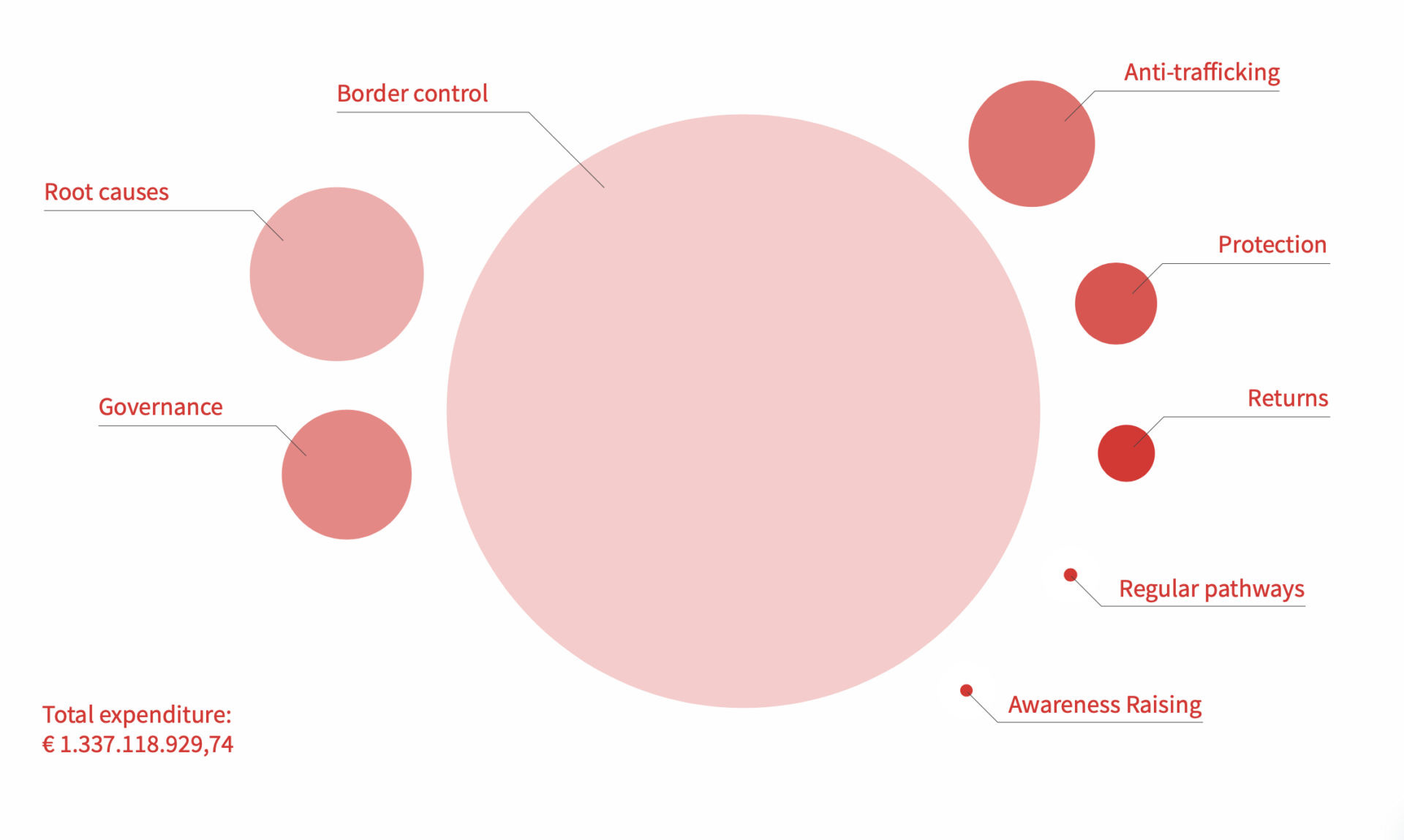
 

Expenditure of Migration Fund
In the Photo: Expenditure of the ‘Emergency Trust Fund for Africa’. Photo Credit: ActionAid.

In fact, these increased deaths show it has achieved just the opposite.

It seems that this renewed focus on a “big wall” in the Mediterranean is merely shifting the flow from the Mediterranean onto the Atlantic sea, where rubber dinghy’s leave Mauritania aiming for the tiny Canary Islands, sometimes ending up filled with corpses as far away as the Caribbean islands.

Building this wall between Africa and Europe has not stemmed the flow of migrants. As Hana Jalloul, Spanish secretary of state for migration, told the Guardian: “Migration is a historical fact and that’s not going to stop.”

Positive Migration Control as a Humane Solution

The denial of the basic facts of migration is handing desperate and vulnerable people into the hands of trafficking gangs, who use dangerously irresponsible types of boats to do crossings which lead to these tragic deaths. Policing, and other negative forms of control, deny the reality of the migrant’s struggle.

Migration is a historical fact and that’s not going to stop.

—Hana Jalloul

There is, for Hana Jalloul, a “need for an intelligent and multilateral approach to people-flows.” More positive, integrative forms of control are far from impossible, nor would they be hugely expensive. 

Georges Soros, in his great article on the subject, has proposed a more humane way of dealing with the fact of migration, arguing that most of the building blocks for an effective asylum system are already available. A brief summary of his proposal runs like this:

  1. The EU sets a firm and reliable quota for migrant entries — between 300,000 and 500,000 a year; 
  2. Countries with a high number of migrants must receive enough financial support to make migrant lives there viable; with a promise that in the next few years they will be part of the 300,000 allowed to make the crossing;
  3. Establishing the “voluntary balancing of supply and demand in other fields, such as with matching students to schools and junior doctors to hospitals. In this case, people determined to go to a particular destination would have to wait longer than those who accept the destination allotted to them. The asylum seekers could then be required to await their turn where they are currently located. 

Such an approach, argues Soros, would be “much cheaper and less painful than the current chaos, in which inevitably the migrants are the main victims.” It would be more equitable too: Those who jump the line would lose their place and have to start all over again. “This should be sufficient inducement to obey the rules,” he writes.

Soros estimates a project of this kind would cost $30 billion, “less than one-half of one percent of total spending by its twenty-eight member governments.” 

Clearly this would be fairly complex to manage, but it would avoid the tragedy of the thousands who drown every year behind the “big wall” the EU has built across the sea. It would be compassionate, fair, cheap, and treat migrants with the dignity they are currently denied.


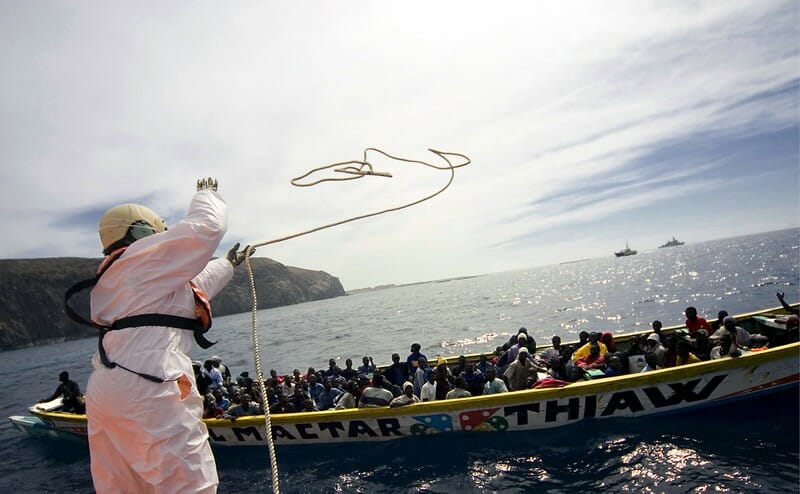
Editor’s Note: The opinions expressed here by Impakter.com contributors are their own, not those of  Impakter.com — In the Featured Photo: The Spanish coastguard intercepts a traditional fishing boat carrying African migrants off the island of Tenerife in the Canaries. Featured Photo Credit: UNHCR Photo Download.


Tags: Border ControlBordersEUImmigrationmigrantsRefugees
Previous Post

These Pictures Show Wildfires Around The World, And It Is Worse Than You Think

Next Post

Canadian Sentenced in China: A ‘Bargaining Chip’ in the Huawei Arrest?

Related Posts

ESG news regarding weakened EU sustainability laws, new metal-fuel funding, legal challenges to California climate rules, and Germany scaling back gas capacity plans.
Business

Europe Retreats: Lawmakers Slash Corporate Climate Obligations

Today’s ESG Updates EU Weakens Sustainability Law: EU lawmakers scaled back the CSDDD, narrowing its scope to only large companies...

byEge Can Alparslan
November 14, 2025
ESG News regarding: only 16% of companies on track to hit net zero targets by 2050 per Accenture report, Orsted completes green transformation, EU and UK to begin carbon market link negotiations, China to expand renewable energy sector
Business

Only 16% of Large Companies on Track for Net Zero

Today’s ESG Updates Accenture Report Highlights Net Zero: While 89% of the world’s largest companies link decarbonization to business value,...

bySarah Perras
November 12, 2025
ESG news regarding EU weakening 2040 target based on lack of forest carbon absorption, EIB grants Iberdrola €500 million for offshore wind project, Trump administration excluded the Atlantic from drilling, and ExxonMobil threatens to leave EU amid new climate law
Business

EU to Weaken Climate Target, Citing Forest CO2 Absorption

Today’s ESG Updates Lack of CO₂ Absorption by European Forests Could Weaken EU 2040 Goals: EU ministers are debating a...

bySarah Perras
November 3, 2025
ESG news regarding Green Climate Fund approving over 3 billion in climate-related projects, division in the EU over 2040 climate targets, Huawei threatening legal action to become a passive member in EU solar lobby, and the effect of deforestation and climate change in Jamaica
Business

Green Climate Fund Approves Record $3 Billion For Climate Projects

Today’s ESG Updates Green Climate Fund Approves Record $3.26 Billion for Climate Projects: The GCF approved 22 new projects across...

bySarah Perras
October 31, 2025
ESG news regarding the US-China Trade Agreement, Australia’s new environmental protection bill, Lukoil selling international assets to a Swiss firm, and truckmakers asking the European Commission to ease carbon emissions rules
Business

The United States and China Reach Trade Agreement

Today’s ESG Updates New Trade Deal Between Trump and Xi Jinping Pauses Trade War: U.S. President Donald Trump and Chinese...

bySarah Perras
October 30, 2025
Morgan Stanley Backs Corvus Energy’s Green Shipping Mission
Business

Morgan Stanley Backs Corvus Energy’s Green Shipping Mission

Today’s ESG Updates Morgan Stanley Supports Corvus Energy’s Green Shipping Mission: Morgan Stanley Investment Management (MSIM) has announced that they...

byEge Can Alparslan
October 10, 2025
France immigration
Future of Europe Series

The Artificial Political Divide: How France’s Immigration Debate Masks Social Reality

Immigration is a highly contentious and contested issue in France. During the past 20 years, 12 laws have been introduced...

byThomas Lacroix - Research Fellow at Sciences Po University
October 7, 2025
ESG news regarding the effect of the US government shutdown on climate programs, failed omnibus agreement, cryptocurrency mining coming to Brazil, and the EU’s steel quotas and tariffs
Business

Government Shutdown, Climate Shutdown

Today’s ESG Updates U.S. Government Shutdown Threatens Climate Programs: The shutdown has paused environmental regulations and research, and halted the...

bySarah Perras
October 2, 2025
Next Post
Canadian Sentenced in China: A ‘Bargaining Chip’ in the Huawei Arrest?

Canadian Sentenced in China: A 'Bargaining Chip' in the Huawei Arrest?

Recent News

ESG News regarding COP30 Declaration on Information Integrity on Climate Change, Trump’s tariff volatility, EV boom in South America, and protests at COP30

COP30 Declaration on Information Integrity on Climate Change

November 18, 2025
Business planning: engineer generating a plan

How Comprehensive Business Planning Can Drive Long-Term Sustainability

November 18, 2025
Encouraging Evidence of Momentum in Negotiations at COP30

Encouraging Evidence of Momentum in Negotiations at COP30

November 18, 2025
  • ESG News
  • Sustainable Finance
  • Business

© 2025 Impakter.com owned by Klimado GmbH

No Result
View All Result
  • Environment
    • Biodiversity
    • Climate Change
    • Circular Economy
    • Energy
  • FINANCE
    • ESG News
    • Sustainable Finance
    • Business
  • TECH
    • Start-up
    • AI & Machine Learning
    • Green Tech
  • Industry News
    • Entertainment
    • Food and Agriculture
    • Health
    • Politics & Foreign Affairs
    • Philanthropy
    • Science
    • Sport
  • Editorial Series
    • SDGs Series
    • Shape Your Future
    • Sustainable Cities
      • Copenhagen
      • San Francisco
      • Seattle
      • Sydney
  • About us
    • Company
    • Team
    • Global Leaders
    • Partners
    • Write for Impakter
    • Contact Us
    • Privacy Policy

© 2025 Impakter.com owned by Klimado GmbH