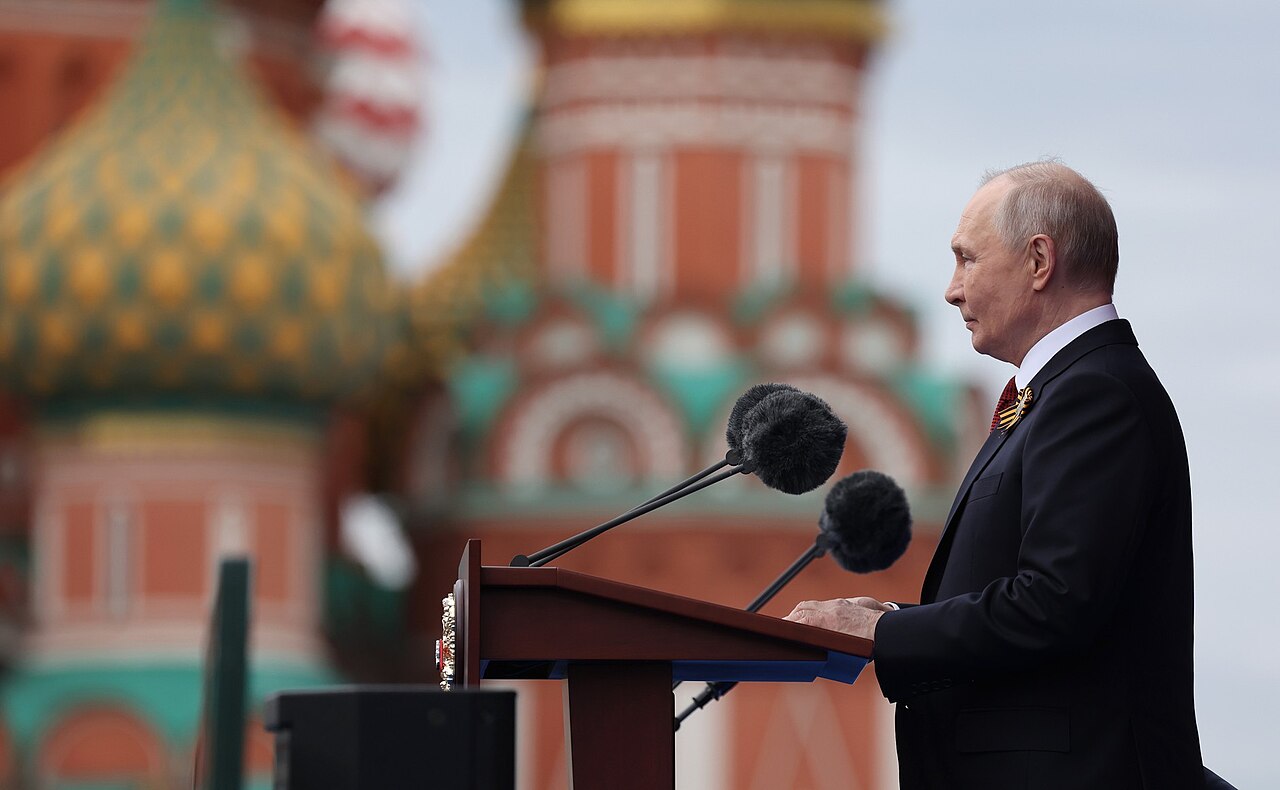
In a recent episode of Clearer Than Truth, hosts George Bogden and Nathan Kiker spoke with Russia analyst Mark Galeotti about what Moscow’s scaled-back Victory Day parade revealed about Vladimir Putin’s political position.
Vladimir Putin walked away from his own Victory Day parade in a weaker position than when he arrived. That was the reading offered by Mark Galeotti, one of the world’s foremost historians of the Russian state, when he joined Clearer Than Truth co-hosts George Bogden and Nathan Kiker for a wide-ranging conversation on the war in Ukraine, the psychology of the Kremlin, and what comes after Putin.
Galeotti has written more than 30 books on Russia, advised the UK Foreign Office and NATO, and been banned from the country he studies. His latest, Forged in War, traces the military history of Russia from its origins to the present. Across the episode, George Bogden and Nathan Kiker used that depth to pull today’s headlines back into their longer historical arc. Deterrence and the risk of miscalculation run through the wider series, including a conversation on Iran and nuclear deterrence.
A Victory Parade With No Victories
Galeotti described the parade as “a performative spectacle,” an annual ritual meant to project military might, international standing, and Putin’s personal command. More than 30 million Russians tuned in. What they saw fell short of the message.
Nathan Kiker noted the absence of tanks and missiles, replaced by marching cadets and North Korean soldiers. Galeotti agreed that the hardware had been relegated to a brief video montage, what he called a “mid-break commercial,” and that Leaders from Belarus, Kazakhstan, Uzbekistan, Malaysia and Laos attended. Slovakia’s prime minister, Robert Fico—not its president—visited Moscow but did not attend the parade. The set-piece speech landed no better. It was Victory Day, Galeotti observed, yet Putin “had no victories to report,” falling back on a message of patience and privation rather than any programmatic vision for ending the war.
What Russians Actually Feel
When Nathan Kiker raised the strain of wartime prices on ordinary households, Galeotti pushed back on the idea that hardship alone could topple the system. The World Bank moved Russia from upper-middle-income to high-income status in 2024, partly because military-related activity boosted measured growth. Retain this only as an attributed characterization by Galeotti..
The deeper reason for stability, in his telling, is coercion combined with resignation. This is a “thuggish police state” with no opposition structures left standing, so the safest move for elite and ordinary citizens alike is to keep quiet and hope. He added a note on patriotism drawn from his own contacts inside Russia, including committed opponents of the regime: even those who never wanted the war, once it began, would “rather it win than lose.”
George Bogden on Putin’s Place in History
George Bogden steered the discussion toward legacy and asked how to read Putin’s recent suggestion that the war was reaching a natural conclusion. Galeotti called it partly a cynical ploy, a promise of “sunlit uplands just over the horizon” meant to keep Russians hanging on. Behind the scenes, he described what he called “a war for Putin’s ear” between hawks predicting Ukrainian collapse and presidential-administration figures quietly floating a negotiated exit that could be sold as triumph. VTsIOM reported 65.6% approval, but its trust measure was much higher. Other pollsters produced different numbers. Name the poll, date and exact question; do not compare unlike measures.
George Bogden offered a comparison of his own, casting Putin as a latter-day Brezhnev, “the first of the gerontocrats,” a leader presiding over stasis and imperial decay rather than dramatic advance. Galeotti embraced the parallel and extended it: an aging leadership that distrusts the next generation, a chief of the general staff who is 70, a president who “famously doesn’t use a smartphone.” His own preferred analogy reached further back, to Ivan the Terrible, whose reign began with expansion and state-building before collapsing into paranoia and ruin.
The Soviet DNA of Putinism
George Bogden then asked what connective tissue best explains Putin’s relationship to the Soviet system. He pointed to Putin’s KGB posting in Dresden and his early patron Anatoly Sobchak. Galeotti answered in three parts.
First, Putin and his circle weren’t children of the Soviet nomenklatura but the first in their families to break into the elite, which sharpened their sense of loss when the system fell. Second, he witnessed two authoritarian regimes disintegrate, East Germany and then the Soviet Union, and drew the lesson that the mob must be crushed and leaders must never go soft. Third, the chaotic St. Petersburg of the 1990s, where Sobchak gave him a long leash among gangsters and license-seekers, unleashed what Galeotti called “the worst instincts of a Soviet citizen suddenly liberated” from Soviet controls.
That Soviet inheritance runs through other episodes as well, including one on how Soviet dissidents became a strategic lens.
What a Post-Putin Russia Might Look Like
Galeotti was candid that the near term looks grim, with a war-scarred economy and a generation of traumatized veterans returning home. His longer view carried more hope. The likely successors, the kleptocrats now in their 50s and 60s, are neither liberals nor democrats, he said, but “we in the West do know how to deal with kleptocrats.” They want their yachts, their children’s American education, and reconnection with the world, and they fear becoming a vassal of China.
His closing thought borrowed the logic of Pandora’s box: once kleptocrats have stolen everything, they tend to want rule of law to protect and pass on what they took. Rule of law can exist without democracy, he noted, but democracy can’t exist without rule of law. A democratic Russia in five years is impossible, in his judgment; a democratic Russia in 50 years is entirely possible.
Where to Follow the Conversation
Galeotti pointed listeners to his newest book, Homo Criminalis, a history of the world told through organized crime, and to his weekly podcast, In Moscow’s Shadows. Nathan Kiker closed by inviting him back at the end of the war, and again once a new leader sits in the Kremlin.
The full conversation is available on Clearer Than Truth, the foreign policy and national security podcast hosted by George Bogden and Nathan Kiker.
Editor’s Note: The opinions expressed here by the authors are their own, not those of Impakter.com