
Since 1995, Lotus Foods has been partnering in fair trade with small family farmers around the world who are growing rice sustainably and preserving rice biodiversity. The company is paving the way to market for smallholder farmers in Africa and Asia who adopt the ecological method of rice cultivation known as the System of Rice Intensification (SRI).
A small company with a big mission, Lotus Foods has emerged as a leader in the specialty rice category, and made a big difference in the quality of life of its family farm suppliers. I spoke to co-founder, Caryl Levine, to find out more.
Q: What inspired the founding of Lotus Foods? What is the mission?
CL: A small purple-black grain of rice is what inspired us to found Lotus Foods. Ken and I were visiting in China in 1993 and we were so smitten with the taste and beauty of the rice that we determined to introduce it to US markets so other people could enjoy it as well. This was still at a time when Americans’ perception of exotic rice was strictly basmati and jasmine. At the markets when we asked the farmers about the rice we were told it was called “longevity” rice for its health benefits or “tribute” rice because legend had it that it was reserved for Chinese emperors. So when Ken and I were touring the Forbidden City, Ken had the bright idea to brand the rice as ‘Forbidden Rice’, the emperors exclusive grain which we did in 1995. Legally the only black rice that can be sold as Forbidden Rice® is ours. From the start our mission has been about three inter-related issues: helping rice-farming families achieve a livable income by offering better prices; preserving rice biodiversity, which has been disappearing rapidly the last 60 years; and promoting sustainable agriculture.
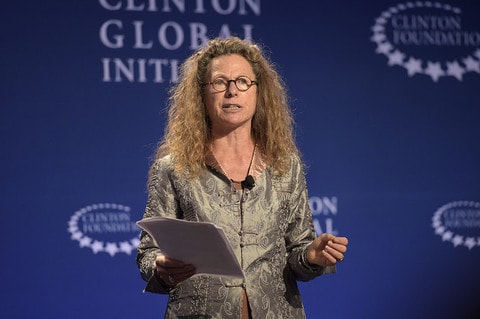
In the Photo: Caryl Levine, Co-founder, speaking at the Clinton Initiative Photo Credit: Lotus Foods
Q: How does Lotus Foods define sustainability? And, how do you incorporate sustainability into your production techniques?
CL: Organic farming probably comes closest to our definition of sustainability with its respect for soil, water and other natural resources to ensure farms remain productive for generations. We are very concerned about the negative consequences of agrochemicals in the global food chain and its downstream impacts.
Encouraging and assisting our suppliers to achieve organic certification has been an ongoing objective over the years, and we’re very proud of that accomplishment. And now we’re working to ensure the entire ingredient deck in our rice value-added products is organic as well. If anything we’ve set our bar for sustainability higher in the last 10 years, since we learned about the existence of agro-ecological approaches like the System of Rice Intensification (SRI), which puts more emphasis on soil health and improving the efficiency of inputs like water.
SRI turns notions about conventional agriculture on its head. For years farmers have been advised that to achieve higher yields they need more seeds, more water, and more fertilizer and pesticides. In fact, farmers adopting SRI practices achieve higher yields with less seeds, water and inputs. By reducing competition among plants, providing an optimum growing environment above and below ground, individual plants are healthier and can fully express their genetic potential.
Related article: “BONAVERDE: SAVING THE PLANET ONE CUP OF COFFEE AT A TIME” by Alessandro Du Besse
Q: Why are these techniques so important, specifically SRI? And, how does this relate to ‘More Crop Per Drop’?
CL: The terms “System of Rice Intensification” or SRI don’t lend themselves well for marketing and helping consumers understand the concept. So we came up with More Crop Per Drop™ to better convey two important outcomes of SRI, namely, that farmers are able to produce more food using less water and seeds. In fact, farmers benefit in multiple ways by adopting SRI, which makes it quite difficult and complex to explain to consumers.
We’ve never really been able to come up with the short elevator pitch. But when we did our brand refresh and introduced our SRI-grown rice in 2010, we conducted an informal survey to gauge the kinds of issues consumers relate to and we found that concern about water scarcity came out on top. This may have been influenced in part by the drought in California. Now Climate Change is on everyone’s mind. So we’ve recently been talking more about how SRI practices reduce the release of methane from rice paddies by eliminating the need to keep fields constantly flooded. Methane is a powerful greenhouse gas and flooded rice paddies are a major source.
Here’s another great benefit not really appreciated until explained. With SRI, farmers get great results from their own seed, so they don’t have to buy new seeds. This helps preserve rice biodiversity and local culinary cultures. Furthermore, SRI practices reduce the quantity of seed needed by 80-90%, so all that rice not used for planting becomes available for food. If you then factor in higher yields, you can see how SRI can become a powerful development catalyst.
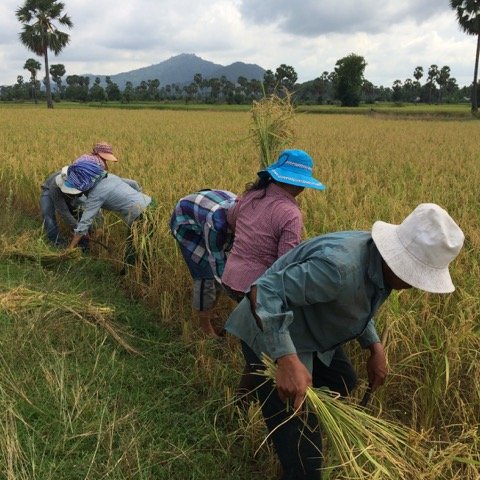
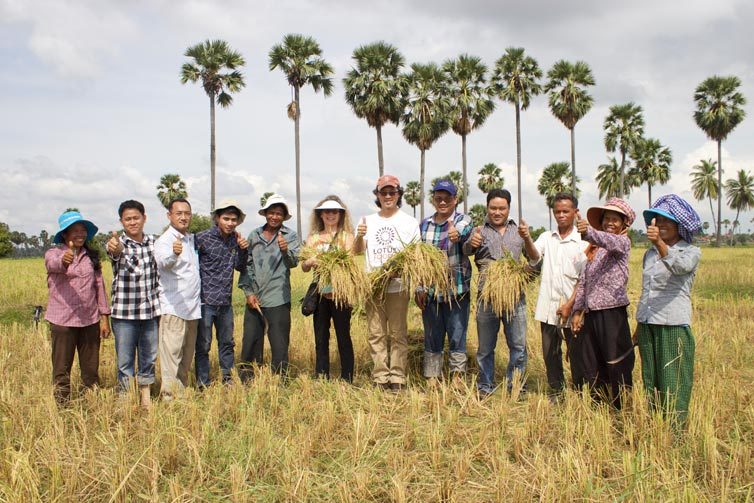
In the Photo: Small hold farmers benefiting from SRI production Photo Credit: Lotus Foods
Q: You have really gained momentum in getting small-scale farmers to adopt SRI, do you think that large scale rice farmers will do the same?
CL: Small-scale and large-scale are relative terms. We have a few families in Madagascar farming up to 20 acres, which is what we’d call large-scale, whereas in Indonesia, many farmers have plots less than one acre. Most farmers would be in the 1-2 acre range. While SRI was specifically developed with small-plot subsistence farmers in mind, the principles of transplanting younger seedlings, wider spacing, less water, planting in rows and mechanical weeding are being adopted and adapted with more mechanization on larger field operations in several countries, like Pakistan and Malaysia and even the US, in NJ and Maryland.
Anson Mills in South Carolina is using SRI methods, which is interesting because if you look at historic images of how rice was cultivated on plantations in the Carolinas in the very early 1800s, the practices were quite similar to SRI with rice planted in rows and water drained regularly from fields. It is not realistic to expect that large industrial-scale farms in the US, where fields are seeded from planes, could ever implement SRI. But even at that scale we think that by demonstrating that rice can thrive with less water, SRI is having a profound impact on reducing the amount of water used by the rice industry around the world.
Q: What is the current role of women in rice production? How do you see this changing with Lotus Foods and SRI?
CL: This is indeed a very important issue and one we’ve become more aware of over the years. The fact is that half the people on the planet rely on rice as their main source of calories. That rice is grown primarily on over 200 million family farms and most of the back-breaking repetitive work to produce a rice crop, like transplanting and weeding, is done by women. Furthermore, that work is done in standing water, very unsanitary conditions where women are exposed to leeches, disease-carrying snails and mosquitoes and other parasites that can cause chronic or acute illness.
Moreover, this work is in addition to all their other obligatory tasks such as bearing and raising children, collecting water, cooking, cleaning, and caring for the sick and elderly. We would argue that this is a major public health issue that’s been totally overlooked by the international community. We’re talking about as many as 500 million women affected. That’s a huge demographic. It’s a public health issue not only from the point of view of women’s health but it also has critical implications for global food security.
With small farms increasingly unable to operate profitably, men migrate to towns for work leaving women to manage the farm. This is a trend now referred to as the “feminization of agriculture.” This is worrying for several reasons. Generally, applying agrochemicals is a man’s task but will now be done more frequently by women. Since women already often purchase the chemicals and mix them, and are exposed when they wash the clothes, this will increase women’s exposure to hazardous chemicals. Many pesticides are more toxic to women because they are stored in their body fat and can even be conveyed in breast milk.
Also, if maintaining home and farm becomes too much, women will not be able to produce as much, which puts the family’s food security at risk. SRI fundamentally alters rice cultivation for women: they don’t have to work in standing water; agrochemical use is minimized or eliminated; they spend less time in the field; and the plant material they have to carry is a lot less and lighter. With the simple push-weeder they can weed through the rows quite rapidly in an upright position rather than weeding manually all bent over. Women we’ve talked to in Cambodia, Madagascar and India especially like that they have 90% fewer seedlings to transplant and can get their work quickly done when the sun isn’t too hot.
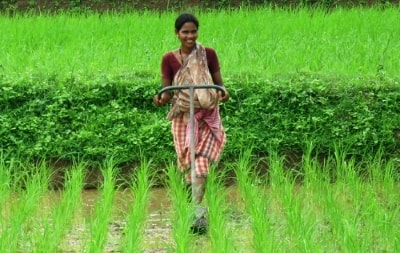
In the Photo: Female farmers, the backbone of rice production. On the left: A woman utilising the push weeder.
Photo Credit: Lotus Foods
Q: The list of awards that each variant of your rice has won is seriously impressive, but, which is your favorite?
CL: I guess we feel about our rices as parents feel about their kids. You couldn’t possibly pick a favorite. They all have their own unique beauty, personality and special qualities. We love the rich density of our pigmented rices like the Red Rice and the Forbidden Rice®, so full of antioxidants. But our Dehraduni Basmati Rice, a true ancient basmati, has a heady aroma and such a delicate taste and elegant appearance. Each rice has attributes that are complemented by other foods and spices, so really it would be hard to choose. We love them all!
EDITORS NOTE: The opinions expressed here by Impakter.com columnists are their own, not those of Impakter.com