Impakter
  • Environment
    • Biodiversity
    • Climate Change
    • Circular Economy
    • Energy
  • FINANCE
    • ESG News
    • Sustainable Finance
    • Business
  • TECH
    • Start-up
    • AI & Machine Learning
    • Green Tech
  • Industry News
    • Entertainment
    • Food and Agriculture
    • Health
    • Politics & Foreign Affairs
    • Philanthropy
    • Science
    • Sport
  • Editorial Series
    • SDGs Series
    • Shape Your Future
    • Sustainable Cities
      • Copenhagen
      • San Francisco
      • Seattle
      • Sydney
  • About us
    • Company
    • Team
    • Global Leaders
    • Partners
    • Write for Impakter
    • Contact Us
    • Privacy Policy
No Result
View All Result
Impakter logo
No Result
View All Result
NASA life

Life Beyond Earth? NASA Finds Potential Signs

Scientists discover methane and carbon dioxide in the atmosphere of an exoplanet 8.6 times the size of Earth, 120 light years away. Here’s what this could mean

Elisa FurlanbyElisa Furlan
September 12, 2023
in Science, Society
0

Using the James Webb Space Telescope, NASA scientists have detected molecules containing carbon — including carbon dioxide and methane — in the atmosphere of K2-18 b, a distant “Super-Earth” exoplanet discovered by NASA in 2015. This could mean life beyond our Solar System.

Super-Earths, “a class of planets unlike any in our solar system,” as NASA explains, “are more massive than Earth yet lighter than ice giants like Neptune and Uranus, and can be made of gas, rock or a combination of both. They are between twice the size of Earth and up to 10 times its mass.”

Exoplanets, meanwhile, are “planet[s] orbiting a star other than our Sun,” also known as “extrasolar planets.”

Super Earth exoplanets are not present in our solar system and are not guaranteed to have the same characteristics as Earth. Nonetheless, one of them was the protagonist of a rather incredible discovery announced by NASA on September 11, 2023.

Investigating K2-18 b 

An exoplanet in the Leo constellation, K2-18 b orbits around K2-18, an M-type star much redder and dimmer than our Sun. Its mass is 8.6 times that of our planet, and it takes 32.9 days to complete one whole orbit.

The exoplanet is 120 light-years from Earth and orbits in the habitable zone, where liquid water might be present at different temperatures.

Scientists investigated K2-18 b by analyzing the light of its parent star — K2-18 — as it passed through the exoplanet’s atmosphere before reaching a telescope (such as the James Webb Space Telescope used for this study).

The results were presented after only two observations of K2-18 b, thanks to the telescope’s incredible technology.

“This result was only possible because of the extended wavelength range and unprecedented sensitivity of Webb, which enabled robust detection of spectral features with just two transits,” said Nikku Madhusudhan, a University of Cambridge astronomer and the lead author of the paper that shared these results. 

“For comparison, one transit observation with Webb provided comparable precision to eight observations with Hubble conducted over a few years and in a relatively narrow wavelength range,” Madhusudhan added. 

In the Photo: James Webb Space Telescope Mirror. Photo Credit: NASA

The investigation on K2-18 b adds to the already ongoing research on whether this exoplanet can be considered a Hycean exoplanet — a planet with the potential to have a “hydrogen-rich atmosphere and a water ocean-covered surface.”

“Traditionally, the search for life on exoplanets has focused primarily on smaller rocky planets, but the larger Hycean worlds are significantly more conducive to atmospheric observations,” said Madhusudhan.


Related articles: Aliens on Mars? NASA Discovers Signs of Ancient Life | Are We Alone? NASA Begins New UFO Research | NASA’s Return to the Moon on Hold | NASA Unveils Deepest-Ever Images of the Universe

The study’s authors believe that the “abundance of methane and carbon dioxide, and shortage of ammonia” discovered on the exoplanet “support the hypothesis that there may be a water ocean underneath a hydrogen-rich atmosphere in K2-18 b.”

They also point to a “possible detection” of dimethyl sulfide (DMS), a molecule that, on Earth, is only produced by life (mostly by phytoplankton).

However, the scientists do make it clear that these discoveries do not guarantee life, as the ocean might be too hot to be habitable or liquid.

Our @NASAWebb telescope detected carbon dioxide and methane in the atmosphere of a planet orbiting a faraway sun. The planet might have an ocean, but more observations are needed to determine whether it could support life: https://t.co/J8ub8PqwMG pic.twitter.com/SbgHjOO9Hv

— NASA (@NASA) September 11, 2023

Whether K2-18 b can potentially present some forms of light is for future research to determine.

“Our ultimate goal is the identification of life on a habitable exoplanet, which would transform our understanding of our place in the universe,” concluded Madhusudhan. “Our findings are a promising step towards a deeper understanding of Hycean worlds in this quest.”


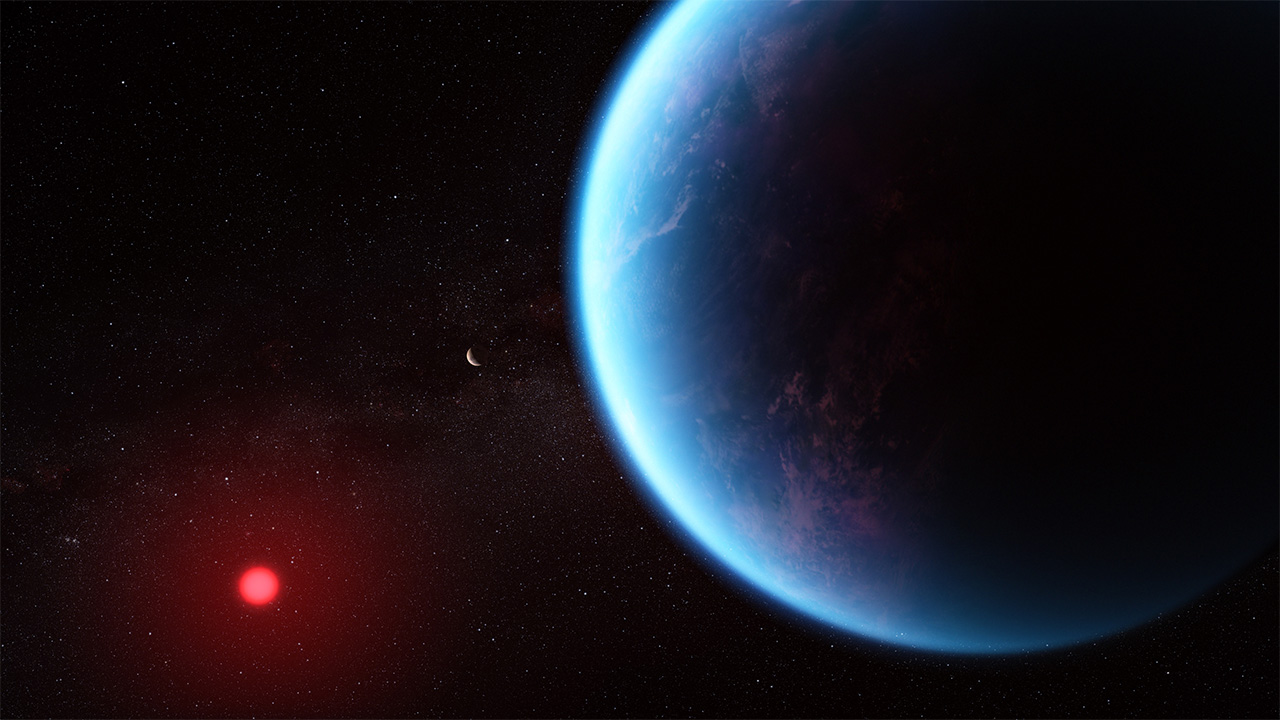
Editor’s Note: The opinions expressed here by the authors are their own, not those of Impakter.com — In the Featured Photo: Illustration of K2-18 b. Featured Photo Credit: NASA.

Tags: ExoplanetsJames Webb Space TelescopeNASAspaceSuper-Earth
Previous Post

Small Island Nations Turn to UN Court for Protection Against Climate Change

Next Post

Ecological Collapse: Why We Should Return to Nature

Related Posts

ESG news regarding first commercial e-methanol plant in Denmark, IFC one-hundred-million-dollar investment in electric vehicles in Mexico, EFC gas awarded five-million-dollar contract from NASA, and germany revising energy grid
Business

European Energy Opens First Large-Scale E-Methanol Plant

Today’s ESG Updates Denmark Opens E-Methanol Plant: European Energy and Mitsui launch the first commercial e-methanol plant to supply green...

bySarah Perras
May 13, 2025
methane-tracking satellite
Business

A New Era in Environmental Accountability: SpaceX Launches Methane-Tracking Satellite

SpaceX, the private aerospace company founded by Elon Musk, has launched into space nonprofit Carbon Mapper’s groundbreaking satellite aimed at...

byJacob Lee
August 23, 2024
Our Outer Space Future: Is There a Better Way Out?
Politics & Foreign Affairs

Our Outer Space Future: Is There a Better Way Out?

Editor's Note: This article was originally published in January 2019 and is being republished now in light of recent news...

byRichard Seifman
February 21, 2024
Antarctica Sea Ice
Environment

Unravelling Antarctica’s Sea Ice Puzzle

Throughout 2023, the area of ocean around Antarctica covered by sea ice was so far below the norm that scientists...

byBenoit Legresy, CSIROand2 others
January 25, 2024
Moon landings
Science

It’s a Wonderful Year for a Moon Dance

The countdown is on for 2024, which is shaping up as the year of Moon landings. As many as 12...

byAlex Gilbert - Fellow at the Payne Institute for Public Policy at the Colorado School of Mines
December 27, 2023
NASA cat video streamed from space
Science

NASA Streams First Video From Deep Space — of a Cat

On December 11, 2023, Taters, a cat, made its broadcast debut in a 15-second video in which it chases a...

byDiana Croce
December 21, 2023
The Sky’s Not the Limit for One Health on Earth
Health

The Sky’s Not the Limit for One Health on Earth

If we can ever get a handle on the risks we face in dealing with the interface of animal, human,...

byRichard Seifman - Former World Bank Senior Health Advisor and U.S. Senior Foreign Service Officer
November 8, 2023
Asteroid Bennu
Science

NASA’s Capsule With Asteroid Bennu Sample to Return to Earth

Nasa’s Osiris-Rex capsule is shortly to return to Earth carrying a vital cargo — dust samples from the asteroid Bennu...

byDavid Bass
September 23, 2023
Next Post
nature

Ecological Collapse: Why We Should Return to Nature

Recent News

ESG News regarding BHP and Rio Tinto are teaming up to expand their iron ore production pipeline

BHP and Rio Tinto to Boost Australian Iron Ore Production

January 15, 2026
ESG News regarding Dimon warning that Trump’s attacks on Fed could raise inflation and rates, Venezuelan oil shipments to China setting to plunge under U.S. blockade, UK awarding offshore wind contracts to power 12m homes, 2025 being the third-hottest year on record as climate science faces political pushback

JPMorgan CEO Warns Trump’s Attacks on Fed Could Raise Inflation and Rates

January 14, 2026
Billionaires Became Richer Than Ever in 2025: Who Are They and What Drove Their Wealth Growth

Billionaires Became Richer Than Ever in 2025: Who Are They and What Drove Their Wealth Growth

January 14, 2026
  • ESG News
  • Sustainable Finance
  • Business

© 2025 Impakter.com owned by Klimado GmbH

No Result
View All Result
  • Environment
    • Biodiversity
    • Climate Change
    • Circular Economy
    • Energy
  • FINANCE
    • ESG News
    • Sustainable Finance
    • Business
  • TECH
    • Start-up
    • AI & Machine Learning
    • Green Tech
  • Industry News
    • Entertainment
    • Food and Agriculture
    • Health
    • Politics & Foreign Affairs
    • Philanthropy
    • Science
    • Sport
  • Editorial Series
    • SDGs Series
    • Shape Your Future
    • Sustainable Cities
      • Copenhagen
      • San Francisco
      • Seattle
      • Sydney
  • About us
    • Company
    • Team
    • Global Leaders
    • Partners
    • Write for Impakter
    • Contact Us
    • Privacy Policy

© 2025 Impakter.com owned by Klimado GmbH