This story on insuring extreme weather disasters originally appeared in the Deutsche Welle (DW) and is part of Covering Climate Now, a global journalism collaboration strengthening coverage of the climate story.
At first, the insurance companies didn’t know what had hit them.
Summer rains had been pouring for weeks in the summer of 2021. The soil in western Germany was sodden. When the storm struck, flooding homes and washing away livelihoods, scientists at the companies who would pick up the bill pored over weather data as they watched footage of destruction roll in on TV.
“It took a couple of days until we realized roads, railways and bridges were also destroyed, [as well as] telecommunication lines and power systems,” said Ernst Rauch, chief climate scientist at Munich Re, the world’s biggest reinsurance firm. The total insured losses, he would find out later, would come to €8.2 billion ($7.8 billion) in Germany alone. His employer would cover nearly half a billion euros of that.
The rains that battered northern Europe last July killed more than 220 people in Germany, Belgium and the Netherlands, resulting in the most expensive weather-related disaster the continent has ever seen. Scientists from the World Weather Attribution network found that burning fossil fuels had made the rainfall 3-19% stronger and at least 20% more likely. The insurers liable for paying out damage claims had not fully priced in the risk.
“I have never, in my more than 30-year career working on natural disasters with Munich Re, seen such destruction from a flash flood,” said Rauch.
Paying for damages, heating up the climate
As the planet heats up and weather extremes grow more violent, insurance companies have found themselves in a unique position near the frontlines of climate change. On the one hand, they are paying more for damages and struggling to price unpredictable risks. On the other hand, they are financing and underwriting polluting activities that warp the climate further.
Insurers have traditionally used historical data to work out the risk of storms and wildfires that threatened their assets — and charged their clients accordingly. But such calculations no longer cut it. A landmark review by the Intergovernmental Panel on Climate Change (IPCC) in April concluded that climate risks are becoming more complex and difficult to manage, with crises increasingly striking at the same time. Sea levels have crept higher. Heat waves have become hotter. Tropical cyclones are growing stronger.
That poses an existential problem for an industry that acts as a “strategic pin” holding the economic system together in the face of catastrophes, said Zac Taylor, a climate finance expert at the Technical University of Delft in the Netherlands. “When it disappears — or it becomes more difficult or more expensive to insure — there are ramifications for the entire system.”
Pulling out of areas deemed too risky
In response, insurance companies have started to push up premiums and pull out of areas they deem too risky. “Ordinary folks are going to feel this at home in two ways,” said Taylor. “Either their insurance is going to cost a lot more or they’re not going to be able to have it.”
When disasters strike and insurers can’t pay, governments may foot the bill with public money. Reinsurance companies — who sell insurance to primary insurers — act as a barrier by sharing that risk among actors with more money. They too expect to raise premiums.
Because the reinsurance market is global, people will pay more even when extreme weather hits other parts of the world, said Taylor. “If there is a really bad flood in Germany, a bushfire in Australia, a typhoon in Japan, then a homeowner’s insurance in Florida goes up — whether or not there’s a hurricane in Florida.”
Related articles: Evidence Keeps Piling Up: Humans Worsen 71% of Extreme Weather Events | Our Emissions Are Aggravating Almost 60% of All Infectious Diseases
World leaders promised in 2015 to limit global warming to “well below” 2 degrees Celsius and ideally to 1.5 degrees Celsius this century. But current policies are instead set to heat the planet 2.7 C, according to an analysis in November 2021 by Climate Action Tracker, a project from two German environmental research institutes. By the end of the century, floods that used to hit once a century will strike most coasts every single year.
Such changes could push weather risks beyond what the global insurance industry can sustainably finance. Speaking in 2015, the then-CEO of insurance giant Axa said “a 2 C world might be insurable — a 4 C world certainly would not be.”
Enabling fossil fuels – or blocking them?
Still, insurance companies also wield enormous power over the energy transition. They can block or enable fossil fuel projects by choosing whether to insure them and for what price. Speeding up the switch to green energy would cut their exposure to catastrophic weather.
A 2021 analysis by McKinsey, a management consultancy, found capital spending on climate solutions like wind farms and electric vehicle charging stations could lead to $10-15 billion in insurance premiums on capital spending alone. The oil and gas market is worth about $18.5 billion in annual premiums, including both new and existing projects, according to a report published last year by environmental campaign group Insure Our Future.
The reinsurance market is so concentrated that you don’t need a lot of movement to make big changes, said Regina Richter, a green finance campaigner at Urgewald, a nonprofit in Germany that worked on the report. “Even a powerful industry like oil and gas at some point is looking for reinsurance. If only a handful of companies move on this, it makes a big difference.”
In a pathway for meeting the 1.5 C temperature target published last year, the International Energy Agency found that no new coal mines, oil fields or gas fields should be approved for development. Activists say the insurance industry has not taken those recommendations seriously.
Munich Re, which has warned about the dangers of climate change for more than half a century, still solicits companies who “handle large amounts of hydrocarbons,” according to its website, and claims it has been a leader in the downstream energy market for 35 years.
The company did stop insuring coal mines and plants in 2018. And more recently, it set targets to cut emissions from the oil and gas projects it insures 5% by 2025, with a view to reach net-zero emissions by 2050.
“Indeed, one can argue this can be faster,” said Rauch. “The issue is if we would pull out of the market of covering fossil fuels, say, by tomorrow or so, the industry still would be there because the demand is there.”
Still, competitors have proven that bolder action is possible. Swiss Re and Hannover Re, the second and third-largest reinsurance firms respectively, have stopped insuring new oil and gas projects. Hannover Re told DW in a written statement it also plans to make a 30% cut in the emissions of its investments by 2025, though it declined to put a number on the current size of its fossil fuel assets.
Berkshire Hathaway, a reinsurance company with no exclusion policy for fossil fuels, declined an interview request. Two other big reinsurers, China Re and Lloyd’s, did not respond to a request for comment.
Campaigners hope that if more insurers exclude new oil and gas projects, energy companies will find it harder to extract polluting fuels. This has already happened with coal, said Richter. “Some coal plants or mines find it really hard to find insurance — and when they do it’s more expensive — so they have to ask if it makes sense or not.”
— —
This article was authored by Ajit Niranjan.
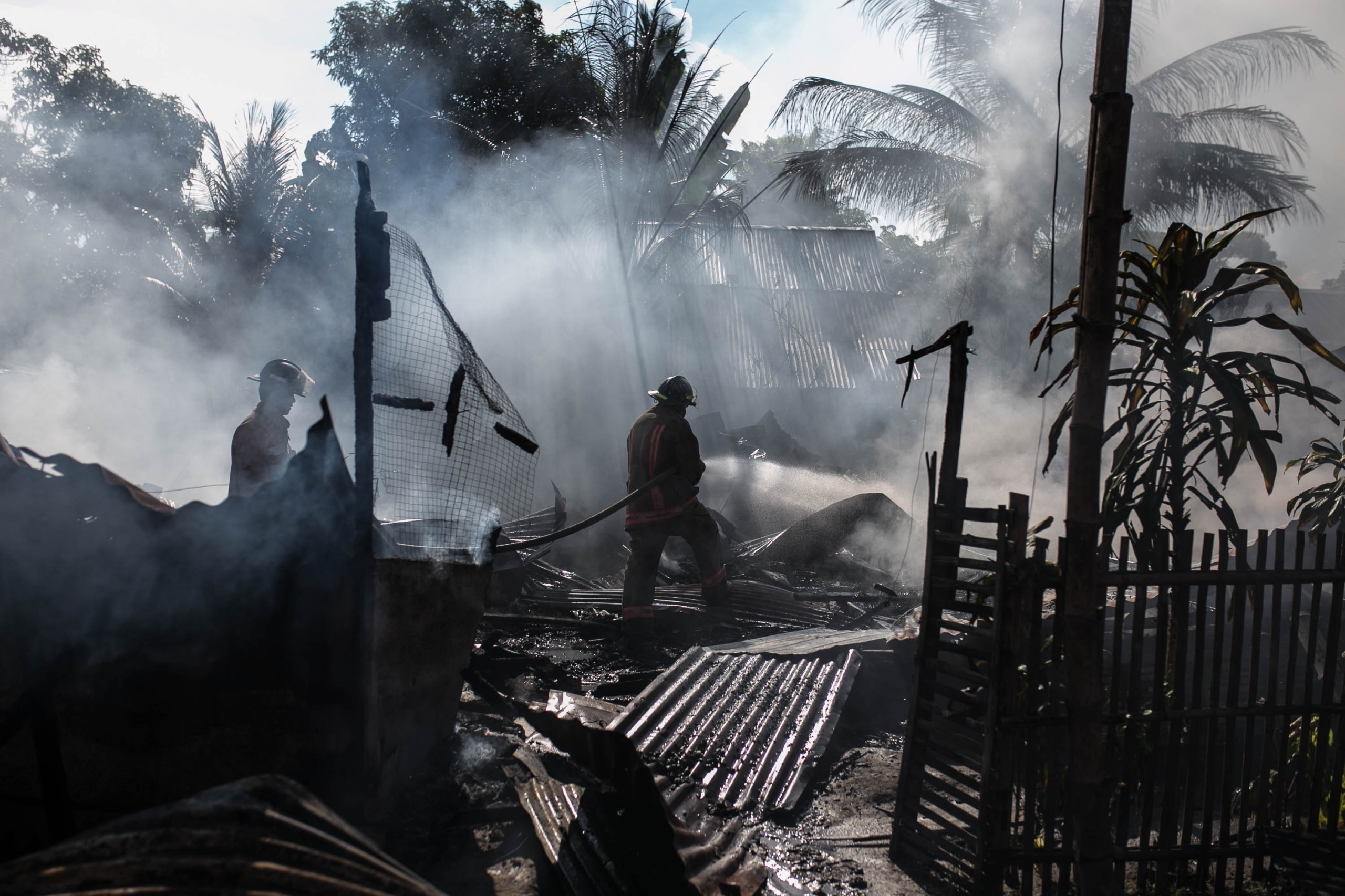
Editor’s Note: The opinions expressed here by the authors are their own, not those of Impakter.com — In the Featured Photo: Silhouette of a fireman holding a hose and cleaning up after an extreme weather disaster. Featured Photo Credit: Denniz Futalan.