There are over six thousand species of coral on Earth, growing in both warm and cold waters. Known as “rainforests of the sea,” coral reefs provide resources such as shelter and food, supporting as much as 25% of marine life despite covering only 0.2% of the seafloor.
The colourful, rocky mounds that we know as coral are actually animals made up of polyps, invertebrates no bigger than a pinhead, which filter seawater to make their limestone exoskeletons from ions in the water. They are not rocks because they take root in the seafloor but they are also not plants because they cannot make their own food.
Like with all of Earth’s ecosystems, reefs are facing new challenges created by climate change and human activity both at sea and on land. Pollution of oceans and rising water temperatures cause the coral to die and turn white. This “bleaching” is when a coral under stress expels symbiotic algae that it relies on, making it harder to catch food drifting by and harder to fight disease.
According to National Geographic, Earth has already lost 20% of its reef habitats, and many more areas colonised by coral are under threat.
Some scientists think that by 2070, reefs will be completely extinct — a dark yet realistic possibility after the Intergovernmental Panel on Climate Change (IPCC) reported that with global warming of 1.5℃, reefs would decline by 70-90% and could completely disappear with global warming of 2℃.
Coral reefs, robots, and restoration
The Great Barrier Reef (GBR) is the world’s largest and perhaps most famous reef; it’s also protected by several laws that govern human activity in the area. Despite this, the Australian Institute of Marine Science found that, whilst many parts of the reef are in good condition, “the number of such reefs has been declining over time. And the number of reefs in poor condition is increasing.”
Technology company Coral Maker is determined to help save the GBR.
Current methods of coral restoration are slow, often reviving only one hectare each year. When tens of millions of hectares are at risk, Coral Maker believes their initiative is the answer to this slow progress.
The scientists at Coral Maker have been mass propagating coral to significantly cut down on the years of exoskeletal growth required to reach maturity. The corals are grown in “locally sourced natural aggregate mixes” and recycled stone waste from the local construction industry — reducing emissions from transportation to the lab and reducing the amount of waste from the construction sector.
This mass production means that 10,000 coral skeletons can be deployed at a restoration site every day, each containing six to eight fragments that will regrow in situ.
Related articles: Small Island Nations Turn to UN Court for Protection Against Climate Change, What You Need to Know About the UN’s Draft Global Plastics Treaty, Why Coral Reefs Need All Our Attention, World Heritage Sites: the Next Victims of Climate Change
“We wanted it to be something we could mass produce at a reasonable price,” Dr. Taryn Foster, founder of Coral Maker, explained to the BBC. “And easy for a diver or a remotely-operated vehicle to deploy.”
“We’ve deployed several different prototypes of our coral skeletons. And we’ve also tested this on four different species,” Foster said. “They’re all growing wonderfully.”
The propagation process is repetitive so Coral Maker has partnered with engineering software firm Autodesk to accelerate the transition into automated coral propagation. According to Coral Maker, their system uses robotics and Artificial Intelligence to work collaboratively with people, making the scientists available to do more complex tasks.
“Some of these processes in coral propagation are just repetitive pick and place tasks, and they’re ideally suited to robotic automation,” said Foster.
The robots have been trained to recognise different coral fragments so they know how to effectively handle different shapes and species of corals. Speaking to the BBC, Dr. Nicole Carey, senior principal research scientist at Autodesk, said: “So far, they’re very good at handling the variability in coral shapes.”
Coral Maker and Autodesk face some challenges in the next phase of the restoration initiative, including moving the robots closer to the reef, possibly onto boats. Living coral needs to be handled delicately and important components of the robots need to be kept dry. Both factors become more difficult to achieve once at sea.
The technology is also expensive, another hurdle that the team at Coral Maker are looking to overcome to ensure the mass propagation project is successful.
But whilst these challenges are very real, coral propagated in this way can grow to full size on the reef in just 12 to 18 months — much faster than other methods. With last year’s coral bleaching event affecting as much as 91% of reefs, perhaps more initiatives like Coral Maker’s are exactly what’s needed.
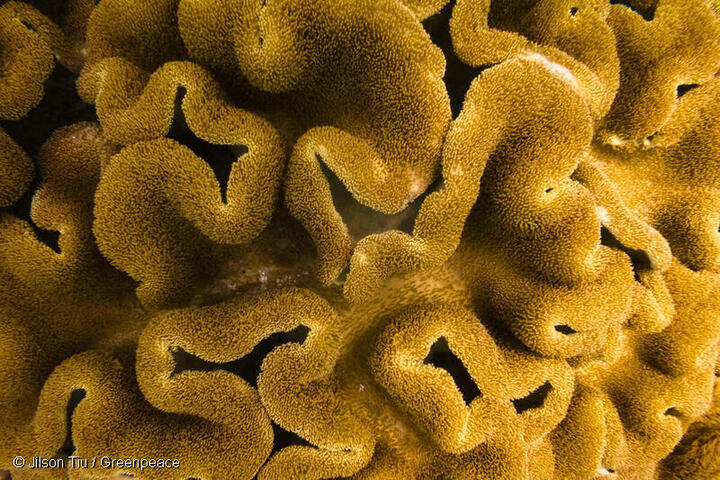
Editor’s Note: The opinions expressed here by the authors are their own, not those of Impakter.com — In the Featured Photo: Paradise Reef, a precious coral garden with significant importance to the marine biodiversity around Samal Island, Mindanao, Philippines, July 29, 2023. Featured Photo Credit: Jason Tiu/Greenpeace.