The 73rd Independence Day celebrations this year in India’s capital city of Delhi were different from past years, as the city experienced one of the cleanest airs in the last eight years. According to the Air Quality Index (AQI) – which rates the quality of air on a scale of 0 to 500 – the air in Delhi hovers around 75, which is deemed satisfactory. The data from Delhi Pollution Control Committee (DPCC) also suggests that the ‘good to moderate’ days increased from 152 in 2012 to 159 in 2019.
However, the city has a long way to go before it can breathe easy, especially during the winters. Aided by monsoons rains, the air generally improves during these months in and around Delhi. But it is the wintertime that tests the city’s ability to control its air pollution.
Delhi is now the second largest city in the world next only to Tokyo. The city population has expanded from six million residents to 25 million today in a span of 40 years. However, this expansion has come at a dubious distinction of being the metropolis with the highest air pollution in the world.
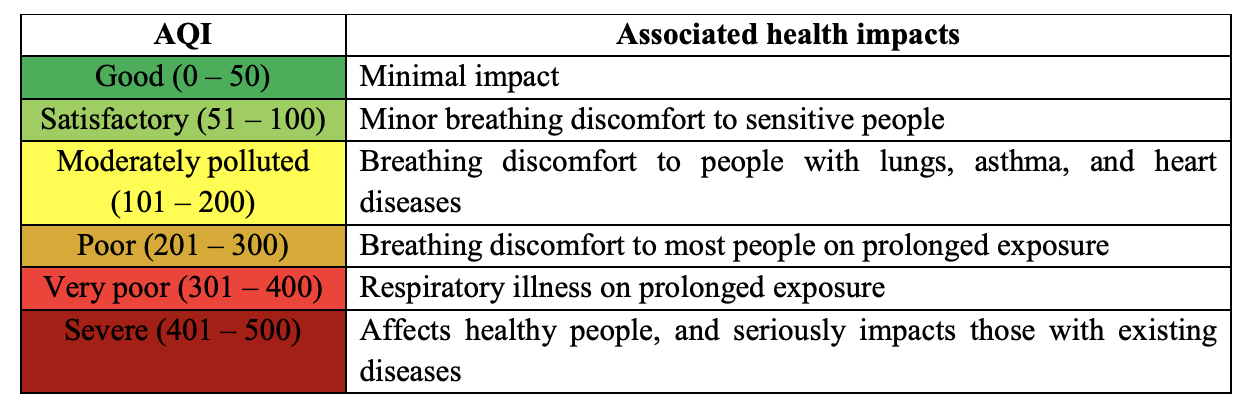
Most of the time, the air remains in the ‘poor’ or ‘severe’ category: for 206 days out of 365 according to the DPCC data. According to the Central Pollution Control Board’s (CPCB) own description, this means that exposure to more than an hour is hazardous for even a healthy human being, and critical for people with asthma or heart condition.
Since Delhi is landlocked, its peculiar geography and climate also exacerbate air pollution. Situated in midst of Indo Gangetic Plains, it is surrounded by four satellite towns (Gurugram, Faridabad, NOIDA and Ghaziabad) and agriculture power houses like the states of Punjab, Haryana and Western Uttar Pradesh.
Winters are especially bad for the residents of Delhi. A thick cover of smoke engulfs the city for most parts of the four months between October and January. This is due to the fires set in the neighbouring wheat fields in Haryana, Punjab and Western Uttar Pradesh where farmers burn the stubbles left in the fields to sow the second crop of the year. This coincides with the onset of winter when the air becomes dense – trapping the smoke as well as particulate matters.
The city has created an elaborate system that has been monitoring air quality over the years. Three organisations – Central Pollution Control Board (CPCB), Delhi Pollution Control Board (DPCB) and the System of Air Quality and Weather Forecasting and Research (SAFAR) of Indian Institute of Tropical Meteorology (IITM), Pune – monitor Delhi’s air quality round the year.
Editor’s Picks — Related Articles:
Tackling Air Pollution – An Interview with Clarity
Deal of the Week: the Uphill Battle for Better Air Quality
India Wants to Double Farmers’ Incomes and Tackle Climate Change – Is Technology the Answer?
They have put air monitoring centres around the city: CPCB has 10 stations where air is monitored manually and 11 other centres monitor air automatically. SAFAR and DPCC share 14 more such stations between them.
They have also developed an ambient Air Quality Index (AQI). Various pollutants are considered by AQI as PM10 (Particulate Matter 10 microns), PM2.5 (Particulate Matter 2.5 microns), NO2 (Nitrogen Dioxide), O3 (Ozone), CO (Carbon Mono-oxide), SO2 (Sulphur dioxide), NH3 (Ammonia), and Pb (lead).
For the ease of understanding, CPCB has created a colour coded chart (figure 1)to show the ambient quality of the air in Delhi to the general public, separated into six colours. Dark green colour represents ‘good’ quality air while deep red is categorised as ‘severe’.
Figure 1: Air Quality Index (AQI)
A close look at the pollutants suggest that the SO2 levels have come down over the years as the administration phased out diesel-driven three wheelers and buses in the late 1990s, and introduced CNG (compressed natural gas) driven vehicles. However, the offset in SO2 was more than compensated by the rise in NO2 as the total number of vehicles grew exponentially during the last two decades. According to the Delhi Government’s 2018 Economic Survey, the total number of registered vehicles in Delhi stood at a little over 10 million, with seven million two wheelers.
A report by CPCB and NEERI (National Environmental Engineering Research Institute) blames extraordinary concentration of vehicles as the main cause of air pollution in Delhi. However, there are other equally important factors that lead to unhealthy air in and around the city.
The vehicular pollution emits noxious gases as well as particulate matter (both PM 10 and PM 2.5), but constant large-scale construction, road dust and industrial emissions as well as fires in landfill, especially at Bhalswa Lake, add to the quantum of particulate matter. According to the 2016 air pollution report of Delhi, the PM 2.5 during January was recorded at 296 micron per cubic meter –far higher than the prescribed limit of 60.
Over the years, both the central government and Delhi’s state government have tried to tackle the menace by resorting to punish farmers who burn stubble and enforce traffic restrictions where cars with even or odd number license plates would ply on alternate days – a strategy also deployed in mainland China. Last year, the Delhi Government deregistered hundreds of thousands of vehicles that were older than 15 years.
The farmers locked horns with the government, arguing that burning the stubble is the fastest way to clear and prepare the field, as the sowing window is too small for the winter crop and the harvest season ends late.
The government then decided to look for alternatives, and has since started making a new technology: Happy-Seeder. Happy-Seeder is popular among the farmers, as it can sow the seeds even while the stubble is present in the fields.
It also initiated steps like offering PNG and CNG for industrial use, closing down coal fired power plant at Badarpur – a densely populated area on city’s southern outskirts. The Supreme Court of India too has stepped, insisting that the auto industry shifts to BS-VI emission standards (Bharat Stage VI which is akin to Euro 5 emission standards) by April 1, 2020.
These efforts have borne fruits; but as history tells us, the gains accrued after installing CNG in late 1990s were lost by allowing indiscriminate proliferation of automobiles, especially diesel SUVs. The city will have to guard against squandering the effects of good work underway.