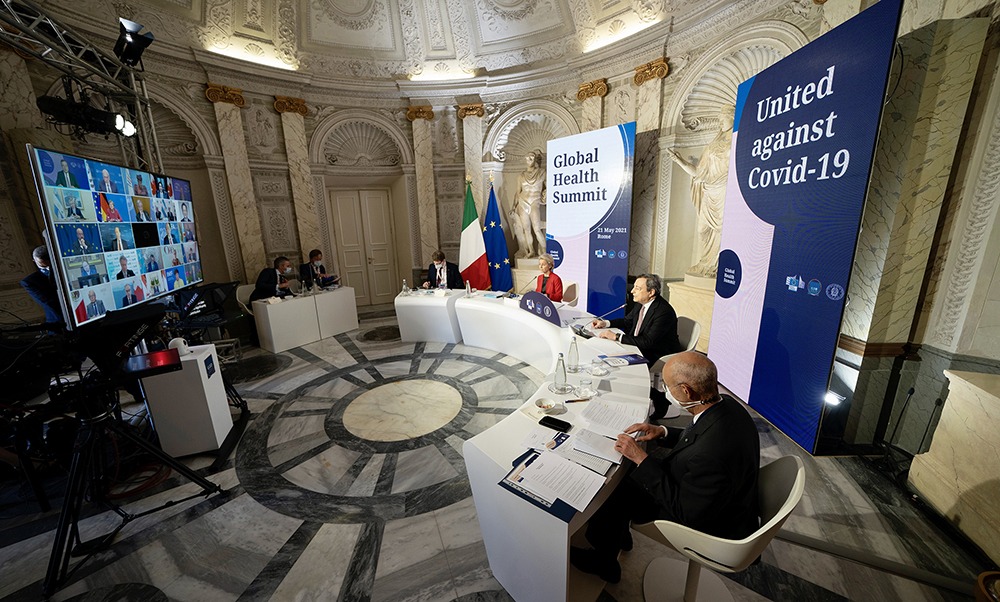
This is the summer of Italy on the World Stage–And recognition of One Health as a global concern: What happens in the Fall when the G20 meets? Will the G20 follow up on the recognition given to One Health by the G7, turning it into a world priority and adopting an actionable plan?
For Italy and for the people around the world, of great importance were two Ministerial meetings, the G7 and the G20 which hold out the promise of greater collaboration for all countries to do common cause at a G20 Summit in the Fall of 2021. “People, Planet, and Prosperity” is the very comprehensive agenda of the G20 that will include the results of the late July meetings on climate change and energy to be held in Naples, and those of a separate Health Ministerial meeting (September 5-6) to be held on Rome.
Both meetings are relevant to human/animal/ecosystem interactions, “One Health”, and the decisions taken there will help shape the G20 Summit itself.
All such actions are underpinned by the aspirational notion that there exists a reality-based global community, one that recognizes and adheres to the best available science, and a set of rules and norms. And further, that these are embraced by essential enablers and transmitters, namely political institutions such as the G7 and G20, the United Nations, science institutions, communities, and individuals.
None of this is either a given or easy, in a world now infected and affected everywhere by digital media. This universal “utility” seems to be better suited to disinformation, extremism, and alternative realities than in advancing knowledge and knowledge sharing and pursuing a common cause.
But with such gloom, there is also sunlight for optimism, for better outcomes, leastways with respect to a subject such as One Health newly seen as a priority. The G7 was the meeting of the rich guys, and for the first time, their communiqué included explicit reference to the human/animal/environmental interface.
On July 9th, the much more representative group of essentially all the major world stakeholders, their G20 Finance Ministers met and identified One Health as a “Key Proposal” and put forward “Specific Action” Items.
The G20’s Summit in October to be held in Italy will determine when all this may or may not be accepted by national leaders. While all countries will be important proponents, Russia, China, the United States, the European Union, will be key during these discussions. Are they able to rise above what has proven to be unholy fractured geopolitics and accept that unless we turn things around dramatically (air, land, sea) we may end up with a very hot planet and dystopic future by the end of this century?
The July 2021 report of the G20 Finance Ministers High-Level Independent Panel “A Global Deal for Our Pandemic Age” reflects they found common ground on One Health.
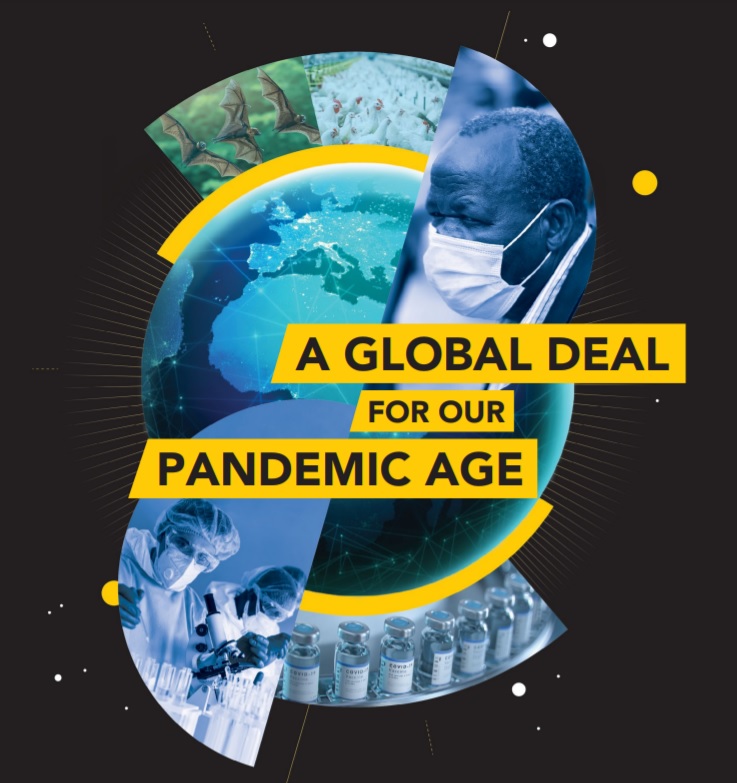
Specific language in the report makes this clear:
Proposal:
WHO and One Health, and put it on more predictable footing?
Greater and more predictable funding is necessary for the WHO to perform its critical functions and ensure that there are no gaps in the surveillance-to-action loop, and to strengthen the integrated One Health approach.
Key Action Items:
… ii. Support WHO, OIE, FAO and UNEP in their integrated One Health approach
These two fundamental points – more funding and designation of institutions to guide the process – will hopefully be taken up and approved by the September G20 Health Ministers meeting, and subsequently by the full G20 Heads of State at its Summit in October 2021.
Nonetheless, with respect to the report recommendations, a few caveats are needed.
First, the language is good, and the G20 High-Level Independent Panel identified all the usual suspects to come up with large and sustained financing. However, and this is worrying, they made no mention of a finite amount for One Health, or for that matter, for any of the other Proposals and Key Action Items included in their report.
But financing is only one piece of the puzzle. A working group of G7 and G20 representatives should begin to hold negotiations, also relying for guidance on the One Health High Level Expert Panel (OHHLEP). Also useful for them and for the wider international community is this considered treatment of the subject published on the Innovation News Network: One Health approach: a symphony of effort, a health exigency worldwide.
For One Health, an accessible short-term option would be to focus on the “software” (operational research, human capacity building, Monitoring and Evaluation, technological innovations for broader application, and so forth). The Global Environment Facility (GEF), an ongoing entity with over 180 country support, has dealt with One Health in its last annual meeting. Then in the future, we could hope that huge and sustainable funds would come onstream based on explicit and substantial funding requirements for regions and countries, based on their choice of the broader menu described above.
A second concern is in the way the G20 Finance Minister’s report is written. It anchors One Health in the World Health Organization (WHO) and that at its core means “human health”. While mention is made of the OIE, FAO, UNEP, and others, it is WHO which is given the lead role and its brand seen everywhere.
The concern here is that WHO would hold human health – now getting the lion’s share of international, national, and non-profit funding, almost in the trillions – the principal focus, with animal and environmental aspects getting much less money and attention. And WHO has not proven in the past so good at multisectoral sharing. To illustrate the point: There was a need to create UNAIDS as a separate entity to respond to last century’s HIV/AIDS pandemic; or for that matter, regarding the fundamental subject of nutrition and recognition of FAO’s role in this area. The G7 and G20 consultations can address such concerns by the time of the final Summit.
A third concern is that this is essentially all the players working at 30,000 feet and seeking to address real-life problems on the ground. This is very good to be sure but, the words “community engagement” and what that means in terms of the voices of youth and women, underlying vaccine hesitancy as a result of mistrust of health authorities, health inequities, and perceptions of prejudice, need to be part and parcel of any global One Health compact.
One Health provides a framework and way to consider the impact of socio-behavioral and cultural factors on public health. Too often when science and the international community find a “solution”, like vaccines, it forgets that people have to be aware of its benefit; they have to want it and must get equitable access, and there should be information about who is at risk and so forth. So, the plea is for there to be voices that speak on behalf of individuals, not just the high-powered, at the G20 Summit and beyond.
In Survival: One Health, One Planet, One Future, the case is made that the concept of One Health recognizes the fundamental interconnections between people, animals, plants, and the environment, which needs to inform the UN-2030 Sustainable Development Goals. In short, we need to work towards the adoption of a new mindset and the first step taken by the G20. Our politicians and the business community should replace their current view of limitless resources, competition, and conflict with one that strives towards well-being for all, shared prosperity and social stability.
Finally, there needs to be one or several world figures – a call for “superstars” – who are taking One Health as a priority and are ready to promote it and turn it into a reality both in the world of politics and the economy. It is often too easy to let something like this end up as good words, but no strong follow-up. Let’s hope this is not the case.
** **
Article Contributor: Bruce Kaplan, DVM, Dipl. AVES (Hon.), CDC/EIS63, Co-Founder of the One Health Initiative and Editor at the One Health Initiative.
Editor’s Note: The opinions expressed here by Impakter.com columnists are their own, not those of Impakter.com