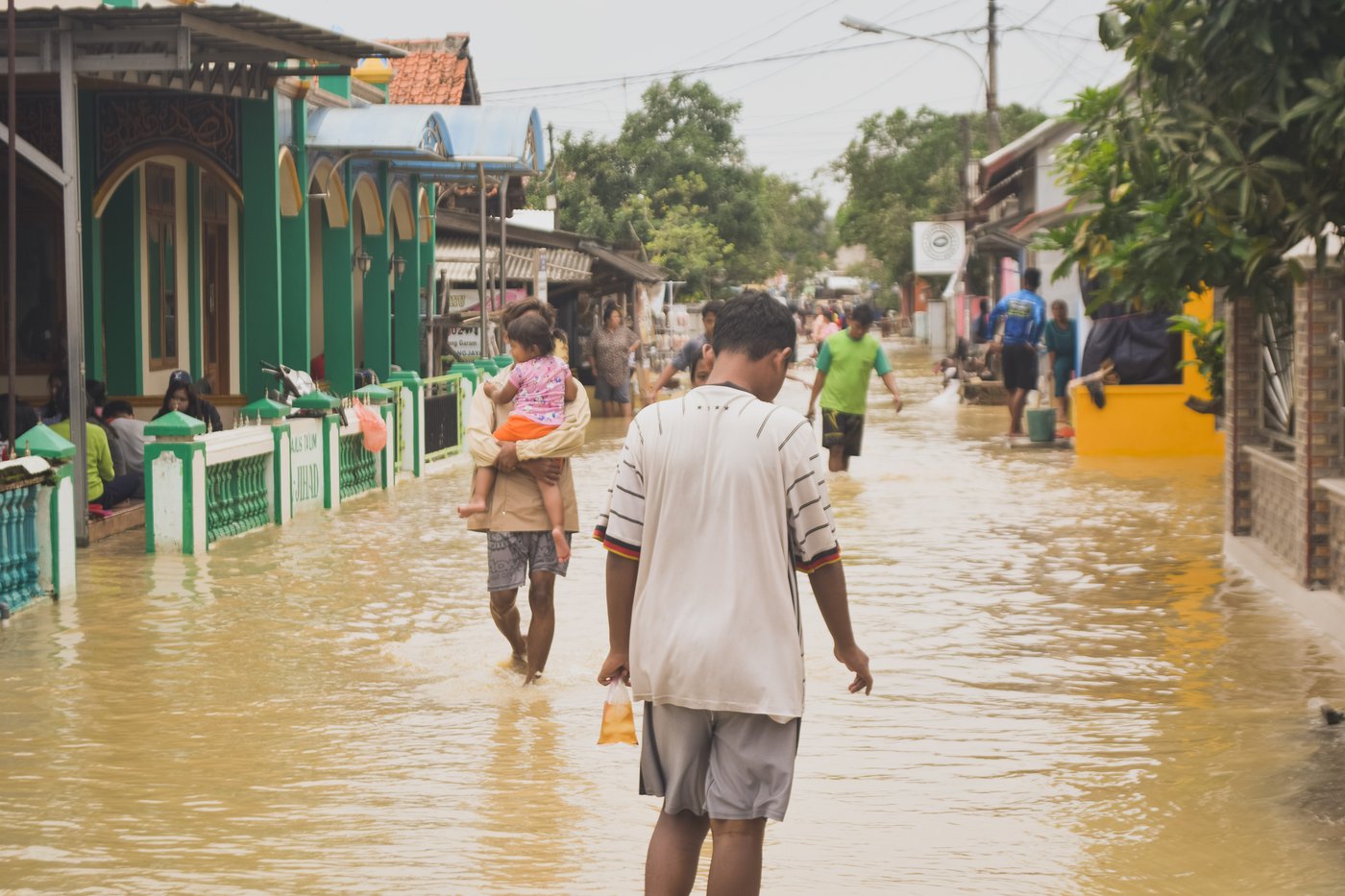
Globally, only extreme storms like hurricanes cause more damage than floods. Over the last 50 years, the global number of weather disasters has increased by five times, but thanks to improved early warnings and disaster management, the number of deaths from such events has decreased almost three-fold.
Flood warning systems are a cost-efficient way to prevent floods from destroying lives and livelihoods. While warnings don’t prevent flooding, they give advance notice of an impending flood to allow communities to prepare: bringing in extra emergency personnel, establishing temporary flood defences, securing clean drinking water, moving valuables or — for the most extreme events — evacuating. Getting the jump on an incoming flood also allows for the mobilisation of resources to accelerate the clean-up after a flood, reaching people in need sooner and reducing the impact.
Flood warnings are one part of a larger flood forecasting system. Warnings are used to communicate the flood forecast to individuals, businesses, and emergency responders. The best flood warnings don’t just provide information on the river level (which is often meaningless to users), they combine this information with an explanation of the potential impacts, for example: “River levels will rise rapidly causing widespread flooding. Damage to roads and property is expected.”
A flood forecasting system only becomes useful when the flood warning leads to effective action. The aim of flood forecasting systems is to provide as much lead-time as possible. The difficulty is that the longer the lead-time, the more uncertain the forecast can be.
The accuracy of weather forecasts is continually improving. Today, the forecast for six days ahead is as good as the forecast for five days ahead from 10 years ago. Flood forecasting models cover all of the major rivers in the world. However, forecasting the most extreme events, such as the intense rainfall in Zhengzhou, China in 2021, or the rapid intensification of Typhoon Nuro in the Philippines, remains a challenge.
In these situations, creative solutions are emerging that seek to help decision-makers understand the inherent uncertainty or use new methods like machine learning to improve lead-time.
Related Articles: New Report Reveals True Financial Cost of Climate Change | “Apocalyptic Flood” in Pakistan: With Over 1,000 Dead, the Government Calls for International Aid
Increasingly, the effectiveness of flood forecasting systems is constrained by poor communication rather than forecast skill. Scientists were shocked that more than 200 people died in the western European floods of 2021. While the forecasts for this event were considered “quite good”, when surveyed, 35% of people in one of the affected regions in Germany said they had not been warned.
In other cases, the flood warnings were received but they did not convey the severity of the impending event.
Communicating extreme events is difficult. An individual’s response to flood warnings is often influenced by their previous experience. Without having seen a river in full flood, it is very difficult to comprehend the destructive power of water or appreciate the urgency of preparation. This communication challenge requires new and imaginative thinking and ongoing work. Some of the innovative graphics and clear communication for Hurricane Ian in Florida shows that progress is being made.
Uncertainty remains a challenge for decision-makers. Actions have costs and no one wants to take them unnecessarily. Flood forecasters need to strike a balance between uncertainty and lead-time. The best way to achieve this balance is to design flood forecasting systems in collaboration with decision-makers to tailor warnings to their needs. Scientists often forget that decision makers have to balance multiple and often competing considerations around economic, political and societal pressures.
But even a reliable and well-communicated flood warning is useless if the recipient does not have the ability to take action. Lead-time is important, but more critically, large parts of society lack the resources to take action.
Studies of major events, such the devastating monsoon flooding in Pakistan in 2022, or the repeated tropical cyclones that hit Madagascar earlier in the year, highlight that alongside the effects of climate change, many people are unable to bounce back from extreme events.
The Red Cross Climate Centre is pioneering the use of forecasts to release funding in advance of floods occurring. This means that vulnerable communities can be supported financially to evacuate, or immediate needs such as clean water and sanitation supplies can be provided. The increasing use of flood forecasts is also helping humanitarian organisations to target their resources to the areas most at risk.
The climate is changing. Extreme weather is occurring more frequently and there is an urgent need to increase flood resilience. To live successfully in a changing climate, all aspects of society need to be ready to adapt when warnings are issued. Warning systems fail when they are not believed or trusted, something that was evident in the response to the forecast summer 2022 heatwave in the UK. Warnings are not issued lightly, they are based on the best possible forecasting science and understanding of the impacts on people and infrastructure. They are issued in advance of events and aim to provide enough time to take preventative action before impacts occur. They should not be ignored.
— —
This article was originally published by 360info™ under Creative Commons.
Editor’s Note: The opinions expressed here by the authors are their own, not those of Impakter.com — In the Featured Photo: Flood warning systems can’t prevent floods, but they provide advance notice to allow authorities to react ahead of time. Featured Photo Credit: Misbahul Aulia.