How many attention-grabbing headlines like the one above have you read, and then nonchalantly clicked on the next article?
Let’s not lie. There is no easy fix. Climate change is a knotty systems problem, requiring long-term commitments from government and private industry that thus far have not been willing to shake hands.
This summer, in Denmark and across Europe, we sweated through scorching heat and periods of drought. That was no surprise to the Danish portal for Climate Change Adaptation, which has predicted that Denmark will get more rain in winter and less in summer, an increase in sea-water levels, and powerful storms—no small threat for a country that sits just a few meters above sea level.
At Copenhagen Institute of Interaction Design (CIID), we are not scientists. But being based in a beautiful city surrounded by water and wind farms, we feel a great responsibility to practice life-centered design—design that considers not just the welfare of humans, but also the greater habitat in which we live, including all planetary life.

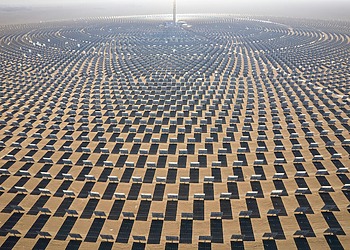
In the Photo: Being surrounded by wind farms invokes a sense of responsibility at CIID. Photo credit: LM Wind Power
And still, we remain optimistic. After all, since the dawn of civilisation, humans have adapted by developing practices, cultures, and lifestyles suited to harsh conditions. What’s even more promising is that today we have the technology and data to monitor, identify, and predict these conditions. Of course, simply being able to see the future doesn’t mean you know how to transform it. Yes, we can all use less water, recycle, reduce our airmiles, and eat less meat, but that will make little difference if industry and government don’t follow suit. The problem is: companies and policymakers don’t yet have the tools they need to effect systemic change.
This is where design can help.
The beauty of interaction design is that it can act as a conduit between people and the systems that govern how we live. Knowing that, we’ve formed collaborative partnerships between private industry, education, and government to ask, how do we equip people from diverse backgrounds with a mindset to approach problems in a holistic way? How do we provide them with the ability to inspire other people to think differently and adapt and respond to a changing world?
One answer has been through teaching the leaders of tomorrow how the tools of interaction design can help make inroads in the 17 Sustainable Development Goals set forth by the UN.
Video Credit: CIID Summer School Copenhagen 2018 from CIID on
We hope that our graduates will go on to design products, systems, and services that will act as a catalysts for bigger thinking, but know that moving from awareness to action is not always a straight path.
To make the process easier, we get tangible from the start, focusing on real life situations both at home and further afield. In 2015, our students collaborated with Space 10 and IKEA on the the context of living a healthier, more sustainable life in an urban environment.
We started by gathering insights about people’s routines, their relationships with everyday objects, and the places they live. Ranging from the present moment, to further out in the future, we proposed solutions such as a chair that won’t let you sit down unless you’ve walked your 10,00 steps a day, and a shower that alerts you when you’ve exceeded your ‘eco’ water limit. If used by IKEA buyer’s alone, that single feature could help save billions of litres of water a day.
In the video: A shower designed to reduce water use, part of the CIID, Space 10 and Ikea collaboration. Video Credit: Space 10
Such concept products are good for business, too, helping IKEA extend their standalone product offerings with dynamic, self-learning systems that work together to make our homes and cities smarter.
This year, our students were challenged to come up with concepts for regions with too much or too little water. Rather than coming up with solutions for individuals, they were asked to investigate more systemic solutions for extreme climate conditions.
One prototype, called Droptop (by Raunaq Patel, Andrea Desiato and Sami Désir), came from Cape Town. Droptop imagined how the local hotel industry could react to a new normal of drastically reduced water consumption in the face of the imminent Day Zero—an event that would see the city’s taps run dry.
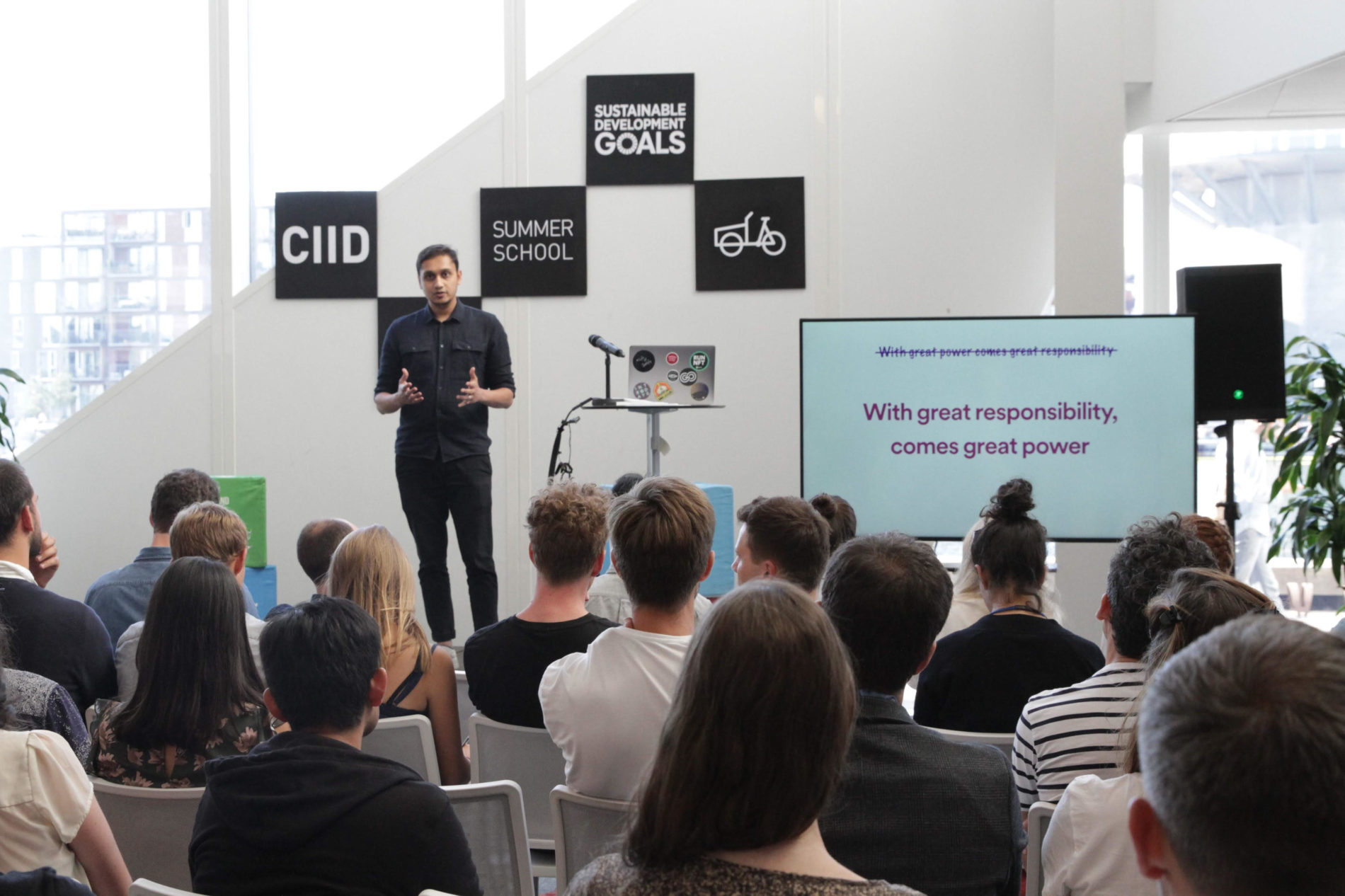
In the photo: The CIID Summer School at the UN. Photo Credit: CIID
As our systems—everything from migration to agriculture—face new challenges and risks, interaction designers can help imagine and test new tools that can help us adapt now and in the future.
The designer’s toolset of prototyping and co-creating with users allows us to explore unforeseen behaviour and system impacts. More importantly, it helps us generate new questions and catalyse different thinking—the type of thinking that can help us face on our transition to low-carbon, more resilient futures.
There is no easy fix. But when the scientists, economists, businesses, and policy makers gather at the table, make sure there’s a designer there to help them find their way forward.