“Any myth is a piece of imagining. Imagining means abstracting the fundamental idea underlying the sum of a given reality, and embodying it in an image; that gives us realism.” With these words, Zhdanov summarized how Russian art developed under the Soviet Union in the middle of 1930’s. This is exactly how the famous “unofficial” movement developed in Moscow and how everything started for Erik Bulatov, one of the most important Russian artists today.
The blue and red inscription “Entrance no-Entrance,” written in Cyrillic characters, signals the entrance to the exhibition, effectively setting the stage for the main thread unravelling through the show.
The visual effect of such painting, produced by the interplay of two colors and the depth of the letters, sheds light on the crucial conundrum at the heart of Bulatov’s oeuvre, orchestrating a dichotomy between space and flatness, prohibition and freedom.
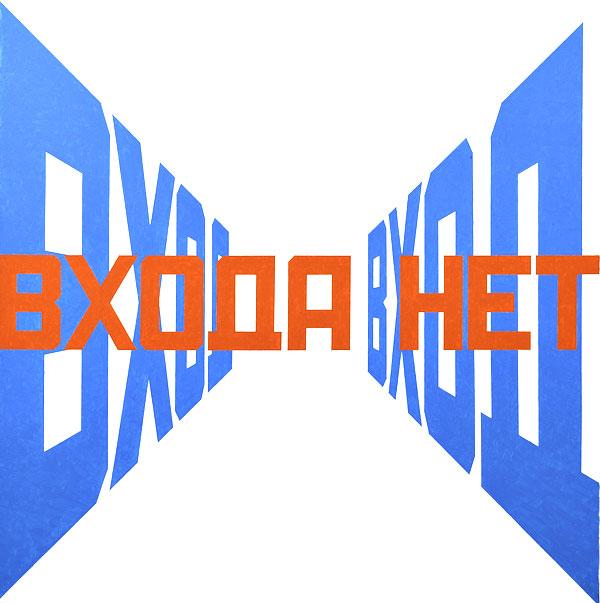
The text “no-Entrance,” painted in red, reveals the flatness of the canvas itself, while drawing attention to its semantic and political function as an obstacle, a ban, and, crucially, a Soviet one.
Behind such red prohibition, our eyes dive into a blue contrasting image with the word “entrance” creating an infinite horizontal space. By indicating the boundary through the text and the flat surface of the red text on the canvas, it automatically demonstrates the limits of its own possibilities and power. The space from outside of the boundary does not belong on the inside, therefore the canvas surface functions as a boundary of the social space that must be crossed.
A further contradiction becomes apparent: while our eyes are focusing on the focal point, they can still read the red prohibition, but in the centre the inscription “no-entrance”, written in Cyrillic characters, is centred with “da,” meaning “yes.” As noted by Bulatov:
Free will, wishes and dreams are set in opposition to the omnipresent ban.
The artist investigates the surface of a living organism, with which he is capable of grasping the reality around him, and through which he seeks to create another surface, just as the sky is yet another type of space and surface. The surface needs space not to fall into the trap of remaining a lifeless flat image, and, simultaneously, to be able to pierce into a different dimension. In Bulatov’s canvases, the two-dimensional planes are converted into a three-dimensional image. The illusion of space generates a relief that seems to physically move closer to the viewer, while inviting them to dive into such merely fictitious constructs.
We are invited to dive into the entrance and the space created, ultimately overcoming the initial prohibition.
The other work which one notices upon entering the exhibition is Bulatov’s recent self-portrait, which seems to extend an almost personal invitation to the exhibition’s cosmopolitan audience to follow the artist along his nearly thirty-year long personal and artistic trajectory.
The visual effect conjured by those two paintings powerfully creates an almost direct synthesis of Bulatov’s life experience.
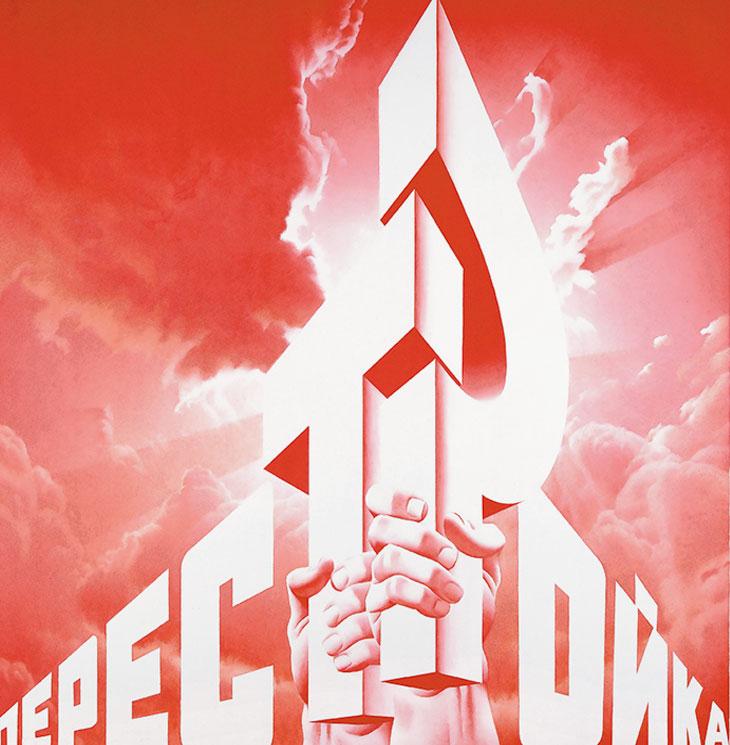
The revolutionary historical “Perestroika” adds yet another layer to the picture, thus allowing the viewer to visualize a complete picture of the artist’s career.
This latter work is made up of monumental letters constituting a red volumetric “Perestroika,” where the central letters “T” and “P” betray the shape of hammer and a sickle, thereby becoming a striking symbol of the key emblems of the Soviet regime. Our gaze strives to penetrate the work but, as the red letter block suggests, we have to look at the red sky in another world, beyond the Perestroika.
The show is the third of the new cultural programme organized by well-known auctioneer Simon de Pury and his wife Michaela; it is housed in the building of Polish collector Jan Kulczyk’s private foundation.
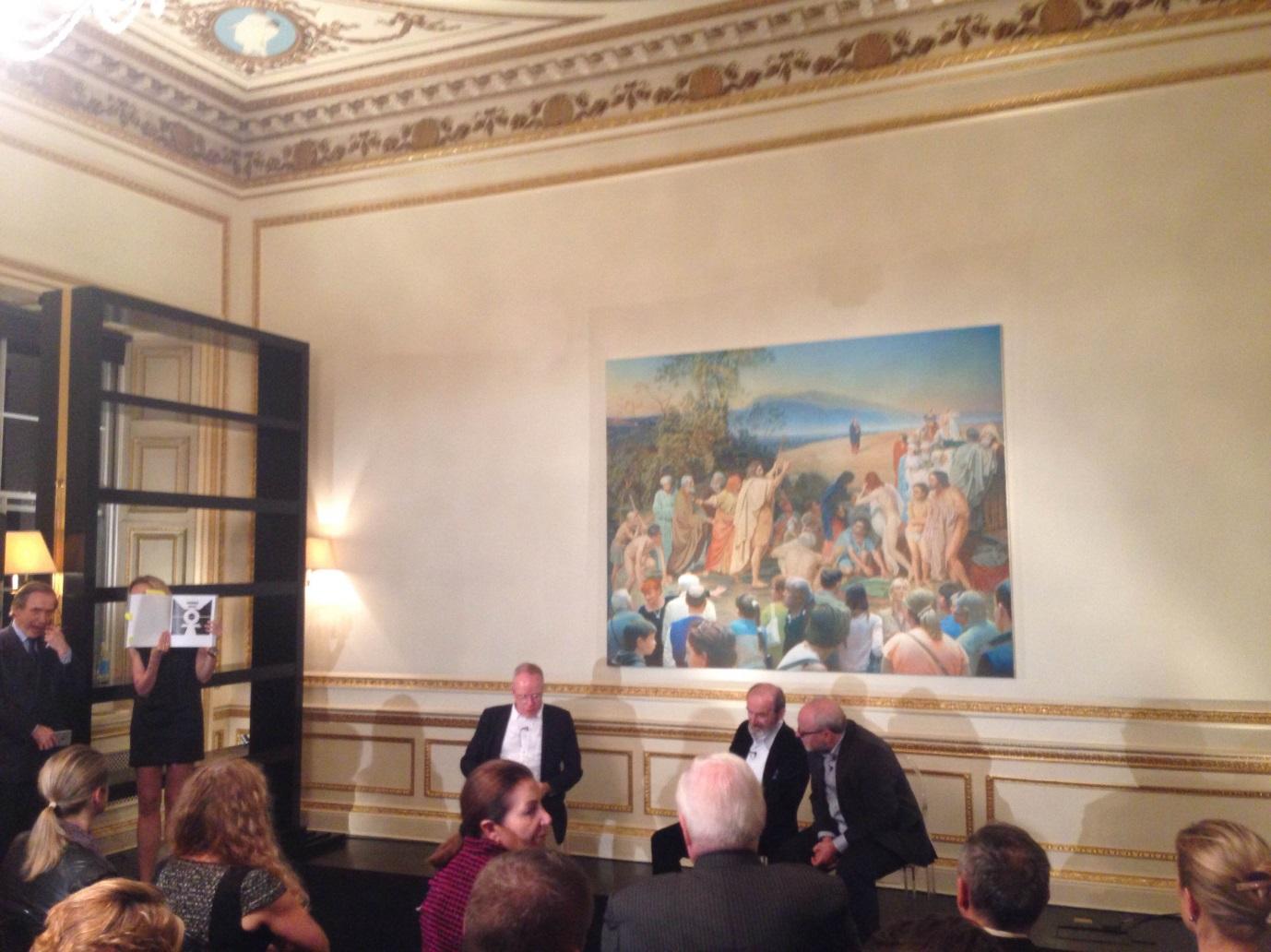
A dialogue between the extraordinary Russian avant-garde artist Erik Bulatov and the international worldwide art curator Hans-Ulrich Obrist. Here are excerpts of their conversation edited for clarity.
H.O.: Thoughts, colors, symbols, and words you reinterpret with Russian Sovietism, how would you describe it?
E.B.: Red doesn’t allow us to enter, the entrance is prohibited. Blue is the colour of entrance, since it creates depth. White is neutral. The flat surface of the painting, when we are in front, and we don’t know if we can enter the space or not.
HO: In the ‘90s you were painting with the French revolution icon and the word “liberate,” what was your intention?
E.B.: That period was a period of transformation. It was the Time of Illusions. Therefore, I transformed Russia with iconic letters. Free will, wishes and dreams are set in opposition to the omnipresent ban with the red and blue inscription.
HO: You have the situation where the verb is the painting?
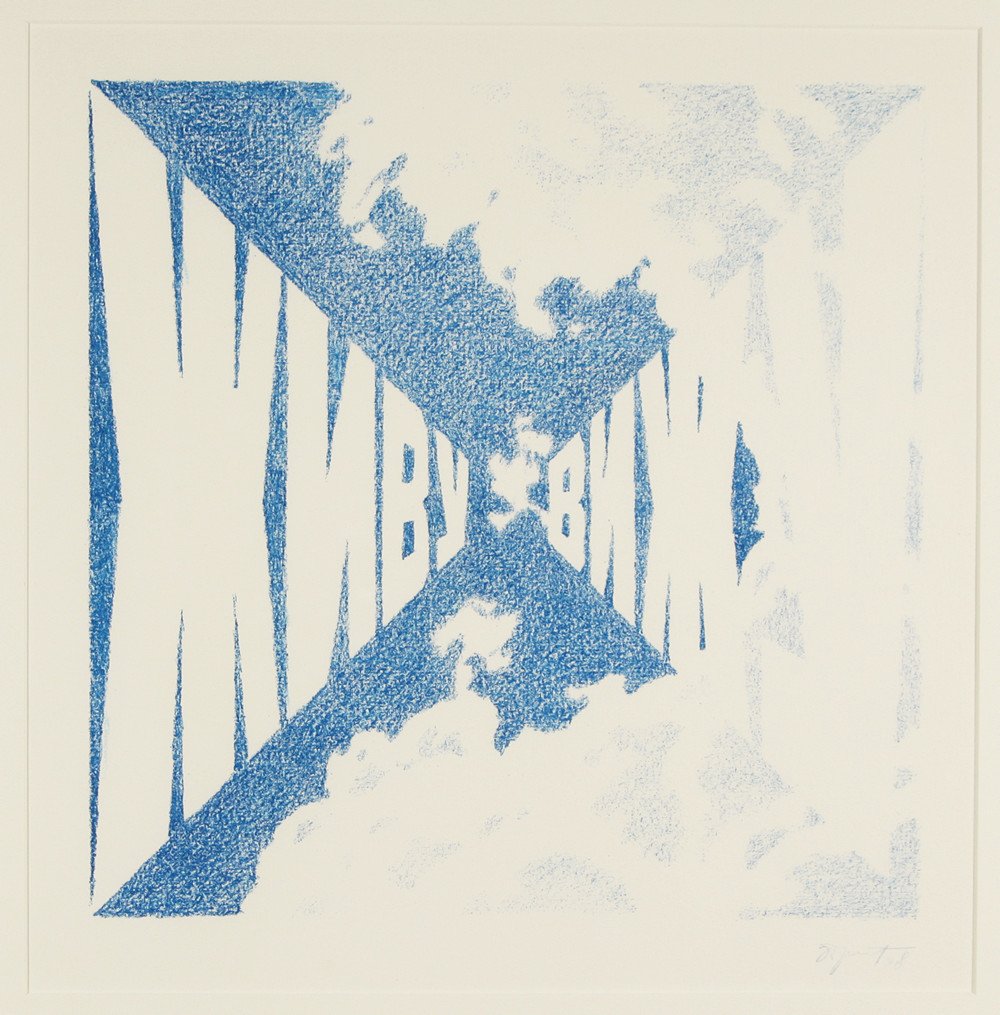
E.B.: What is important is that the words themselves create the space of the painting. What we have in the original is a blue circle. Then, the words turn the vertical surface into a horizontal space. It becomes a river that flows. The visual image of the work is more important. Words have a visual meaning and are more important than their literal context.
HO: The words connected to poetry and using poetry as a connection. How is this connected to Nekrasov poetry?
E.B.: I should say the fact that I use poetry for my paintings is not me trying to illustrate the poetry but it is rather the other way round. The meaning of the painting is different from the meaning of the poetry. These words don’t want to be in a flat surface but want to have another dimension: the way the words interact with the visual and transform the space.
What is important for me is the way the words transform the space. My paintings quite often pretend to be something else. They could be seen as commercials or politics posters, but if you take a closer look you see that they are paintings in the classic sense of the word. They are canvases.
The first impression is nothing else but a mark and if you have a closer look you realize, you see a painting as a landscape. The white is the neutral color of my landscape. The letters are rotting in the space. The abstract transforms to concrete, surface into space. These are the important things.
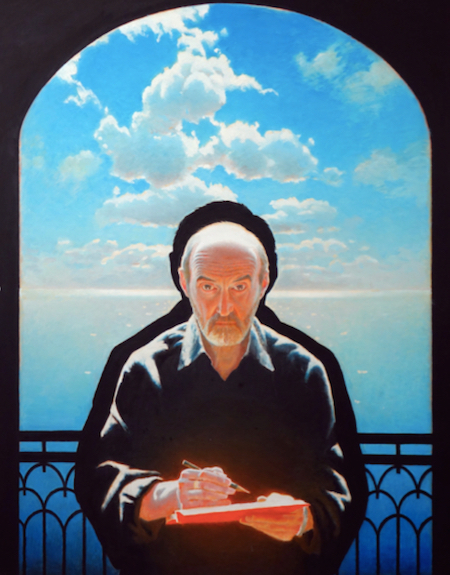
HO: The exhibition leaves a lot of surprise especially with the self-portrait. You had never done one until 2012… and there is a connection with Fra Angelico where life comes out of the painting.
It is not easy to speak of this painting. At the beginning I didn’t want to put in the black, but then the black became the surface separating what is inside from the outside. I had an image in my mind and made it as close as possible. The interaction is with the space between the black and the death and I am on the other side. It is space interaction. I’m in front with the light that comes from the death. The light gives life.
Hans-Ulrich Obrist Instagram
Erik Bulatov