Ukraine and Russia may be just days away from reaching a deal that would enable exports of millions of tons of trapped Ukrainian grain to resume via Black Sea ports, according to Turkish President Recep Tayyip Erdoğan.
“Negotiations are going ahead so that this grain, and sunflower oil, everything can reach the world,” Erdoğan told reporters on Tuesday at a joint press conference with Italian Prime Minister Mario Draghi. “In a week or 10 days we will intensify the talks and try to arrive at a result.”
Since the start of the Russian invasion of Ukraine on February 24, attacks against the country’s Black Sea ports, which normally carried up to 90% of Ukraine’s food exports, have chocked off the country’s principal routes for grain exports.
As Ukraine is one of the largest exporters of wheat, corn, and sunflower oil worldwide, the war-induced disruption of harvest production, as well as blockades on Black Sea ports, have had a devastating ripple effect on global food supplies, sparking a soar in living costs worldwide and widespread food shortages, of which the world’s most vulnerable economies bear the brunt.
Kyiv has publicly accused Moscow of using food and hunger as a weapon of war, driving the world deeper into a global food crisis through blockades and attacks on grain silos, and of stealing Ukrainian harvest from Russian-occupied territories of Zaporizhzhia, Kherson, Donetsk, and Luhansk.
Russia has repeatedly denied all accusations, claiming that Ukrainian sea mines prevent the safe passage of agricultural exports through the Black Sea.
Amid escalating tensions, Turkey, which has maintained diplomatic relations with both Kyiv and Moscow, has emerged as a key mediator between the warring parties.
Erdoğan reaffirmed at the press conference in Ankara that he took the issue of Ukrainian grain exports very seriously because, while his own country was not yet suffering from severe shortages, Africa was facing “a huge problem.”
Italian Premier Mario Draghi hailed Turkey’s “central role” in the plan to reopen maritime routes for grain exports, which he said had been outlined at the G7 meeting of leading economies by UN Secretary-General António Guterres. “That role is to guarantee the security of ships, and ensure that the ships don’t carry arms,” said Draghi.
Kyiv has indeed asked the Turkish government to provide security guarantees to ships transporting harvest through the Black Sea.
According to Draghi, the UN plan does not require demining Black Sea ports as maritime routes have been adjusted to the current state of conflict and related risks, and the working group has been established. The last missing element is “the final agreement of the Kremlin,” said Draghi.
The Italian Premier stated the potential deal was of “very high strategic value” as it would be the first agreement to be reached between Kyiv and Russia since the start of the war five months ago – and could help pave the way for a negotiated peace.
“In the context of efforts to reach peace, this is a first step to an agreement, for an objective that must involve all of us because it affects the lives of millions of people in the poorest countries,” he said.
To say that Turkey has been an ambiguous, even obdurate ally to the West is no understatement – but it’s probably what enabled it to maintain a more appeased relationship with Moscow and later emerge as a key mediator between Russia and European countries.
While recognizing Russia’s invasion of Ukraine as a violation of international law, Ankara has not sanctioned Moscow nor has it closed its airspace to Russian aircraft.
Related articles: Global Food Crisis Becomes Strategic Pivot in Russo-Ukrainian War | NATO and Putin’s Nuclear Threats | NATO Summit: Alliance Unveils Plans to Bulk up Defences, Turkey Lifts Veto on Sweden and Finland’s Membership
Will Ukraine’s “stolen” grain kill the deal?
But for all of Turkey and Italy’s optimistic claims, talks of truce between Ukraine and Russia remain extremely fragile – and analysts fear Ankara’s ambiguous role in the alleged theft of Ukrainian harvest by Russia will dash all hopes of reaching an agreement anytime soon.
Turkey recently seized a Russian-flagged cargo ship, the Zhibek Zholy, after news broke early on June 30 that it left the Russian-occupied port of Berdiansk, a Ukrainian port in the southeast of the country, carrying 7,000 tons of grain.
The ship anchored one kilometre off the Turkish port of Karasu late last Friday, according to Marinetraffic.com.
The office of Ukraine’s prosecutor general immediately wrote to Turkey’s justice ministry claiming that the ship was carrying stolen grain and asking that Turkish authorities “conduct an inspection of this sea vessel, seize samples of grain for forensic examination, demand information on the location of such grain.”
Russia’s foreign minister, Sergei Lavrov, confirmed that the ship was Russian-flagged, but denied that Moscow in fact owned the cargo.
“The ship really is Russian-flagged but I think it belongs to Kazakhstan and the cargo was being carried on a contract between Estonia and Turkey,” Lavrov said.
Yet the Zhibek Zholy’s departure from Berdiansk was celebrated by the Moscow-appointed head of the occupied Zaporizhzhia region as the “first commercial ship” to set sail from the Ukrainian port after months of raging conflict, bringing claims of theft back into sharp focus and compromising the prospects of a fair deal to reopen the Black Sea ports.
“This is a complete farce,” said Nazar Bobitski, the Polish Union of Employers and Entrepreneurs’ representative in Ukraine. “It is extremely likely that Russia will say ‘look, we can organize safe corridors for grain,’ but from the Russian-occupied ports – meaning that Ukrainian farmers will have to surrender the grain to the Russian forces in order to get transit.”
Turkey may in fact be contemplating a kind of trade alliance with Russia, at the risk of being seen by Ukraine as turning a blind eye to Moscow’s alleged pillage of Ukrainian harvest.
According to the TASS Russian news agency, Erdoğan said at a press conference that Turkey “can supply or re-export wheat, barley, sunflower oil and other agricultural products to countries in need.” Sait Akman, director of the G20 Studies Center at the Centre for Multilateral Trade Studies at the Turkish Economic Policy Research Institute (TEPAV), said that it looked like Russia was trying to supply Turkey with cereal that would “help reduce wheat prices in Turkey, a major item in the rising bread prices.”
Such a scenario would leave Ukraine in a treacherous situation, where it could be compelled to agree to a deal which, under the guise of brokering peace, sanctions the organised theft of its resources.
“Ukrainians have a very difficult balancing act: in this case, they don’t want to look like obstructionist, even when Russian is stealing their grain,” said Asli Aydintaşbaş from the European Council on Foreign Relations. “Russia’s entire game is about getting Ukraine to walk away from this grain export mechanism,” she said, “so the Russians can go and say they’re open to negotiations and a reasonable deal, but Ukrainians are not.”
Speaking on national television on Sunday, Ukraine’s ambassador to Tukey Vasyl Bodnar said he hoped the grain from the Zhibek Zholy will be confiscated by Turkish authorities.
“We have full cooperation,” he said. “The ship is currently standing at the entrance to the port. It has been detained by the customs authorities of Turkey.”
If Ankara fails to investigate Ukraine’s claims that Russian ships anchoring in its waters are loaded with stolen grains, its efforts to emerge as an impartial deal-broker may wind up going down the drain for good, taking all prospects of an agreement with it.
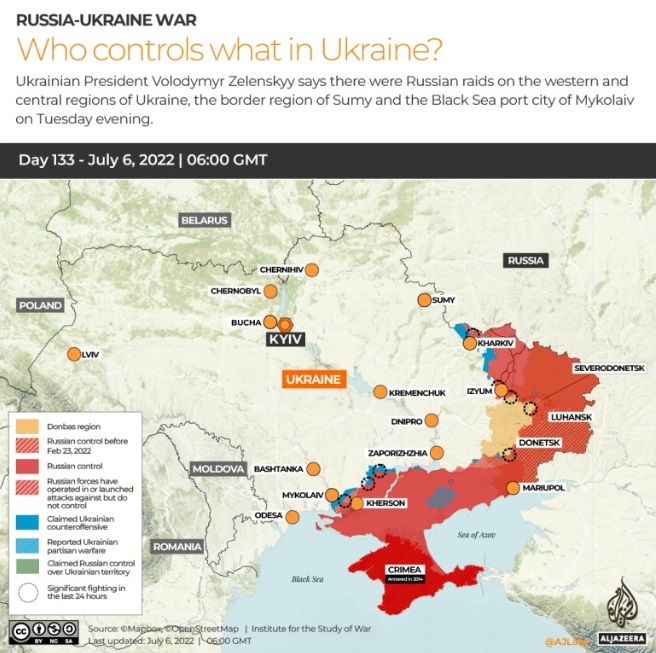
In the meantime, Russian forces are pushing westward after they captured over the weekend the city of Lysychansk, securing control over the Luhansk region. The following goal will likely be the capture of the Donetsk region, according to the UK Ministry of Defence.
While these recent victories may incline Russia to make concessions in a Black Sea deal, experts warn fighting may intensify in the coming weeks, threatening to cut yet another swath through a country devastated by the Kremlin’s invasion.
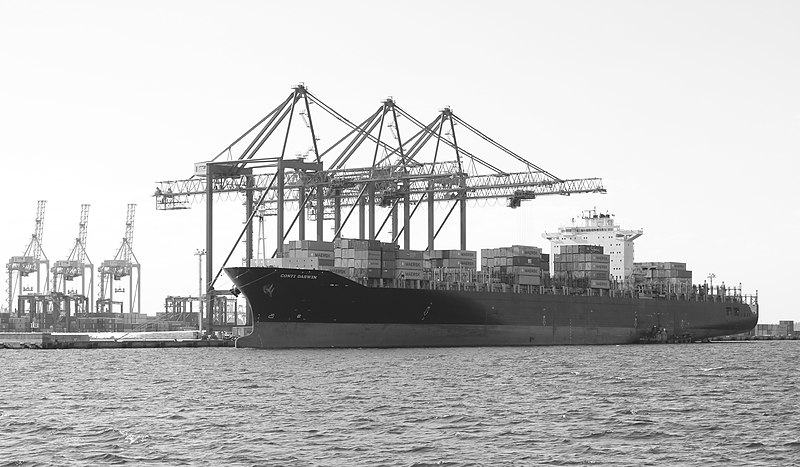
Editor’s Note: The opinions expressed here by Impakter.com columnists are their own, not those of Impakter.com — In the Featured Photo: “Conti Darwin,” a large container ship in the port of Odessa, Ukraine. Featured Photo Credit: George Chernilevsky/Wikimedia Commons.