
Much like 2023, many climate and energy records were broken in 2024.
It was Earth’s hottest year on record by a wide margin, breaking the previous record that was set just last year by an even larger margin. Human-caused climate-warming pollution and atmospheric greenhouse gas concentrations reached new heights. But the record deployment of clean technology solutions in 2024 prevented emissions from rising even higher yet.
Scientists found many other planetary vital signs also at record levels, including ocean acidity, sea level rise, ice cover, heat-related mortality rates, meat production, and loss of forest cover. But they also noted that the level of global deforestation due directly to human activities in places like the Brazilian Amazon is declining, fewer organizations are investing in fossil fuel company stocks, and more countries are charging a price for the climate-warming emissions from an increasing number of economic sectors.
In short, 2024 saw a mixed bag of worrying climate records combined with some advances in policy solutions. But the U.S. election results narrowed the window of possible climate progress in the coming years.
2024 was a hot year for the climate – and clean energy
When the final data is in, 2024 will easily break the record for Earth’s hottest annual average global surface temperature. That record was set in 2023, which easily broke the previous record set in 2016 and tied in 2020. Climate change also played a role in worsening many extreme weather disasters in 2024.
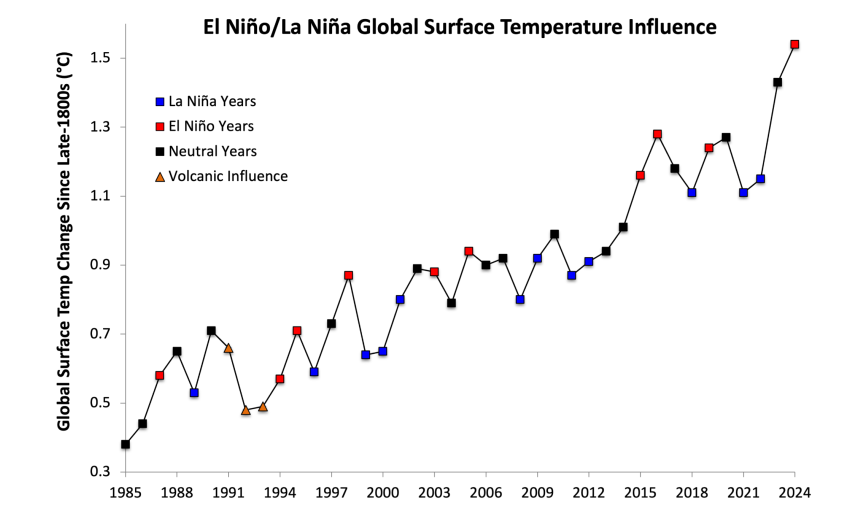
The exceptional heat of the past two years is mainly due to the long-term global warming trend, plus an El Niño event that drew warm water to the surface of the Pacific Ocean. But climate scientists are also investigating what role changes in cloud cover played in these past two record-shattering hot years and whether declining pollution due to cleaner shipping is influencing that cloud formation.
And while climate pollution caused by burning fossil fuels reached record levels, surpassing 37 billion metric tons while pushing atmospheric carbon dioxide levels to a new height of 422.5 parts per million, those emissions increased by less than 1% compared to the previous year. That’s due to a record deployment of clean technologies around the world.
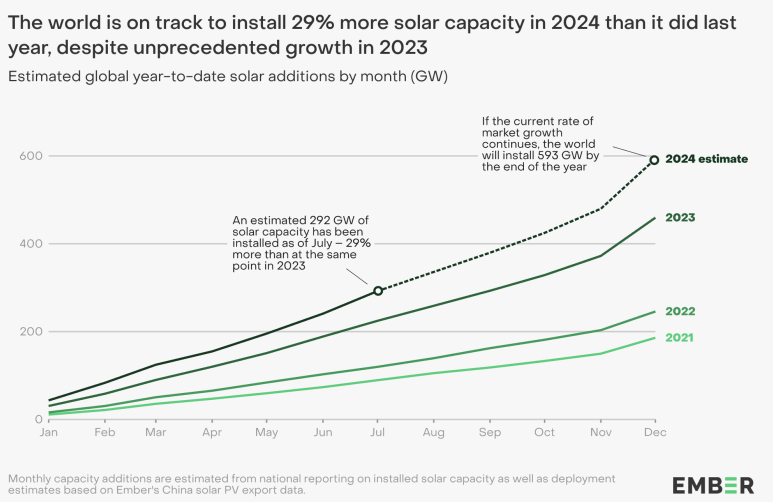
For example, electric vehicles (EVs) and plug-in hybrids accounted for over 20% of new car sales globally in 2024, up from 18% last year. In China, half of new car sales were electric over the past five months, and adoption is growing fast. Solar panel deployments also continued to set records globally, and especially in China, in large part because in most cases they’ve simply become cheaper than fossil fuel alternatives.
The U.S. climate policy outlook for 2025
In the United States, President-elect Trump and a Republican Congress will take office in January. Eight years ago, this same political structure led to the U.S. withdrawal from the Paris Climate Agreement and a rollback of over 100 climate and environmental regulations. The country’s climate pollution rose slightly during the ensuing three years until the COVID pandemic struck.
This time around, U.S. emissions are declining with the help of financial incentives for clean technology in the Inflation Reduction Act, or IRA, which Democrats passed in 2022. Some of the law’s provisions may survive the next Congress. About two-thirds of new clean manufacturing and energy projects built and planned since the IRA was signed into law are in districts represented by Republicans, as well as more than three-quarters of investment dollars and jobs, according to data compiled by the nonpartisan group E2.
That’s primarily because new manufacturing and energy facilities require large tracts of affordable, available land, which are usually located in rural areas, whose residents tend to skew more politically conservative. Republican-led states also tend to lure these kinds of business investments through generous tax breaks. Were the IRA or some of its key provisions revoked, executives running many of these new facilities warn that they would have to lay off workers or close up shop altogether.
Related Articles: How Climate Change Affects Health and How Countries Can Respond | COP28: Say Climate Crisis, Think Health Crisis | Climate Change Poses Dire Health and Human Rights Risks
As a result, many congressional Republicans support preserving some IRA provisions.
“You’ve got to use a scalpel and not a sledgehammer, because there’s a few provisions in there that have helped overall,” House Speaker Mike Johnson recently said.
An analysis by energy modelers at Princeton conducted after the IRA was signed into law also found that around half of its potential clean energy deployment and climate pollution reductions could be lost if the U.S. doesn’t build electrical transmission infrastructure fast enough to connect new clean energy projects to the power grid. As a result, permitting reform has become a hot topic among climate policy wonks seeking to speed up that process. Lawmakers narrowly failed to agree on a bipartisan permitting reform deal this year, but negotiations could begin anew in 2025.
President-elect Trump has also pledged to institute expansive tariffs once he takes office. In a bill called the Foreign Pollution Fee Act, Republican Senators Bill Cassidy, a Republican of Louisiana, and Lindsey Graham, a Republican from South Carolina, have proposed to implement a carbon tariff on imports of a few key materials into the country.
Analyses by the Niskanen Center and Climate Leadership Council found that American-made products tend to produce less climate pollution than those made in many other key countries like China and Russia. A carbon tariff would put a price on the extra carbon content of imported products above the average carbon content of the domestic equivalent. This would both level the playing field for American products in competition with dirtier and cheaper imports and create an incentive for other countries to decarbonize their industries to avoid paying the U.S. carbon tariff.
Republican policymakers also tend to be open to carbon capture solutions. Those include collecting carbon pollution from smokestacks before it enters the atmosphere or removing it from the atmosphere through either technological or natural means. America’s aging forests are starting to remove less carbon from the atmosphere each year. Forestry or other natural climate solutions, which could be included in the 2025 Farm Bill, thus offer some potential for bipartisan climate progress.
One key story to watch starting in 2025: If the new U.S. leadership shrinks away from climate policies at a time when the rest of the world is rapidly shifting toward a green economy powered by clean technology, China could seize the opportunity to bolster its economic and geopolitical ambitions.
** **
This article by Yale Climate Connections is published here as part of the global journalism collaboration Covering Climate Now (CCN).
Editor’s Note: The opinions expressed here by the authors are their own, not those of Impakter.com — In the Cover Photo: Extreme heat warning sign, Los Angeles, September 2022. Cover Photo Credit: Wikimedia Commons.