For years, sustainability appeared in the furniture world as a footnote: a symbol on a label, a recycled component in a sea of traditional materials. But as the climate crisis deepens and the environmental cost of manufacturing becomes harder to ignore, the industry is forced to confront an urgent question: can design furniture truly be sustainable?
The challenge is significant. Furniture production intersects with forestry, mining, petrochemicals, energy consumption and global logistics. Each step leaves a measurable footprint, and the lifespan of a product influences how quickly materials re-enter the waste stream. Across Europe, a growing group of manufacturers is moving beyond generic “green” statements and treating sustainability as a structural design constraint, much like ergonomics or safety. Especially Italian companies, from Poltrona Frau to Moroso, illustrate how environmental thinking can reshape both craft and industry.
Material Reform: Poltrona Frau and the Engineering of Lower-Impact Leather
Among the brands redefining their environmental responsibilities, Poltrona Frau represents a decisive move toward material transparency. The iconic Poltrona Frau Archibald chair uses Pelle Frau® ColorSphere® Impact Less, a leather tanned without chromium and formulated with reduced-impact chemical components. This approach limits hazardous by-products and significantly lowers water use compared to traditional tanning, a sector long scrutinized for pollution risks.
The company has also introduced industrial-scale actions that matter from an environmental standpoint. Its production facility operates with 18,000 thin-film photovoltaic panels generating more than 1.6 million kWh annually, cutting over 1,100 tons of CO₂. Waste management follows a “Zero Waste” model that prioritizes separation, reuse, and material recovery. These steps reveal an important shift: sustainability is not treated as a design aesthetic but as an engineering challenge.
Bioplastics and the Reinvention of Plastics: Kartell’s Research Path
Plastic furniture is often viewed as inherently unsustainable, yet Kartell offers a different angle by focusing on bio-based polymers derived from renewable sources. Instead of relying on petrochemicals, Kartell collaborates with biotechnological partners to develop materials sourced from agricultural residue and non-edible biomass.
Several of these polymers are certified for industrial compostability or incorporate recycled content while maintaining the structural demands of design-grade furniture. This work does not erase the issue of plastic waste, but it does point toward second-generation plastics that rely less on fossil inputs and more on circular carbon systems.
Longevity as Emissions Reduction: The Case Study of Vitra and Fritz Hansen
One of the most overlooked environmental strategies is simply extending a product’s lifespan. Vitra (Switzerland) and Fritz Hansen (Denmark) have embraced longevity as a core principle:
- products engineered for repairability, not disposal
- availability of spare parts for decades
- modular designs that allow components to be replaced individually
- strict sourcing of FSC-certified wood and low-VOC finishes
Their approach aligns with a fundamental environmental truth: the longest-lasting object often has the lowest long-term impact, because it reduces demand for new extraction and manufacturing cycles.
Supply Chains Under Scrutiny: From Arper to Moroso
Italian brands Arper and Moroso integrate environmental responsibility into their research and supply-chain management.
- Arper regularly conducts Life Cycle Assessments (LCA) to quantify impacts from resource extraction to disposal.
- Moroso, through collaborations with designers and material researchers, explores low-impact foams, recycled textiles, and biodegradable composites.
Both companies adopt a regionalized supply chain when possible, reducing transport emissions and strengthening traceability of raw materials, elements often missing in globalized furniture production.
Circular Models in Practice: Saba and the Logic of Low-Impact Production
Italian brand Saba Italia approaches sustainability through circular design principles and material research. Its strategy can be understood through three key pillars:
- Design for disassembly: Sofas and seating systems are engineered so that every component can be separated without damaging the product. This makes repairs, upgrades, and end-of-life material sorting significantly easier.
- Component modularity: Many collections rely on independent modules, allowing users to replace only the worn or damaged parts rather than discarding the entire piece. Modularity extends product longevity and reduces the volume of waste generated over time.
- Circularity as a systemic logic: Sustainability is understood as the ability of a product to re-enter responsible reuse and recycling processes. The focus is not only on what a material is made of, but on how easily it can be repaired, maintained, and reintegrated into a controlled waste cycle.
A Shifting Paradigm: Design Culture Within Planetary Boundaries
If design furniture is to become sustainable, the transformation must occur at multiple levels: chemistry, engineering, supply-chain transparency, and cultural expectations around consumption.
What is emerging today is not just a greener product category but a more environmentally literate mindset within the design industry; one that treats materials as active agents, values longevity over novelty, and builds production systems in dialogue with ecological limits.
In this context, sustainability is not a trend but a new grammar of responsibility, reshaping how objects are conceived, produced, and ultimately returned to the planet.
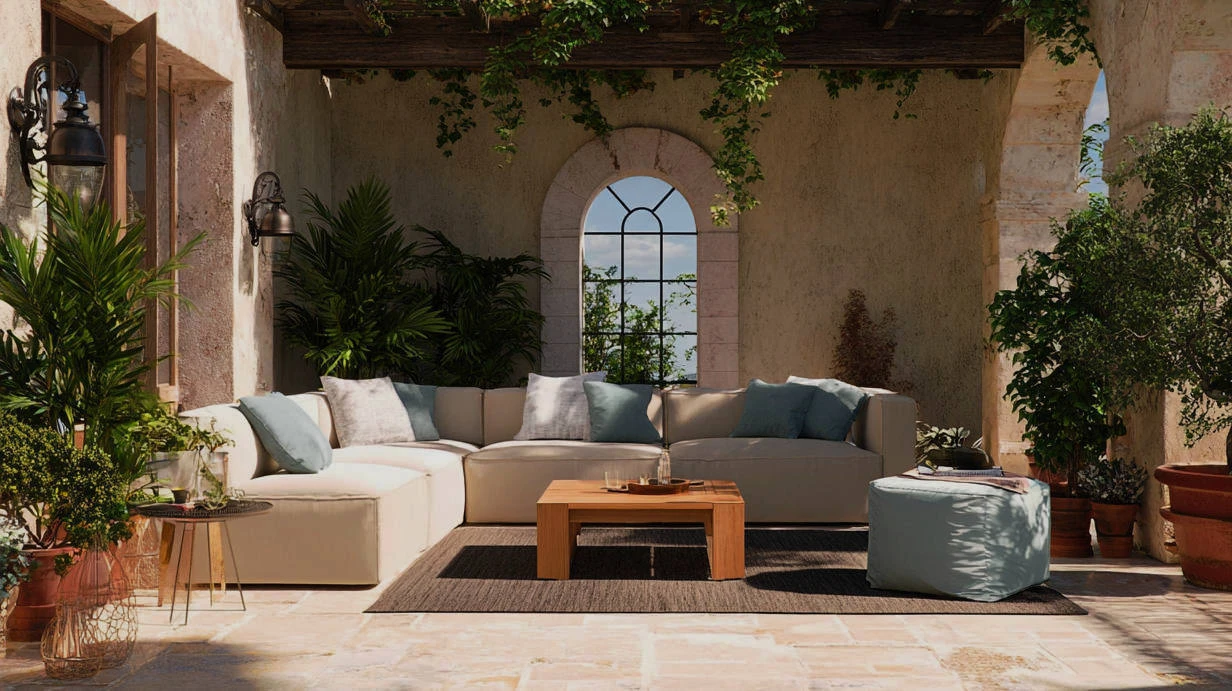
Editor’s Note: The opinions expressed here by the authors are their own, not those of Impakter.com — In the Cover Photo: A sustainable poltrona Frau in a Tuscan villa living room. Cover Photo Credit: Poltrona Frau