Impakter
  • Environment
    • Biodiversity
    • Climate Change
    • Circular Economy
    • Energy
  • FINANCE
    • ESG News
    • Sustainable Finance
    • Business
  • TECH
    • Start-up
    • AI & Machine Learning
    • Green Tech
  • Industry News
    • Entertainment
    • Food and Agriculture
    • Health
    • Politics & Foreign Affairs
    • Philanthropy
    • Science
    • Sport
  • Editorial Series
    • SDGs Series
    • Shape Your Future
    • Sustainable Cities
      • Copenhagen
      • San Francisco
      • Seattle
      • Sydney
  • About us
    • Company
    • Team
    • Global Leaders
    • Partners
    • Write for Impakter
    • Contact Us
    • Privacy Policy
No Result
View All Result
Impakter logo
No Result
View All Result
Boko Haram’s Decline: A Positive Opportunity

Boko Haram’s Decline: A Positive Opportunity

Camilla Schippa - Director of Global Strategy at the Pure FoundationbyCamilla Schippa - Director of Global Strategy at the Pure Foundation
November 15, 2017
in NGO & Charities, Philanthropy, Politics & Foreign Affairs, SDG Series
0

Today’s release of the 2017 Global Terrorism Index highlights welcome news for Nigeria. The sub-Sahara African nation has been beleaguered by the activity of Boko Haram. The group, which has been active since 2002, became infamous globally following the abduction of 276 schoolgirls from Chibok in 2014. Yet, as the index highlights, the group’s capacity has since been severely curtailed following numerous military defeats at the hands of the Multinational Joint Task Force; which includes forces from Benin, Cameroon, Chad, Niger and Nigeria and assistance from the United States. This military intervention has seen the group spilled into three factions; two of which are reported to be negotiating with the Nigerian Government to oust the remaining and more violent faction. As a direct result of this, in 2016 Boko Haram was responsible for 61 percent fewer attacks, which has resulted in 80 percent fewer deaths when compared to the previous year. Boko Haram’s decline is also having a positive ripple effect on neighbouring countries with Cameroon, Chad and Niger collectively recording 75 percent fewer terrorism deaths.
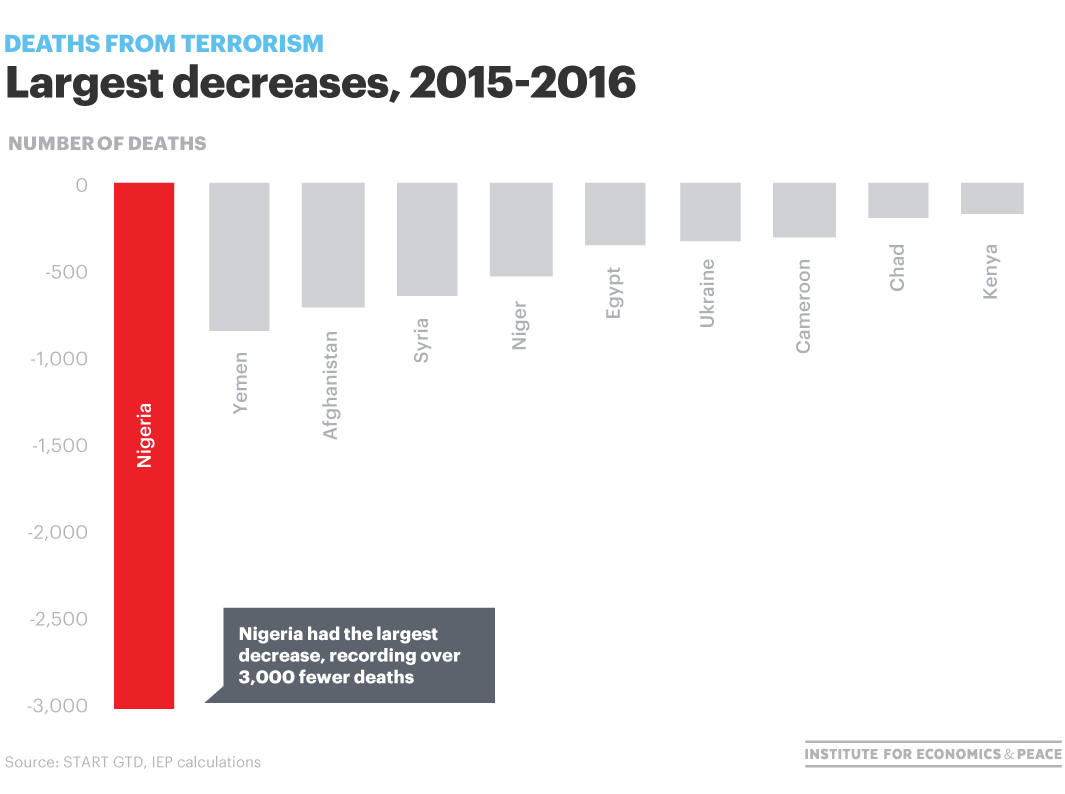
largest decrease terrorism deaths

Boko Haram’s decline is extremely significant. The group’s presence and terrorist activity has directly constrained the prospects of lasting peace in not only Nigeria but in neighbouring countries. It has also limited Nigeria’s and the broader region’s economic potential as there are huge direct and indirect economic costs to terrorism. Attacks, including bombings and kidnappings carry a direct cost. This is borne by the victims and governments through increased expenditure such as associated medical costs. However, there is also a significant indirect cost as a result of lost productivity and earnings as well as the psychological trauma to the victims, their families and friends. In Nigeria, the cost of violence, including terrorism is estimated at around $600 per capita, according to the Goal 16 Progress Report.
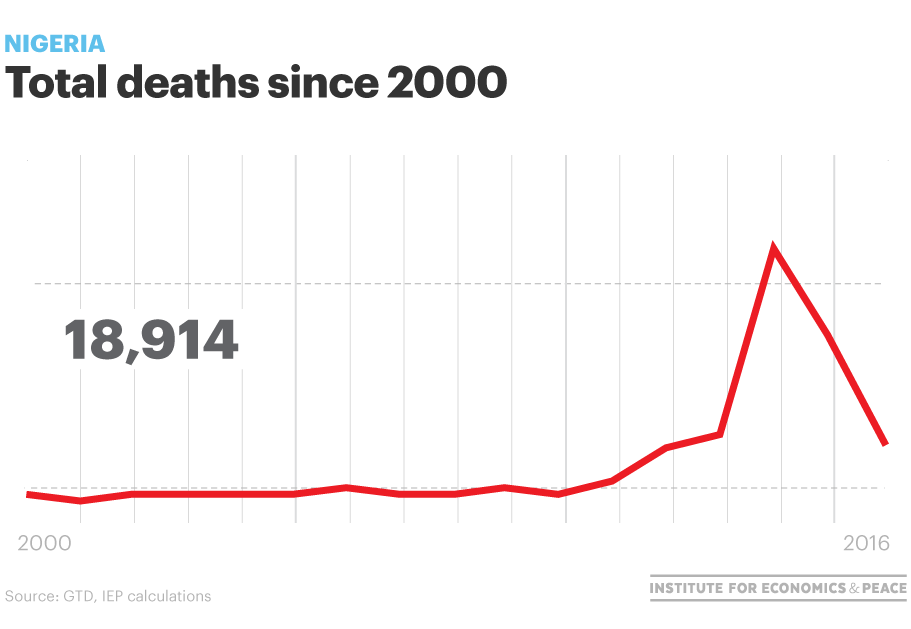
nigeria total deaths

This is why the decline of Boko Haram marks a milestone moment for Nigeria. It presents the opportunity for Nigeria to transition from a peace that is defined by an absence of violence to a state of Positive Peace. Through the joint taskforce, Nigeria and its neighbouring countries have invested heavily in suppressing Boko Haram. This investment has paid dividends with 675 Boko Haram fighters neutralised, 566 presumed members arrested, over 30 training and bomb-making facilities shut down and over 4,500 hostages rescued. Nigeria now has a window of opportunity to invest in the Pillars of Positive Peace that will help bring about lasting peace. By investing in holistic and systemic improvements in the attitudes, institutions and structures that create peaceful societies, Nigeria can transition from a country that has contained violence to a country rich in Positive Peace.

This approach can be challenging to implement in underdeveloped countries where there are competing needs for government and business investment. However, earlier this year, the Institute for Economics & Peace (IEP), which also publishes the Global Terrorism Index, identified the critical areas of investment.


Related Article: MAKING THE CRISIS CONNECTION: GLOBAL SECURITY, THE ENVIRONMENT AND CLIMATE


According to the Positive Peace Report 2017, there is a strong correlation with four of the eight pillars of peace for low peace countries. For mid peace countries, there is a correlation with six of the pillars. In the case of Nigeria, these correlations highlight the importance of investing in measures to address corruption, the functionality of government, good neighbourly relations and the acceptance of the rights of others.

However, this does not mean that Nigeria should ignore the remaining pillars (high levels of human capital, the equitable distribution of resources, the free flow of information and the development of a sound business environment). It has been firmly established that investment in all eight pillars is required to attain lasting Positive Peace. The analysis highlights a framework for policymakers to understand how investments may be targeted while also illustrating the correlation between areas of investment seeing as some pillars are more critical at different stages of peace.
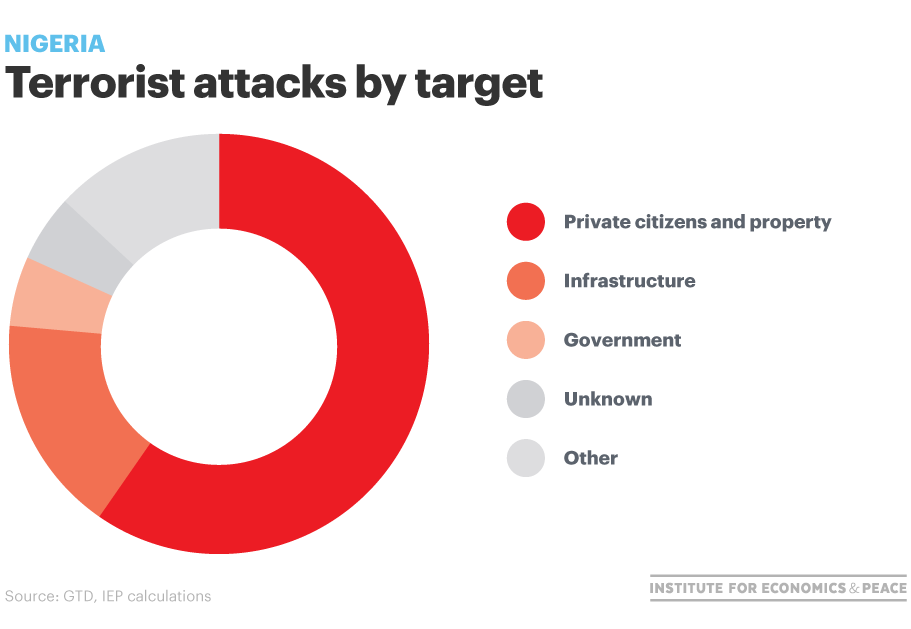
nigeria attacks by targetIn the case of Nigeria, the Positive Peace Index ranked the sub-Sahara nation as 141 out of 163 countries. This low score highlights the need for investment in all eight pillars but as highlighted by the analysis, Nigeria may benefit from a more targeted focus on the four factors that correlate with low peace countries. This targeted investment may also assist Nigeria attain the UN Sustainable Development Goals, which, if realised, would help sustain lasting Positive Peace for the estimated 190 million Nigerians, who have lived with the threat and bared witness to the atrocities of Boko Haram for too long.

To access interactive maps on the Global Terrorism Index and to view the full report go to http://visionofhumanity.org.


This article has been published under a Creative Commons Licence and may be republished with attribution.

EDITOR’S NOTE: THE OPINIONS EXPRESSED HERE BY IMPAKTER.COM COLUMNISTS ARE THEIR OWN, NOT THOSE OF IMPAKTER.COM. 
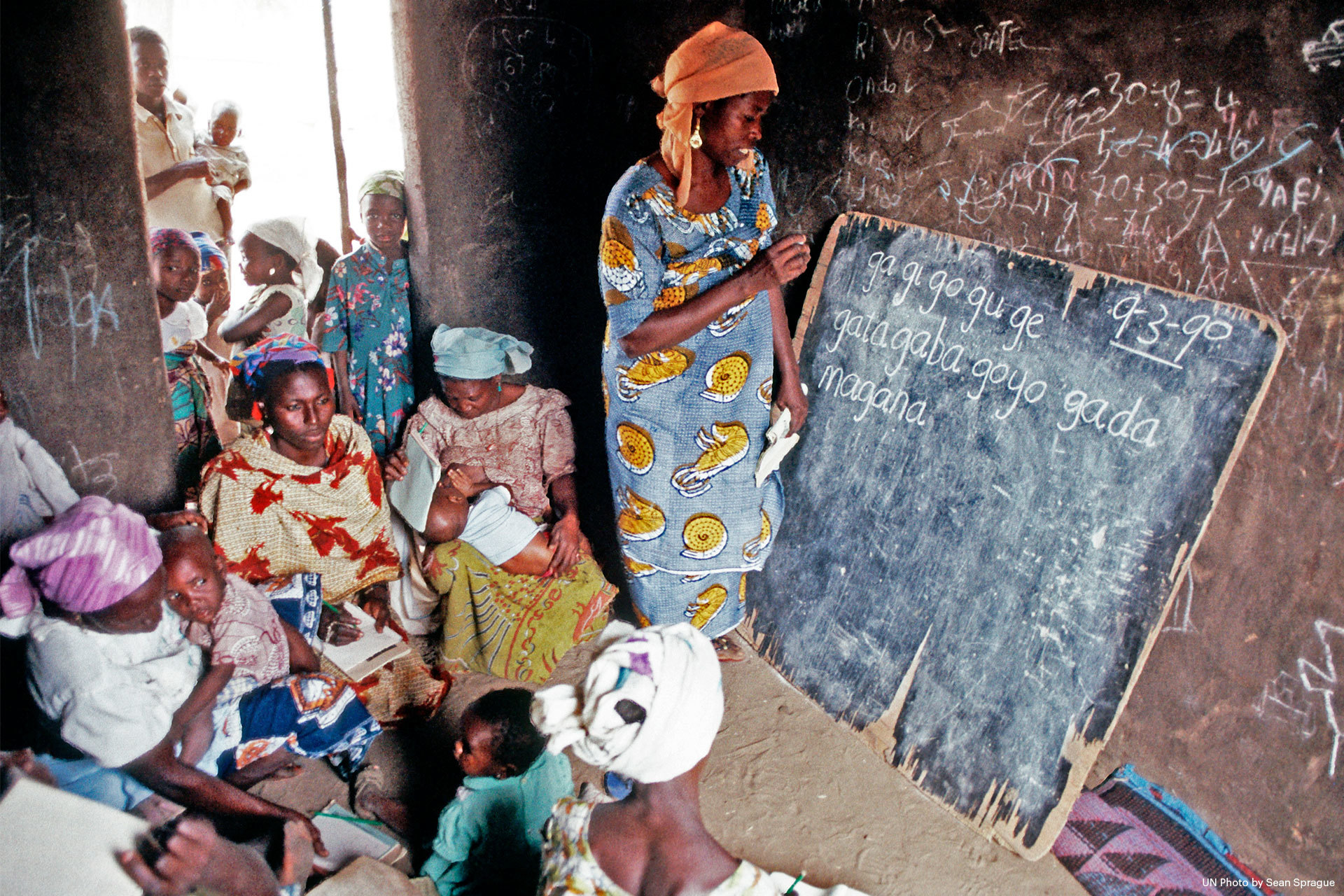
FEATURED PHOTO: The decline of Boko Haram provides Nigeria with an opportunity to invest in the pillars of Positive Peace, including educational institutions that help build human capital. Photo Credit: UN PHOTO/SEAN SPRAGUE 
Tags: Boko HaramConflictEnvironmentEqual RightsGlobal Terrorism Index 2017Institute of Economics and PeaceNigeriaPeaceSDGsustainable development goalsViolenceviolence against women
Previous Post

Defending Wildlife: The Road to SDG 16 in Mali

Next Post

The Future of Green Fashion: Interview with Guido Dolci

Related Posts

ESG News regarding Flooding in Indonesia; Glencore promises copper production boost; Trump proposes slashing fuel efficiency standards, and Vulcan Energy receives $2.57bn of funding for lithium project
Business

Indonesians Blame Deforestation for Recent Floodings

Today’s ESG Updates: More than 700 Lives Lost in Recent Indonesian Floods: A combination of mass deforestation and heavy rainfall...

byAriq Haidar
December 4, 2025
How a Framework Convention Could Address Climate and Socio-Economic Displacement
Politics & Foreign Affairs

How a Framework Convention Could Address Climate and Socio-Economic Displacement

The unprecedented shift in human (im)mobility has seen over 120 million forced to flee their homes due to war, violence,...

byDr. Shepherd Mutsvara - Research Fellow at the University of Münster, Germany
December 3, 2025
ESG News regarding the UK’s Updated Environmental Improvement Plan, modernizing Mauritania’s railway system, the EU carbon border tax, and the EU’s cross-border energy projects
Business

UK Unveils Updated Environmental Improvement Plan

Today’s ESG Updates UK Accelerates Nature Recovery: The government commits £500m to Landscape Recovery and targets 250,000 hectares of restored...

bySarah Perras
December 1, 2025
COP30: Countries’ Climate Agrifood Ambitions Undermined by Funding Gaps, Report Finds
Biodiversity

COP30: Countries’ Climate Agrifood Ambitions Undermined by Funding Gaps, Report Finds

Developing countries recognize the urgent need to adapt agrifood systems to climate change, but most National Adaptation Plans (NAPs) are...

byThe Food and Agriculture Organization of the United Nations (FAO)
November 19, 2025
ESG News regarding: only 16% of companies on track to hit net zero targets by 2050 per Accenture report, Orsted completes green transformation, EU and UK to begin carbon market link negotiations, China to expand renewable energy sector
Business

Only 16% of Large Companies on Track for Net Zero

Today’s ESG Updates Accenture Report Highlights Net Zero: While 89% of the world’s largest companies link decarbonization to business value,...

bySarah Perras
November 12, 2025
From Caves to COP30: Comparing the Neanderthals and Modern Humans
COP30

From Caves to COP30: Comparing the Neanderthals and Modern Humans

There is much positive to be said about life in this twenty-first century; we live longer and have multiple technologies...

byRichard Seifman - Former World Bank Senior Health Advisor and U.S. Senior Foreign Service Officer
November 9, 2025
climate change and food
Biodiversity

COP30: Climate Extremes Are Already Impacting Food Yields Today

The 30th United Nations Climate Change Conference (COP30), taking place in Belém, Brazil, brings together world leaders, scientists, non-governmental organizations, and...

byThe Food and Agriculture Organization of the United Nations (FAO)
November 7, 2025
Baler Compactors
Circular Economy

Compressing Waste, Expanding Impact: How Baler Compactors Advance Corporate Sustainability

It is easy to see the glitzy side of sustainability. Solar panels, windmills, electric fleets. But there’s more to sustainability...

byHannah Fischer-Lauder
October 29, 2025
Next Post
The Future of Green Fashion: Interview with Guido Dolci

The Future of Green Fashion: Interview with Guido Dolci

Recent News

The Best Virtual Office Address In London For Your Startup

How To Choose The Best Virtual Office Address In London For Your Startup

December 5, 2025
Granddaddy Purple Strain

Where Granddaddy Purple Strain Gets Its Iconic Grape Flavor

December 5, 2025
ESG news regarding Deforestation Mandate Being Pushed; EUs Acceleration on Hydrogen and Net Zero Revolution; AT&T Will End All DEI; UK Watchdog Blocks Nike and Lacoste Ads Over Green Claims.

U-Turn in Europe: Deforestation Mandate Pushed Back Again

December 5, 2025
  • ESG News
  • Sustainable Finance
  • Business

© 2025 Impakter.com owned by Klimado GmbH

No Result
View All Result
  • Environment
    • Biodiversity
    • Climate Change
    • Circular Economy
    • Energy
  • FINANCE
    • ESG News
    • Sustainable Finance
    • Business
  • TECH
    • Start-up
    • AI & Machine Learning
    • Green Tech
  • Industry News
    • Entertainment
    • Food and Agriculture
    • Health
    • Politics & Foreign Affairs
    • Philanthropy
    • Science
    • Sport
  • Editorial Series
    • SDGs Series
    • Shape Your Future
    • Sustainable Cities
      • Copenhagen
      • San Francisco
      • Seattle
      • Sydney
  • About us
    • Company
    • Team
    • Global Leaders
    • Partners
    • Write for Impakter
    • Contact Us
    • Privacy Policy

© 2025 Impakter.com owned by Klimado GmbH