What is Afrofuturism?
The term “Afrofuturism” was formally articulated and penned by scholar Mark Dery in 1994 essay ‘Black to the Future: Interviews with Samuel R. Delany, Greg Tate, and Tricia Rose’. Dery maps Afrofuturism to the U.S.A. context where he suggests:
“[Afrofuturism is] speculative fiction that treats African-American themes and addresses African-American concerns in the context of twentieth-century technoculture—and, more generally, African-American signification that appropriates images of technology and a prosthetically enhanced future…” (Dery, 1994:180).
Speculative fiction, as its name suggests, is a space where supernatural, fantastical, historical, and futuristic elements merge together. It also is closely linked to science fiction and technology and explores the different ways in which humanity could exist. Dery goes on to ask:
‘Can a community whose past has been deliberately rubbed out, and whose energies have subsequently been consumed by the search for legible traces of its history, imagine possible futures?’ (Dery, 1994:180).
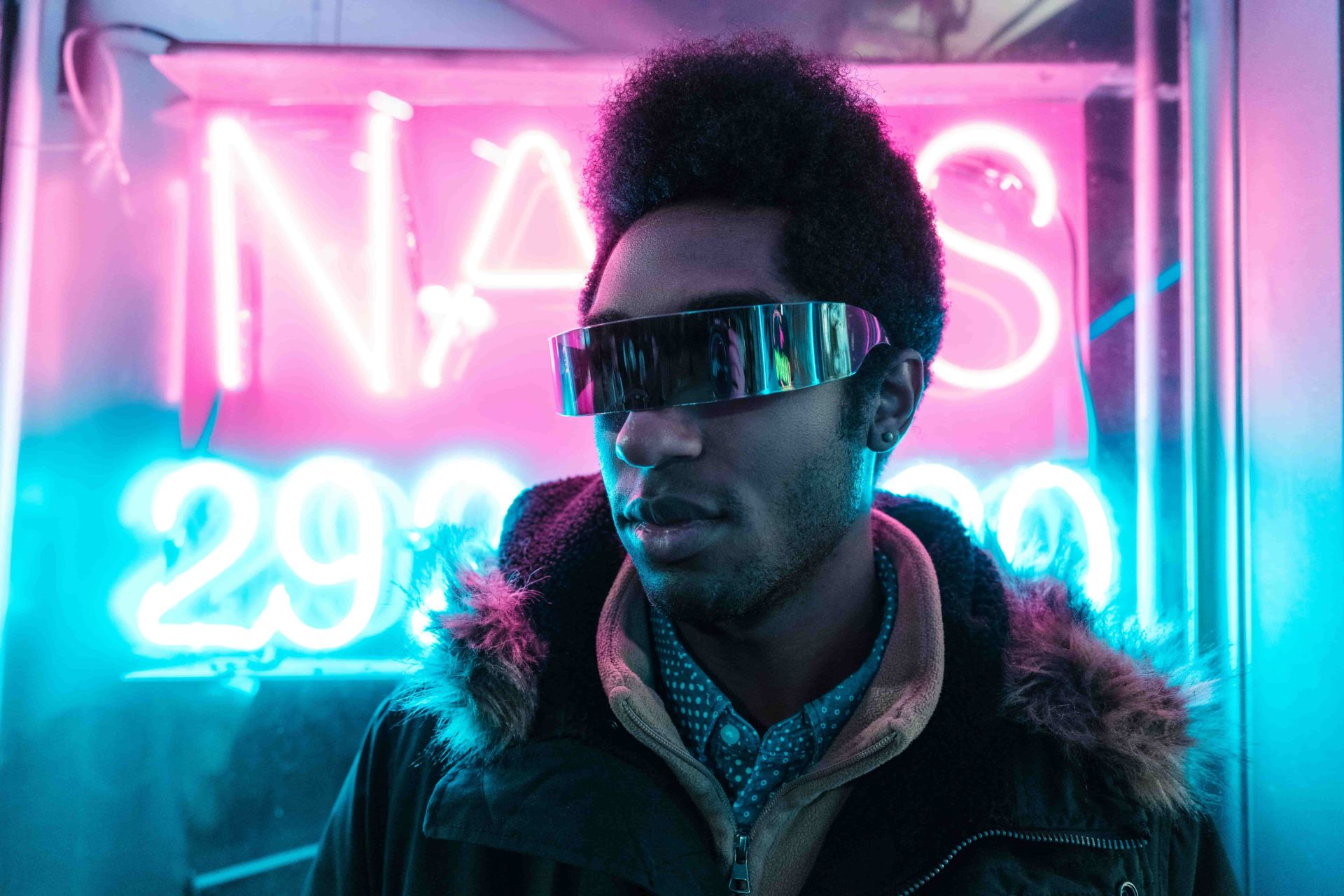
Enter Afrofuturism. This aesthetic movement seeks to capture the Afrodiasporic experience by reimagining/recreating the past and reinventing the future. It celebrates the black imagination, black dreams summoning ancestral power, and redefining the conceptions of black subjectivity.
Afrofuturism is grounded in the past and present histories of African-descended peoples employing the motifs of science-fiction (particularly the elements of alienation and the sensation of being ‘Other’).
It also encapsulates STEAM (Science, Technology, Architecture, and Maths) searching for innovative ways to reclaim and transform modern communication about black lives.
Technology, Afrocentricity, African cosmology, and spirituality are used as tools for activism and social cohesion. Afrofuturism is an avenue through which African and African-descended imaginaries can be re-examined offering counterstrategies to past and present Western narratives. It is confident in itself.

Indeed, Afro-descendants have engaged in Afro-futuristic creations long before Dery’s coining of the term. Let’s hark back to 1920 to W.E.B Du Bois’s The Comet.
This short story described as “proto-Afroturist” (Elia, 2016) is a forward-thinking social critique on the racial tensions in post-WWI America.
It reflects ‘double consciousness’, which according to Du Bois is a ‘sense of always looking at one’s self through the eyes of others, of measuring one’s soul by the tape of a world that looks on in amused contempt and pity.’ (Du Bois, 1897).
Elia (2016) encourages us to consider Martin Delany and Frances Harper’s work in the mid 19th century, which touched upon elements of the Afrofuturist movement and African-American utopian fiction.
Nevertheless, Sun Ra, a renowned jazz musician who proclaimed to be from Saturn, is most recognized as being at the vanguard of Afrofuturism.
The experimentalist fusion of jazz, reggae, and funk, among others, that embodied his work, commenced in the 1940s opening the door to an innovative Afrofuturistic sound.
Ralph Ellison’s The Invisible Man (1952) although not always viewed as strictly adhering to Afrofuturism, Yaszek does suggest that “it is a literary clarion call for an Afrofuturist imaginary that was just barely thinkable at the time of Invisible Man’s publication” (2005:299).
Further, Octavia Butler, considered the ‘Mother of Science Fiction’ and ‘Godmother of Afrofuturism’ paved the way for many black women to immerse themselves in the movement as a form of creative empowerment.

Afrofuturism is not only applicable to an African-American context but extends to Africans and the African diaspora. Franco-Guyano-Danish new media artist Tabita Rezaire’s Deep Down Tidal is a searing critique of the inequalities that pervade our society through the Internet.
Rezaire’s work traces the transoceanic fiber-optic matrix that runs deep through the oceans. This oeuvre delves into the complex intersection of mystical, metaphorical, technological, and political histories anchored in the ocean, revealing the connection to colonial trade routes.
The Nigerian-American writer Nnedi Okorafor, takes this further working on Africanfuturism, which is “less concerned with “what could have been” and more concerned with “what is and can/will be”. It acknowledges, grapples with, and carries “what has been” (Okorafor, 2019). Here the imagination is firmly rooted in African history, mysticism, culture, and philosophy.
Brazilian creatives Sabrina Fidalgo and Kênia Freitas are among the growing number of media and culture Afro-Brazilian enthusiasts who include Afrofuturism in their work.
It is paramount to reclaim and affirm African ancestry in the Brazilian context where, despite Afro-Brazilians making up more than 50% of the population, they are barely visible in mainstream film or television.

Why are Afrofutures important?
We are in the midst of an unprecedented global pandemic that predominantly affects people of African descent. We are still sadly having to remind people that that Black Lives Matter, and we are seeing the urgent need to build a more inclusive STEAM pipeline to bridge the digital diversity divide.
Recognition, representation, and reimagination matter. As we saw with the box office hit Black Panther, Netflix hits such as Luke Cage and Black Lightening while clear examples of Afrofuturism and black liberation, they are clearly male-dominated.
More recently though, women have been coming to the fore with the female creatives and writers aforementioned and those like N.K. Jemisin making history by winning the ‘Best Novel’ Hugo Award three times in a row from 2016-2018.
French-Beninese Mawena Yehouessi’s transmedia hub Black(s) to the Future is a dynamic fusion of art, literature, academic critique to revalorize how Africans and the African diaspora are viewed in the world. Women are taking more prominent spaces in Afrofuturism sharing new perspectives on how we view ourselves in the future while questioning who we have been in the past and who we are in the present.
Brooks and Pollock’s Minority Reports from 2054: Building Collective and Critical Forecasting Imaginaries via Afrofuturetypes and Brooks and Best’s Game Jamming and Afro-Rithms of the Future project are endeavors which seek to practice black (and sometimes non-black) speculative pathways to push the parameters of our current frame of reference of what the future might be.
Afrofuturist forecasting methodologies are employed to see how spaces and scenarios are defined in the future, now. They provide the opportunity of using foresight to predict non-Eurocentric narratives that do not use past or present modes of calculations, but rather the game jam methodology encourages collective synergy necessary for forward-thinking innovation.
We are halfway through the UN International Decade for People of African Descent, and there remain 10 years for states to meet the UN Sustainable Development Goals ensuring that no one is left behind.
Recently, there have been statements of solidarity with African-descended people and advice for businesses on how to combat racism.
There are platforms where black and other racialized people are holding their own spaces to foster innovation and reimagine their identities using technology and other communicative tools.
It has been, is, and will be necessary to consider Afrofutures to construct new alternative memories of the future, now.